What Makes Speech-to-Text HIPAA-Compatible?
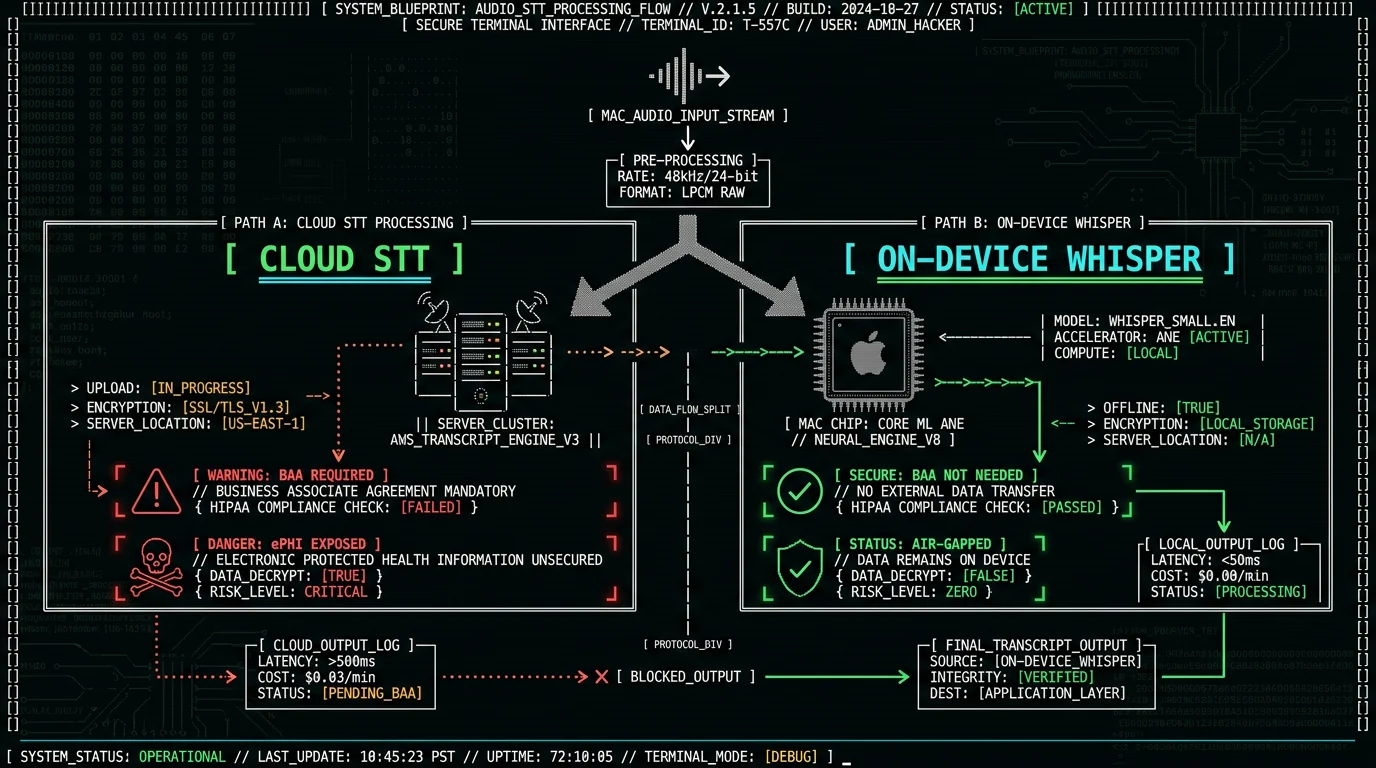
HIPAA — the Health Insurance Portability and Accountability Act of 1996 — defines two technical safeguards that any speech-to-text tool must satisfy when processing electronic protected health information (ePHI): access controls and transmission security, per the HHS Security Rule. In practice, that means three things. The audio stream containing patient names, diagnoses, or treatment details must be encrypted in transit (TLS 1.2+). The transcribed text must be encrypted at rest if it sits on vendor servers. And the vendor processing the audio must sign a Business Associate Agreement (BAA) committing to HIPAA obligations. The BAA is the load-bearing legal document. Without it, any vendor that touches ePHI is in technical violation, and the covered entity (the clinic, hospital, therapist, or solo practitioner) inherits the breach liability. HIPAA penalties scale with the severity and scope of a violation, and HHS's Office for Civil Rights publishes its enforcement actions and breach reports on its public breach portal. Settlements for serious cases have reached into the millions. I'm Andrew Dyuzhov, solo founder of MetaWhisp, the free on-device voice-to-text app for macOS. Compliance is a common question among clinicians — therapists, dental hygienists, primary-care physicians, and physical therapists. This guide explains what HIPAA actually requires of speech-to-text tools, which Mac apps meet that bar, and why on-device transcription sidesteps most of the compliance burden.Why On-Device Speech-to-Text Skips HIPAA's BAA Requirement
When speech-to-text runs locally on a Mac, the audio is processed inside the operating system's memory by a model that lives on the user's disk. No data crosses the network. There is no "business associate" because no third party touches the ePHI. The clinician's Mac is the covered entity's own device, governed by the clinic's existing HIPAA policies — locked-screen requirements, FileVault encryption, MDM enrollment — not by external vendor contracts. This is the same logic that lets a clinician use Microsoft Word locally on their Mac without Microsoft signing a BAA for every patient note. Microsoft Word doesn't transmit the document content. The transcript stored locally is no different from any other clinical note on the device's encrypted disk.Pro tip: The HHS Office for Civil Rights explicitly addresses this in their conduit exception guidance. Software that operates entirely on a covered entity's own systems — not transmitting ePHI to a vendor's cloud — is not a "business associate" under HIPAA and does not require a BAA. See the HHS business associate guidance for the regulatory framing.The practical implication for solo practitioners: on-device voice-to-text apps like MetaWhisp, SuperWhisper's local mode, and command-line whisper.cpp let you dictate clinical notes without negotiating a single vendor agreement. You configure FileVault, you enable auto-lock, you use a strong password — and your existing device-level HIPAA controls cover the transcription workflow.
Which Mac Speech-to-Text Apps Offer HIPAA BAAs?
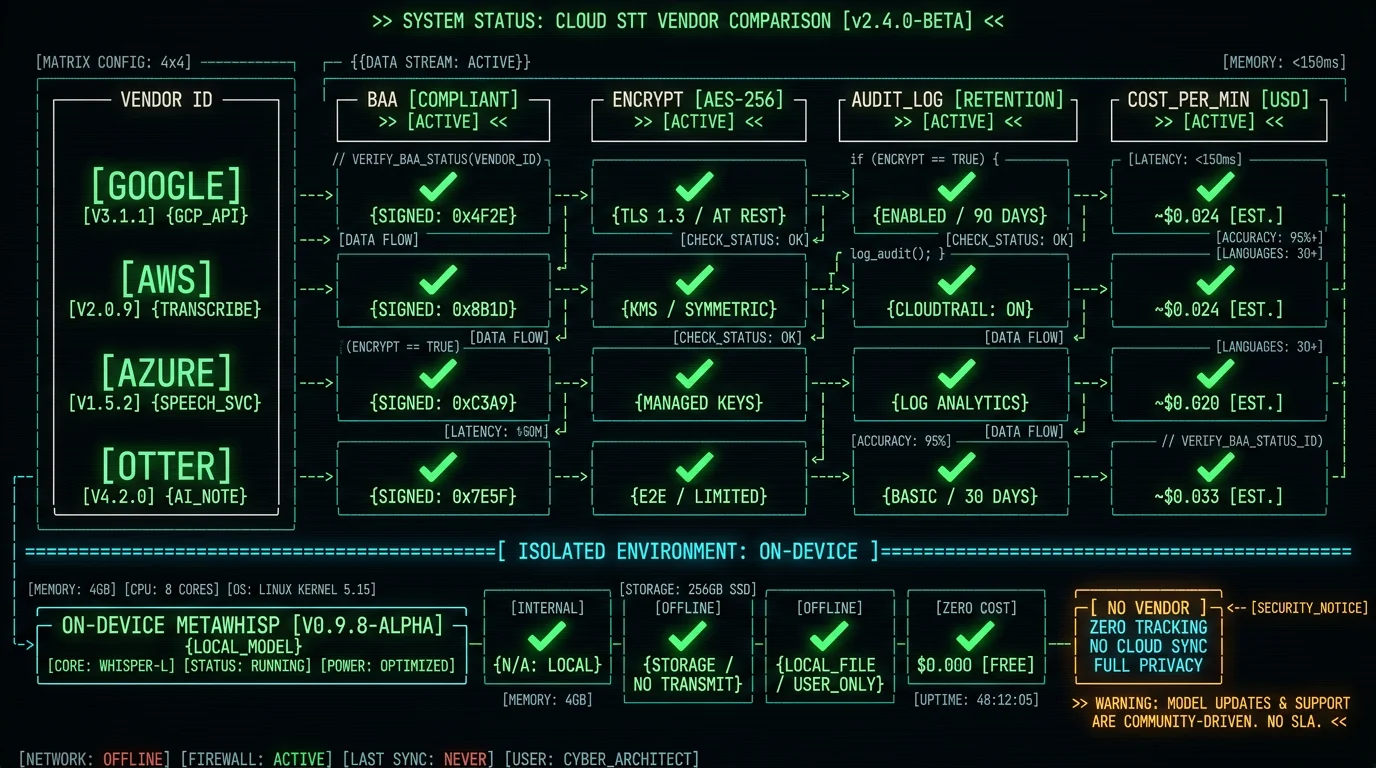
Among cloud-based speech-to-text vendors that ship Mac clients or APIs accessible from Mac, exactly four offer Business Associate Agreements as of May 2026. The rest do not, and using them with ePHI is a HIPAA violation.| Vendor | BAA Available? | Tier Required | Cost |
|---|---|---|---|
| Google Cloud Speech-to-Text | Yes | HIPAA-eligible tier (sign BAA) | $0.016/min audio |
| AWS Transcribe Medical | Yes (default) | Medical service tier | $0.075/min audio |
| Microsoft Azure Speech Service | Yes | Enterprise tier (sign BAA) | $0.017/min audio |
| Otter.ai Business | Yes (signed BAA on request) | Business tier ($30/user/mo) | $30/user/mo |
| OpenAI Whisper API | No | — | $0.006/min audio (consumer) |
| Wispr Flow | No | — | $15/mo (consumer) |
| Apple Dictation | N/A (offline mode on M1+) | "Enhanced Dictation" off | $0 (built into macOS) |
Is Apple's Built-In Dictation HIPAA-Compatible?
Apple's built-in macOS Dictation runs in two modes. The default "Standard Dictation" sends audio snippets to Apple's servers for processing, then returns text. The "Enhanced Dictation" mode (available on Apple Silicon Macs running macOS 13+) processes audio entirely on-device using Apple's Neural Engine. For HIPAA purposes, Enhanced Dictation is fine; Standard Dictation is not. Apple does not offer a Business Associate Agreement for its consumer services, including iCloud, Siri, and Standard Dictation. When dictation audio leaves the Mac to be processed in Apple's cloud, that constitutes ePHI transmission to a third party without a BAA — a HIPAA violation.Why Wispr Flow Cannot Be Used for HIPAA Workflows
Wispr Flow is a popular Mac voice-to-text tool that has gained traction in 2025-2026 for its low-friction global hotkey UI. However, Wispr Flow's architecture and business model make it incompatible with HIPAA for clinical workflows. Three specific issues:- No BAA available: Wispr Flow operates as a consumer service. Its privacy policy does not mention HIPAA or BAAs. Repeated requests from healthcare customers have not resulted in a published BAA program as of May 2026.
- Cloud processing path: Wispr Flow's default architecture uploads audio to its cloud for transcription. While the company has announced an "on-device mode" in newer releases, it requires a Pro subscription and the cloud path remains the default for all free-tier users.
- Third-party transcription providers: Wispr Flow's terms permit subcontracting transcription to third-party model providers. Each subcontractor in the chain would need their own BAA, and none have been disclosed.
Does OpenAI Whisper API Support HIPAA?
The OpenAI Whisper API — the cloud endpoint that runs Whisper large-v3 on OpenAI's servers — does not offer a BAA. OpenAI's business terms and enterprise privacy documentation explicitly state that the API is not designed for HIPAA workflows. The Enterprise tier offers a Zero Data Retention policy but does not constitute a BAA. This is a critical distinction because many third-party Mac apps use the OpenAI Whisper API as their backend. SuperWhisper's cloud-hybrid mode, several Electron-based dictation tools, and various web-based transcription services all route audio to OpenAI behind the scenes. Using any tool that proxies to the OpenAI Whisper API for ePHI is a HIPAA violation unless OpenAI signs a BAA — which they currently do not.For HIPAA-bound healthcare professionals on Mac, the cleanest path is locally-running Whisper variants: large-v3-turbo via MetaWhisp's Core ML compilation, SuperWhisper's "local mode" with cloud disabled, or raw whisper.cpp run from the command line. All three keep audio on-device with no network transmission, sidestepping the BAA requirement entirely.
How On-Device Whisper Architecture Satisfies HIPAA
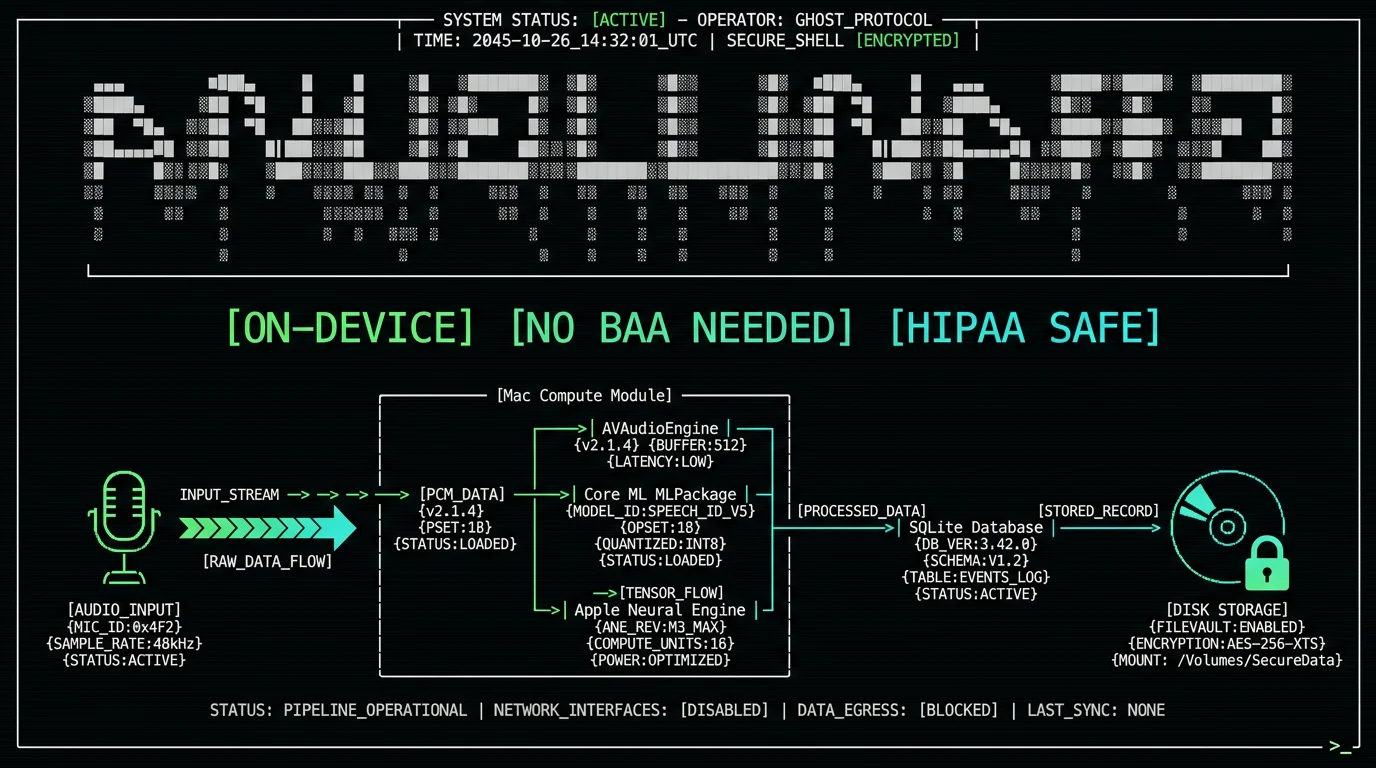
MetaWhisp's on-device transcription runs Whisper large-v3-turbo locally via Apple's Core ML framework, dispatching inference to the Neural Engine (ANE). The audio flow:- Microphone captures voice via
AVAudioEngine(Apple's local audio framework) - Audio buffers are passed to Core ML's
MLModelrunning Whisper large-v3-turbo as a compiled.mlpackage - The Neural Engine performs inference, producing text tokens
- Text is written to a local SQLite database in
~/Library/Application Support/MetaWhisp/ - The user can copy, save, or delete the transcript via MetaWhisp's UI
.mlpackage file never transmit anywhere; the activations are flushed from ANE memory after each inference batch; and the audio input buffers exist only in the calling app's process address space. This makes ANE-based Whisper inference fundamentally different from cloud APIs that transmit raw audio to remote servers for processing. For HIPAA purposes, on-device ANE inference is equivalent to running any other clinical software locally — the device, not a vendor, processes the ePHI. The same compliance posture applies whether you use MetaWhisp, SuperWhisper local mode, or raw whisper.cpp compiled with Metal acceleration. The architectural property that matters is the absence of network egress for the audio stream — everything else is implementation detail. The clinic's HIPAA risk analysis under 45 CFR §164.308(a)(1) need only verify the chosen app has no cloud upload path.
What Happens If a HIPAA Speech-to-Text Tool Is Misconfigured?
Misconfiguration is the most common path to HIPAA violations in transcription workflows. The HHS Office for Civil Rights maintains a public breach portal listing reported incidents — review it for the specific case patterns relevant to your practice. The common failure modes are predictable:- Using a free or consumer tier when the HIPAA-eligible tier requires explicit opt-in. Most cloud vendors (Google, AWS, Microsoft, Otter) offer HIPAA-eligible services on specific paid tiers with a signed BAA. The free tier of the same product is usually NOT HIPAA-eligible.
- Using macOS Standard Dictation (cloud-routed) instead of Enhanced Dictation (on-device) for clinical notes. Apple does not offer a BAA for consumer dictation services.
- Using OpenAI Whisper API, Wispr Flow, or other vendors without HIPAA BAAs for any audio containing ePHI.
HIPAA Speech-to-Text on Mac: 30-Second Decision Tree
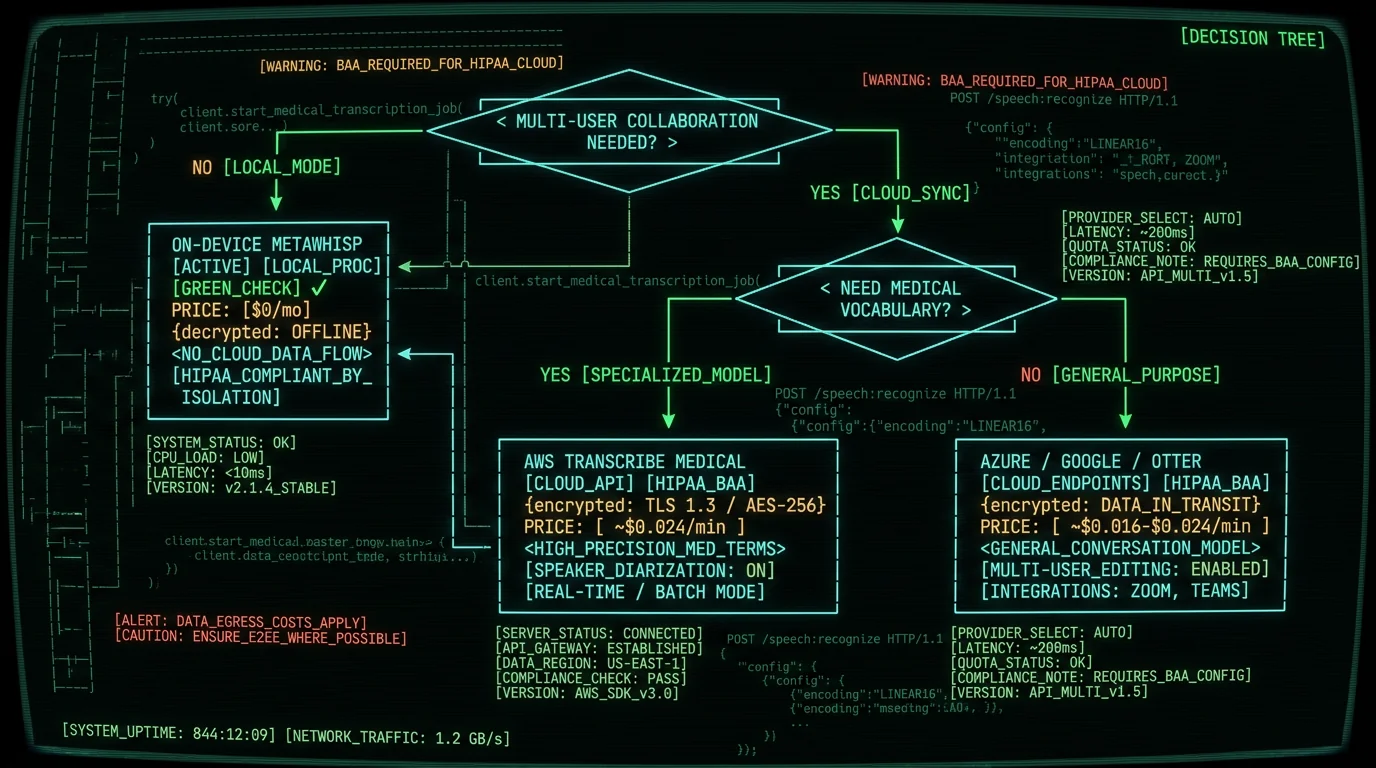
- Solo practitioner, no IT staff: Use MetaWhisp or SuperWhisper local mode. Skip the BAA paperwork entirely. Enable FileVault, auto-lock, and strong password — your existing device controls cover the workflow.
- Small clinic, want multi-user collaboration on transcripts: Microsoft Azure Speech Service with BAA + clinic Azure AD for access control. Costs $0.017/min audio plus Azure infrastructure overhead.
- Large hospital, need medical-specific vocabulary tuning: AWS Transcribe Medical with default BAA + AWS HealthLake integration. Costs $0.075/min audio. Comes with PHI-specific entity detection.
- Already on Google Workspace: Google Cloud Speech-to-Text HIPAA tier + signed BAA + Google Workspace Healthcare add-on. Integrates with existing Google login.
- Need free option for low-volume use: MetaWhisp (free, on-device) or Apple Enhanced Dictation (free, lower accuracy).
Frequently Asked Questions About HIPAA Speech-to-Text on Mac
Is on-device Whisper transcription HIPAA-compatible on Mac?
Yes, when run entirely on-device with no network transmission of audio or transcripts. Apps like MetaWhisp that use Apple Neural Engine for local Whisper inference do not transmit ePHI to any vendor, so no Business Associate Agreement is required under HIPAA. The clinic's existing device-level safeguards — FileVault encryption, auto-lock, strong passwords — cover the workflow. This is the simplest HIPAA-compatible path for solo practitioners and small clinics.
Does Otter.ai support HIPAA workflows?
Otter.ai Business tier ($30/user/month) offers a signed Business Associate Agreement on request, making it HIPAA-eligible. The free Basic tier and the paid Pro tier do not offer BAAs and are not HIPAA-compatible for ePHI transcription. If you use the wrong tier with patient audio, you are in technical HIPAA violation. Confirm in writing that your account is on Business tier with BAA executed before transcribing any clinical content.
Can I use the OpenAI Whisper API for medical transcription?
No. The OpenAI Whisper API does not offer a Business Associate Agreement at any tier as of 2026, including the Enterprise tier with Zero Data Retention. Any tool that proxies audio to the OpenAI Whisper API — including some third-party Mac dictation apps — is not HIPAA-compatible for ePHI. Use locally-running Whisper variants instead (MetaWhisp, SuperWhisper local mode, or raw whisper.cpp) to keep audio on-device.
Is Wispr Flow HIPAA-compatible?
No. Wispr Flow does not offer a Business Associate Agreement and operates as a consumer service with default cloud processing. Its terms permit subcontracting transcription to third-party providers without disclosure. Using Wispr Flow for any audio containing patient names, diagnoses, or treatment details exposes the covered entity to HIPAA breach liability. For Mac-based HIPAA-bound workflows, choose on-device alternatives like MetaWhisp instead.
What is a Business Associate Agreement (BAA)?
A BAA is a contract required by HIPAA between a covered entity (clinic, hospital, therapist) and any vendor that processes electronic protected health information (ePHI). It commits the vendor to HIPAA's privacy and security obligations — encryption, breach notification, access controls — and establishes liability if the vendor mishandles data. Without a BAA, any vendor touching ePHI puts the covered entity in violation of HIPAA, regardless of the vendor's actual security practices.
Does Apple offer a HIPAA BAA for macOS Dictation?
No. Apple does not offer a Business Associate Agreement for its consumer services including macOS Standard Dictation, Siri, and iCloud. However, Apple Enhanced Dictation runs entirely on-device using the Neural Engine on Apple Silicon Macs (macOS 13+), so no ePHI leaves the device. Enhanced Dictation is HIPAA-compatible without a BAA, but only if explicitly enabled in System Settings to disable the cloud fallback path.
How much does HIPAA-compatible speech-to-text cost on Mac?
On-device options are free or have one-time costs: MetaWhisp is free, Apple Enhanced Dictation is free, and raw whisper.cpp is free. Cloud-based HIPAA-eligible options run $0.016-0.075 per minute of audio: Google Cloud Speech-to-Text HIPAA tier ($0.016/min), Microsoft Azure Speech Service ($0.017/min), AWS Transcribe Medical ($0.075/min). Otter.ai Business is $30/user/month flat. For solo practitioners under 10 hours of dictation weekly, on-device is dramatically cheaper.
What's the average HIPAA fine for using non-compliant speech-to-text?
HIPAA penalties scale with the severity and scope of a violation. HHS's Office for Civil Rights lists its enforcement actions and breach reports on its public breach portal, and settlements for serious cases have reached into the millions. That financial exposure can significantly exceed the cost of a properly licensed BAA-backed cloud vendor — and on-device tools eliminate the breach surface entirely.
About the Author
Andrew Dyuzhov is the solo founder and CEO of MetaWhisp, a free, open-source, on-device voice-to-text app for macOS that runs Whisper large-v3-turbo locally via WhisperKit. He built MetaWhisp on an on-device architecture specifically because privacy-bound users — in healthcare, law, and confidential business — need transcription that never sends audio to a third party. This article is for general informational purposes and does not constitute legal advice; consult your privacy officer or attorney for organization-specific HIPAA compliance decisions. Connect on X or GitHub.
Related Reading
- Dictation for Doctors: HIPAA-Compatible Mac Workflows — clinical dictation step-by-step
- HIPAA-Compatible Local Dictation on Mac — what air-gapped means and why it matters
- Private Voice-to-Text on Mac: Zero Cloud Upload — architecture deep dive
- Voice-to-Text for Therapists on Mac — session-note workflows that don't break HIPAA
