Which Should You Choose for Mac Voice-to-Text in 2026?
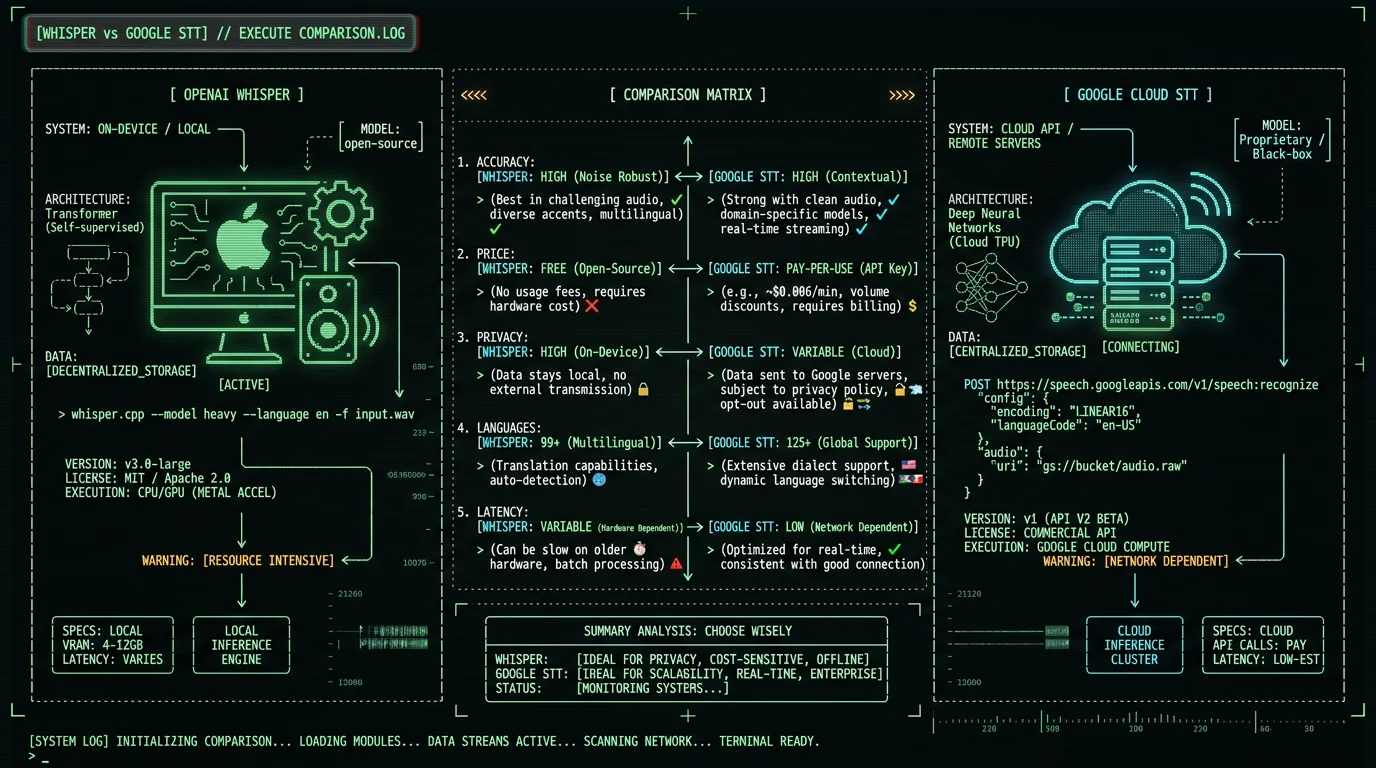
Quick decision framework based on your use case:- Personal dictation, Slack messages, notes on Mac — Whisper via MetaWhisp or similar. Free, on-device, sub-second latency.
- Healthcare, legal, or confidential business meetings — Whisper on-device. Audio never uploads. No BAA needed.
- Building a SaaS product that transcribes user audio at scale — Google STT or another cloud API. Pay-as-you-go scales better than managing your own GPU servers.
- Telephony or phone-call transcription — Google STT's telephony model is optimized for 8 kHz phone audio. Whisper struggles with low-bandwidth audio.
- Languages outside Whisper's 99-language coverage — Google STT covers 200+ languages. Some less-common languages have better accuracy on Google.
- Real-time streaming with sub-200ms latency — Google STT's streaming API is more mature than open-source Whisper streaming implementations.
Accuracy: How Close Are They on Word Error Rate?
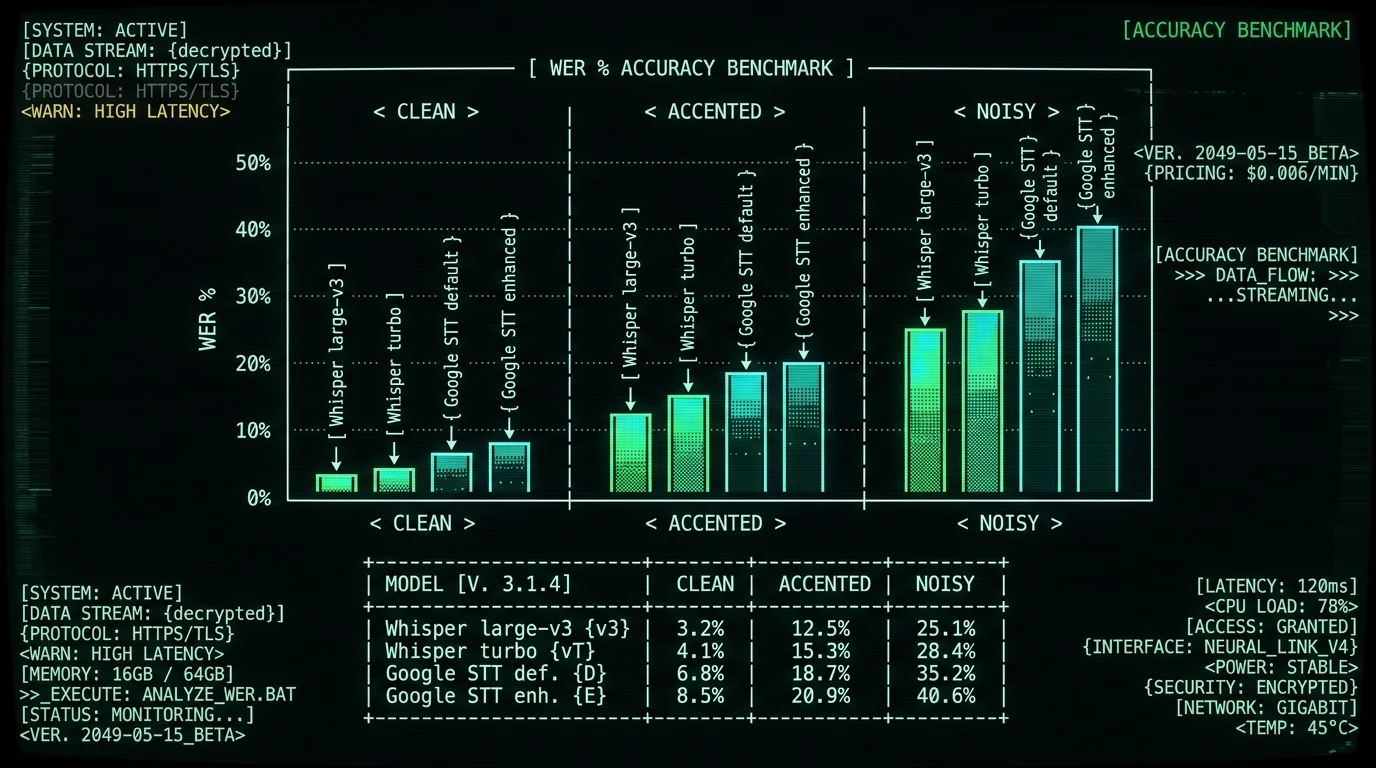
Both systems target similar accuracy ceilings on clean English audio. Reported word error rates (WER) on standard benchmarks:| System | WER (clean English) | WER (accented English) | WER (noisy) |
|---|---|---|---|
| Whisper large-v3 | 3.5% | 5-7% | 8-12% |
| Whisper large-v3-turbo | 3.7% | 6-8% | 10-14% |
| Whisper small | 5.7% | 8-10% | 12-18% |
| Google STT (default) | 4-6% | 6-9% | 10-15% |
| Google STT (enhanced) | 3-5% | 5-7% | 8-12% |
| Google STT (telephony) | 5-8% | 7-12% | 12-18% |
- Noisy environments — Whisper's training included more diverse audio conditions; tends to be 1-2 percentage points better on real-world noisy recordings
- Accented English (Indian, African, Scottish) — Whisper large-v3 has slight edge from larger training corpus; difference is 1-3 percentage points
- Telephony audio (8 kHz, compressed codecs) — Google STT's telephony-specific model wins meaningfully here; Whisper isn't optimized for low-bandwidth audio
- Technical or domain-specific vocabulary — Both engines support custom vocabulary configuration; Google's is more mature for enterprise terminology
Pricing: How Much Does Each Cost?
The pricing models are fundamentally different. Whisper:- Open-source: free to download and use, no usage fees
- Compute cost: runs on your existing Mac hardware (Apple Neural Engine on M1+)
- Total cost for personal use: $0
- If you build a SaaS using Whisper: GPU hosting costs (~$0.50-2/hour for an A10G or similar; per-transcription cost varies by infrastructure choices)
- Default model: $0.016 per minute of audio (per Google's official pricing page)
- Enhanced model: $0.024 per minute
- Free tier: 60 minutes per month included
- Volume discounts available for enterprise contracts
- Whisper via MetaWhisp: $0/month
- Google STT default: 1,800 minutes × $0.016 = $28.80/month
- Google STT enhanced: 1,800 minutes × $0.024 = $43.20/month
- Whisper self-hosted on GPU: ~$3,500-7,000/month infrastructure + ops
- Google STT default: 100,000 × $0.016 = $1,600/month
- Google STT enhanced: 100,000 × $0.024 = $2,400/month
Privacy: What Happens to Your Audio?
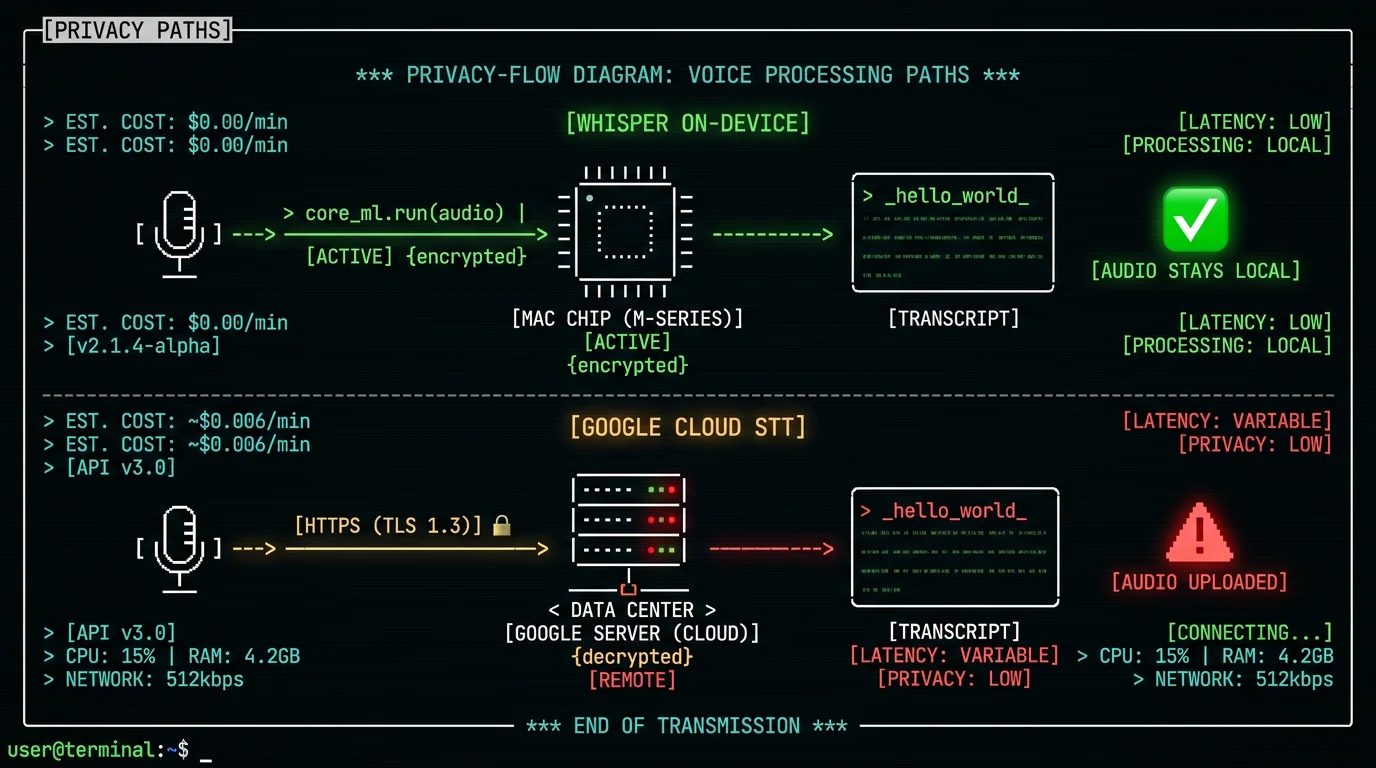
This is where the two engines diverge most starkly. Whisper running on-device (via MetaWhisp, MacWhisper, whisper.cpp):- Audio captured into RAM by the app
- Inference runs on your Mac's Apple Neural Engine or GPU
- Transcript written to local disk or system clipboard
- Audio buffer released from memory after transcription
- Nothing transmitted over the network at any point
- Verifiable: run in airplane mode, or monitor with Little Snitch firewall
- Audio uploaded to Google's servers via HTTPS
- Inference runs in Google Cloud (region depends on your project settings)
- Transcript returned via API response
- Audio may be retained per Google's data retention policies (configurable; default is short-term for service improvement)
- Google may use audio for model training unless you opt out via data logging settings, per Google's data logging documentation
Language Coverage: How Many Languages Does Each Support?
Whisper: 99 languages with built-in language detection. The full list is published in OpenAI's Whisper repository. Auto-detection identifies the language from the first 30 seconds of audio without requiring manual configuration. Google Cloud Speech-to-Text: 200+ languages and language variants. The exact list is at Google's supported languages page. Requires explicit language selection via API parameter; auto-detection is available but limited. For most users, Whisper's 99 languages are sufficient — it covers all major world languages (English, Spanish, Mandarin, Hindi, Arabic, French, German, Portuguese, Japanese, Russian, etc.) plus regional dialects. Google STT's advantage is in less-common languages: small African languages, indigenous American languages, some Pacific languages, and specific regional dialects that Whisper doesn't handle. Accuracy by language varies widely on both engines. The OpenAI Whisper paper documents per-language WER on multilingual test sets; Google's documentation provides confidence indicators per language. For users transcribing in a language they're unsure about, run a 5-minute test sample on both engines and pick the better result.Latency: Real-Time vs Batch Processing
Whisper:- On-device with Apple Neural Engine: 50-150 ms per 30-second audio chunk (M2/M3 Macs)
- On-device with CPU only (older Intel Macs or non-ANE workloads): 1-5 seconds per chunk
- Streaming implementations exist in whisper.cpp but are less mature than Google's
- Streaming API: 100-400 ms first-token latency, with continuous incremental transcription
- Batch processing: 1-2× audio length for completion
- Network round-trip adds 30-200 ms on top of processing time depending on geographic distance to Google's servers
Mac Compatibility: How Easy to Set Up?
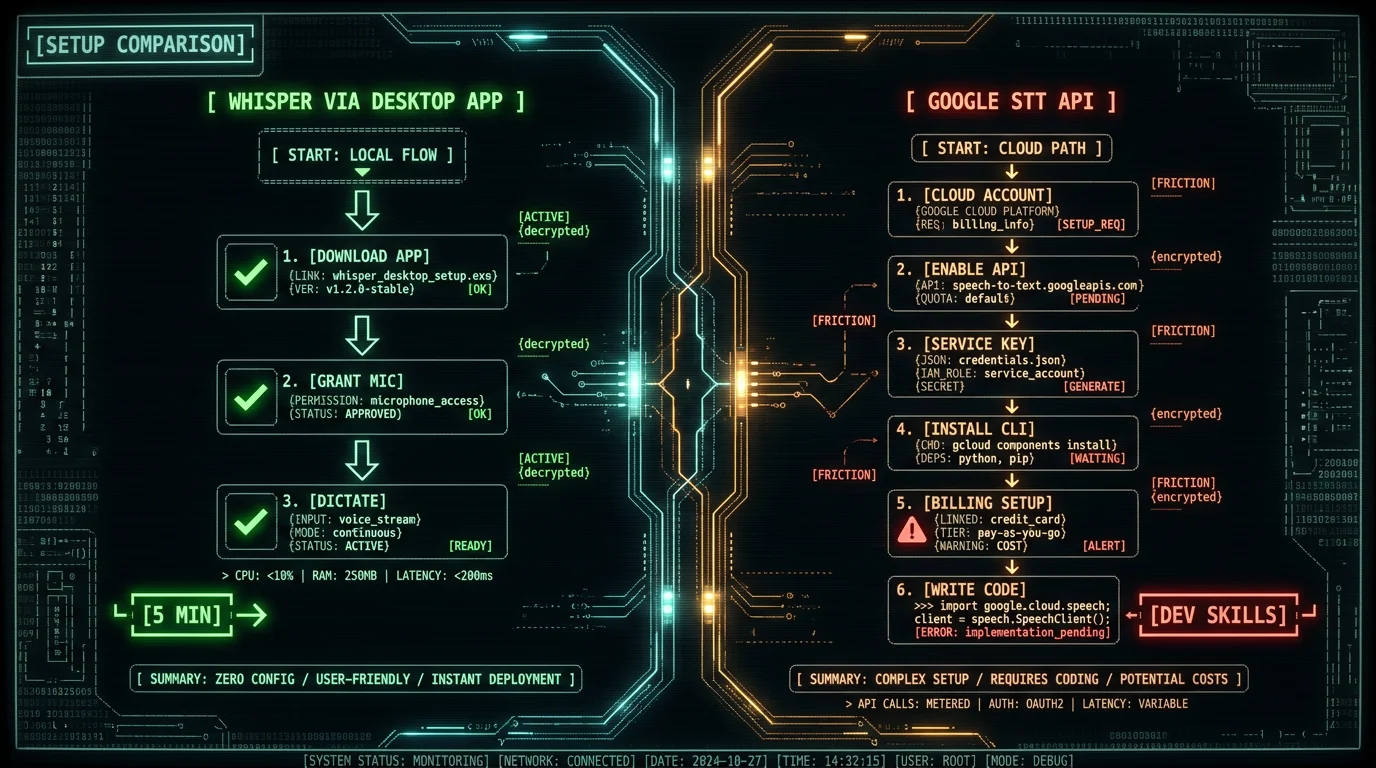
Whisper on Mac:- Easiest path: download MetaWhisp, MacWhisper, or SuperWhisper from their websites or Mac App Store. Install in 5 minutes. No API key, no account.
- Command-line:
brew install whisper-cpp, download model, run from Terminal. Free, scriptable. - Python:
pip install openai-whisperfor the reference implementation. More flexible but heavier dependency footprint.
- Requires Google Cloud account and project setup
- Enable Speech-to-Text API in Cloud Console
- Create service account or API key for authentication
- Install Google Cloud CLI or language-specific client library
- Set up billing (free tier is 60 minutes per month)
- Write code to call the API from your application
Which Apps on Mac Use Whisper vs Google STT?
Quick survey of which speech recognition engine powers each major Mac voice-to-text app:| App | Engine | Where it runs |
|---|---|---|
| MetaWhisp | Whisper large-v3-turbo | On-device (Apple Neural Engine) |
| MacWhisper | Whisper (multiple sizes) | On-device |
| SuperWhisper | Whisper (multiple sizes) | On-device or cloud-hybrid |
| Wispr Flow | Whisper-based (proprietary tuning) | Cloud (their servers) |
| Otter.ai | Proprietary (Whisper-inspired) | Cloud |
| Google Docs Voice Typing | Google STT | Cloud |
| Apple Dictation | Apple's own model | On-device (Enhanced) or cloud |
| OpenAI Whisper API | Whisper large-v3 | Cloud (OpenAI servers) |
Can I Use Both Whisper and Google STT?
Yes, and several use cases benefit from running both:- Personal dictation + business product — Whisper-based desktop app (MetaWhisp) for your personal Mac dictation, Google STT in your SaaS backend that transcribes user audio at scale
- Privacy tiering by content sensitivity — Whisper for confidential audio (interviews, therapy sessions), Google STT for non-sensitive bulk audio
- Fallback for accuracy edge cases — Whisper as primary, fall back to Google STT for telephony-specific audio or unsupported languages
- Comparison and validation — Run important transcripts through both engines, manually compare for accuracy verification
Frequently Asked Questions About Whisper vs Google Speech-to-Text
Which is more accurate, Whisper or Google Speech-to-Text?
On clean English audio, both produce comparable accuracy: Whisper large-v3 at 3.5% word error rate, Google STT enhanced at 3-5%. The difference is imperceptible in most use cases. Whisper has slight edge on accented English and noisy real-world audio because its training corpus included more diverse conditions. Google STT has slight edge on telephony audio (8 kHz, compressed codecs) because of their dedicated telephony model.
How much does Google Speech-to-Text cost vs Whisper?
Google STT costs $0.016 per minute (default model) or $0.024 (enhanced model) with 60-minute free tier per month. Whisper is free for personal use because it runs on-device on your Mac. For 30 hours of monthly dictation, Google STT costs $28-43; Whisper costs $0. For SaaS at scale, Google STT's pay-per-minute can be cheaper than self-hosting Whisper on GPU infrastructure due to fixed infrastructure costs.
Is Whisper better than Google Speech-to-Text for Mac dictation?
For most Mac users, yes. Whisper running on-device (via MetaWhisp or MacWhisper) is free, has sub-second latency, works offline, and keeps audio on your Mac. Google STT requires API setup, ongoing per-minute fees, network connectivity, and uploads audio to Google's servers. The accuracy gap is minimal. For SaaS builders or enterprise users with specific telephony or rare-language requirements, Google STT may have advantages.
Can Whisper run offline like Google Speech-to-Text can't?
Yes. Whisper's open-source model can run entirely on your Mac via Apple Neural Engine (M1+ Macs) or GPU. Tools like MetaWhisp, MacWhisper, and whisper.cpp implement this on-device path. Google Cloud Speech-to-Text requires network connectivity to Google's servers — it cannot run offline. For users who travel, work in remote areas, or want guaranteed availability without network dependencies, Whisper's offline capability is materially valuable.
Does Whisper or Google support more languages?
Google Cloud Speech-to-Text supports 200+ languages and dialects per their documentation. Whisper supports 99 languages per OpenAI's published list. For most users, Whisper's 99 covers all major world languages including English, Spanish, Mandarin, Hindi, Arabic, French, German, Portuguese, Japanese, Russian. Google's advantage is in less-common languages: small African languages, indigenous American languages, specific regional dialects.
Is Google Speech-to-Text HIPAA-compatible?
Only on specific tiers with a signed Business Associate Agreement. Google Cloud offers HIPAA-eligible service via the Cloud BAA program, which covers Speech-to-Text on supported configurations. The default consumer API tier is NOT HIPAA-compatible. For healthcare workflows, either configure HIPAA-eligible Google STT with signed BAA, or use on-device Whisper which sidesteps the BAA requirement because audio never leaves the Mac.
Which is faster for real-time dictation?
On Apple Silicon Macs, Whisper running via Apple Neural Engine completes inference in 50-150 ms per audio chunk with zero network round-trip — consistent sub-second user-perceived latency. Google STT's streaming API has 100-400 ms first-token latency plus network round-trip (30-200 ms depending on geographic distance to Google's servers). For Mac real-time dictation, Whisper on-device is materially faster and more consistent.
Which is easier to set up for non-developers?
Whisper is dramatically easier via desktop apps. Download MetaWhisp, MacWhisper, or SuperWhisper, grant Microphone and Accessibility permissions, start dictating. Total setup: 5 minutes. Google Speech-to-Text requires Google Cloud account, API enablement, service account creation, billing setup, and code to call the API. Practical only for developers building products. For Mac users doing personal dictation, Whisper-based desktop apps are the clear winner.
About the Author
Andrew Dyuzhov is the solo founder and CEO of MetaWhisp, a free on-device voice-to-text app for macOS that runs Whisper large-v3-turbo on Apple Neural Engine. He chose Whisper as MetaWhisp's engine because the open-source architecture lets MetaWhisp deliver private on-device transcription without ongoing per-user costs that would force a subscription model. This comparison reflects hands-on benchmarking of both engines for personal dictation, file transcription, and meeting workflows on M3 MacBook Air. Connect on X or GitHub.
Related Reading
- What Is Whisper large-v3-turbo? — deep-dive on the Whisper variant powering most Mac apps
- Whisper Model Sizes: Tiny to Turbo — pick the right Whisper variant for your Mac
- 7 Best Voice-to-Text Apps for Mac (2026) — apps using both Whisper and other engines compared
- Private Voice-to-Text on Mac — on-device architecture deep-dive
- HIPAA-Compliant Speech-to-Text on Mac — when cloud STT needs BAA agreements
