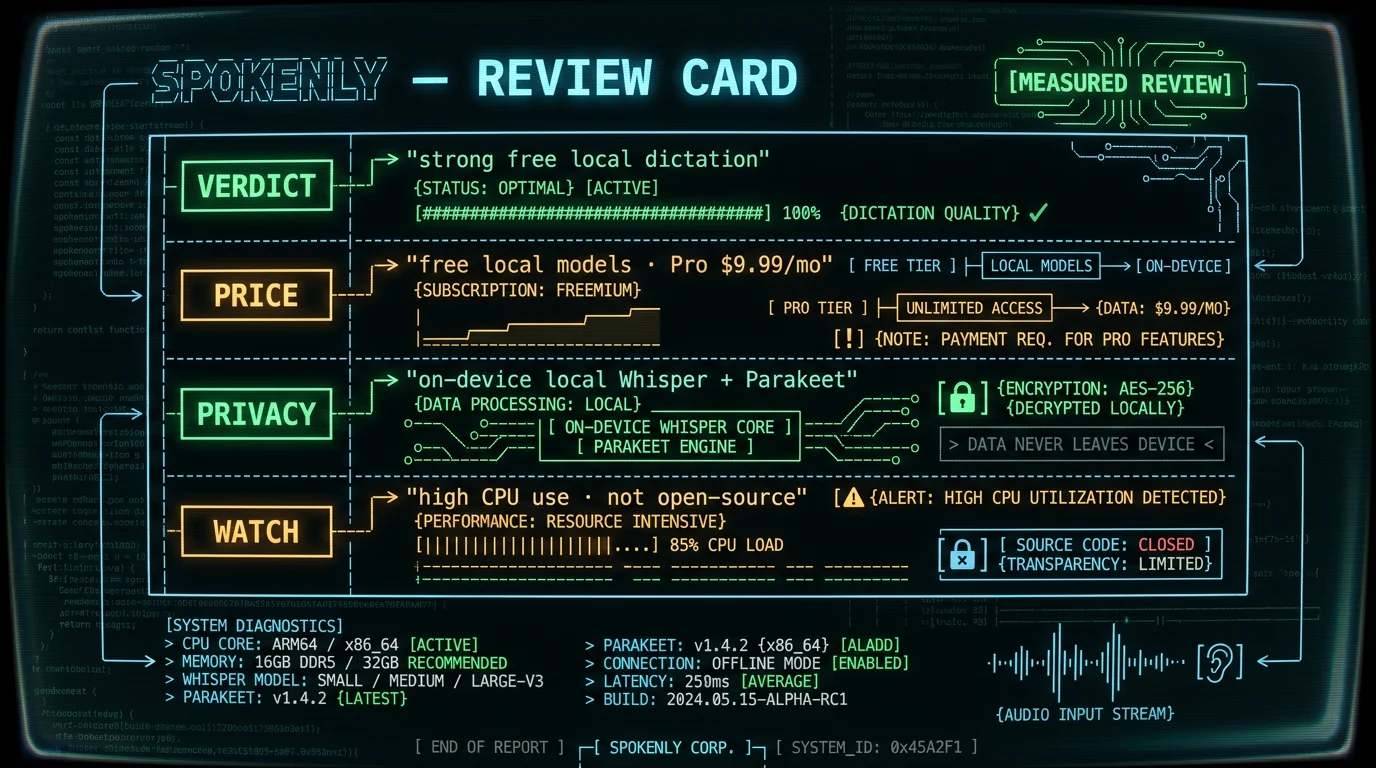
How this review was built: from Spokenly's current published facts (features, pricing) verified June 2026, plus independent testing and review reports, with links. I build a competing app — disclosed above — so the tone stays factual and every claim is sourced rather than spun.
What Is Spokenly?
Spokenly is an AI dictation app for Mac and iPhone: you press a shortcut, speak, and your words appear at the cursor in any app. What sets it apart among free tools is model choice — it runs both OpenAI's Whisper and NVIDIA's Parakeet speech models locally on Apple Silicon, and lets you bring your own cloud API keys (OpenAI, Deepgram, Groq) if you want managed cloud accuracy. It also ships an iOS app with a custom keyboard, speaker diarization, file transcription, and an agent mode that can trigger macOS automations from spoken commands.Spokenly Pricing (2026)
Spokenly's pricing is refreshingly simple. As of June 2026, per Spokenly's site:- Free — unlimited local transcription (Whisper + Parakeet) and bring-your-own-key cloud transcription, with no time limit or word caps
- Pro — $9.99/month — adds Spokenly-managed cloud models and priority support; one subscription covers both the Mac and iOS apps
Is Spokenly Private?
Yes, in its local mode — with one honest caveat about verification. Local processing keeps audio on your device. Spokenly's local Whisper and Parakeet models run on-device on Apple Silicon, so for local dictation your audio isn't sent anywhere; it works offline. That's the same privacy-by-architecture that makes on-device tools trustworthy, and you can confirm it by dictating with Wi-Fi off. The caveat: it's closed-source, and cloud is optional. Spokenly is not open-source, so you trust its local-only behavior rather than auditing the code (you can still verify it empirically offline). And if you choose a cloud model — either BYOK or Pro-managed — audio goes to that provider for that request, by design. So "is Spokenly private?" depends on the mode: local model = on-device; cloud model = sent to the provider you picked.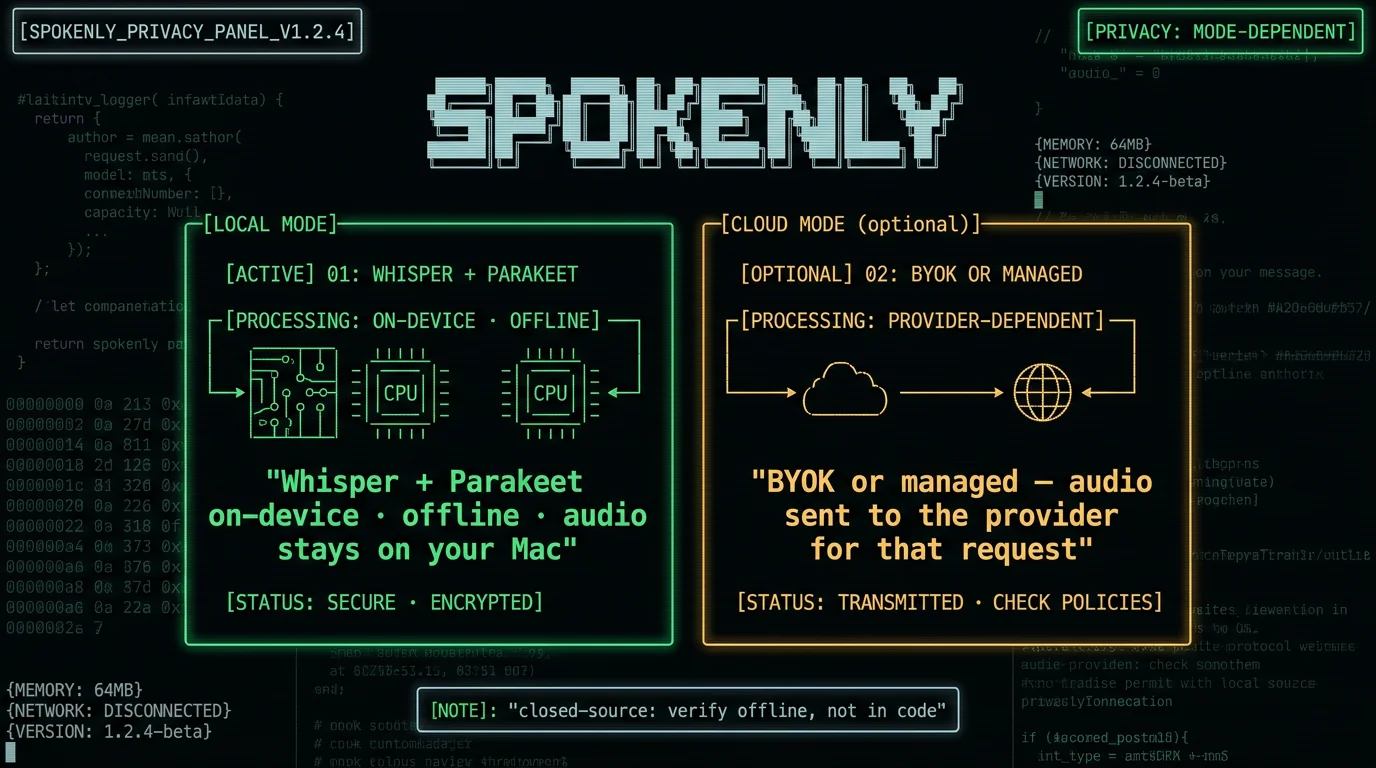
What's Genuinely Good About It
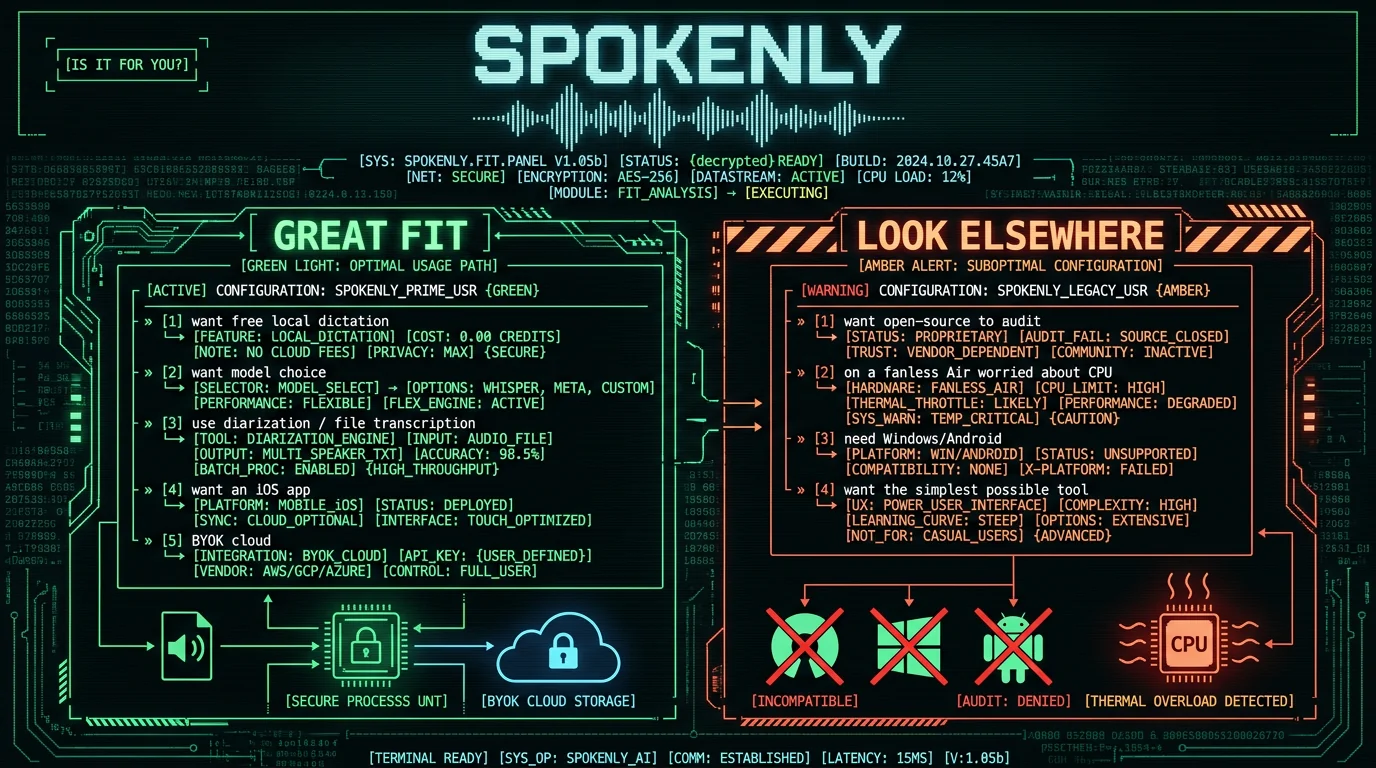
The praise Spokenly earns is real, and it's mostly about breadth and price. Free, unlimited, on-device. The headline strength: full local dictation at no cost, no account, no word caps. For a feature this useful, free-and-unlimited is rare. Model choice. You can switch between Parakeet (very fast) and Whisper large-v3-turbo (which runs on the Apple Neural Engine for strong accuracy), tuning speed versus accuracy to your hardware and task. Most free tools lock you to one model. Genuinely useful extras. Speaker diarization, file transcription, an iOS app with a custom keyboard (one Pro subscription covers both platforms), and MCP integration with coding agents like Claude Code, Cursor, and Codex — plus an agent mode that triggers macOS automations from voice. That's a lot of surface area for a free app. Built for Apple Silicon. Native on M1 through M4, running Whisper large-v3-turbo on the Neural Engine. For grounding, I benchmarked that same model on LibriSpeech test-clean in May 2026: 2.76% word error rate, 5.5× faster than real-time — the accuracy a good local Whisper app delivers.The Real Trade-Offs
A measured review names the downsides, all factual and sourced. High CPU use. Independent 2026 testing reports flag Spokenly's CPU use during dictation as among the highest of the Mac dictation apps compared — enough to spin up the fans on a MacBook Air. If you're on a fanless or battery-sensitive machine, that's worth weighing. Local Parakeet can mis-detect language. Reviewers and App Store feedback note the fast local Parakeet model sometimes detects the wrong language and defaults to English. Switching to a Whisper model generally resolves it, but it's a known rough edge. Closed-source, Mac/iPhone only. It's not open-source, so privacy is verified by behavior rather than code, and there's no Android or Windows app — it's an Apple-ecosystem tool.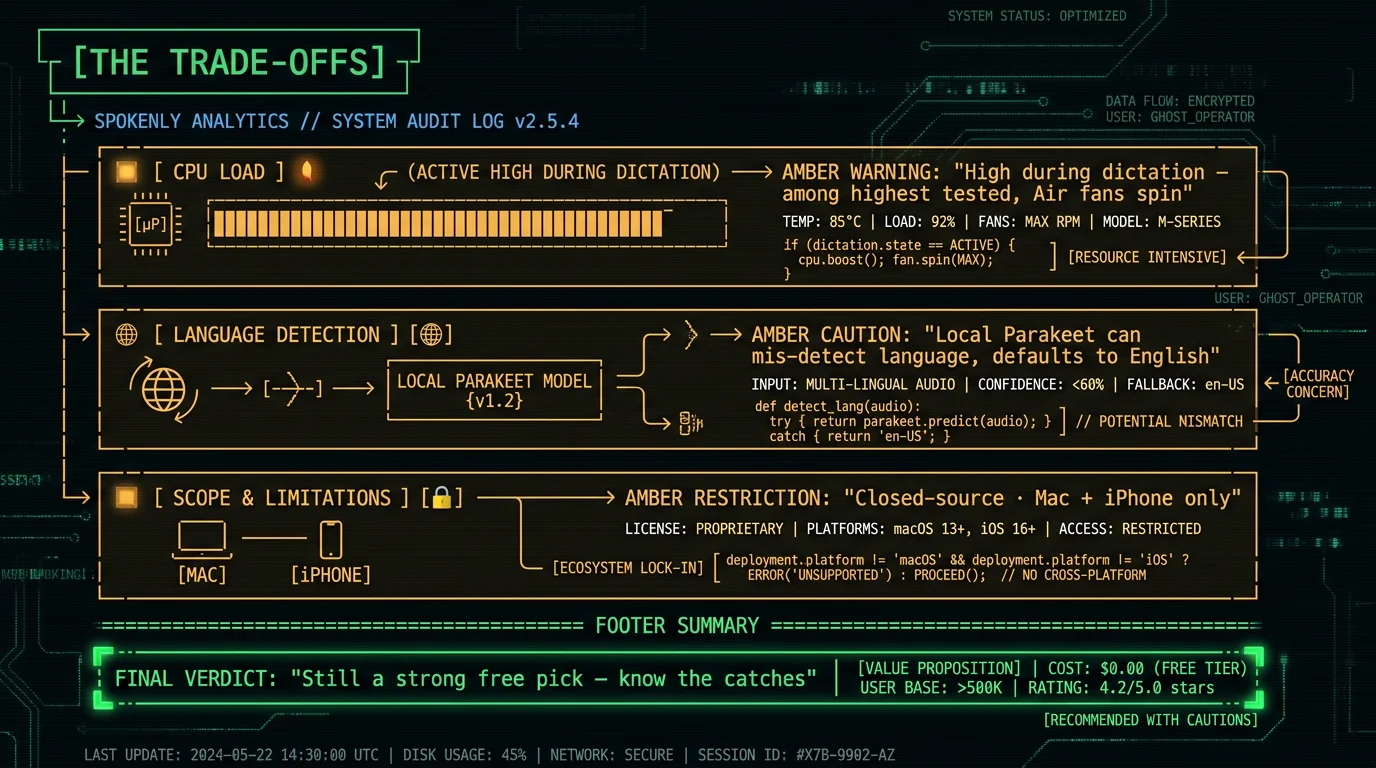
Spokenly vs a Free Open-Source App
Here's my bias up front: I build MetaWhisp, a free, open-source, on-device dictation app, so weigh this accordingly. Spokenly and MetaWhisp overlap a lot — both are free and on-device — so the honest contrast is narrow. Spokenly optimizes for breadth: model choice, cloud options, diarization, an iOS app, MCP integrations. MetaWhisp optimizes for simplicity and verifiability: it does free live dictation with Whisper large-v3-turbo on the Neural Engine, it's open-source so the privacy is auditable in code, and it's lighter. If you want the bigger feature set and don't mind closed-source plus higher CPU, Spokenly is excellent. If you want open-source you can audit and a lean, focused tool, that's the gap MetaWhisp fills.Who Should Use Spokenly?
Frequently Asked Questions
Is Spokenly free?
Yes. Spokenly's local Whisper and Parakeet models are free with no account, no time limit, and no word caps, and you can bring your own cloud API key (OpenAI, Deepgram, Groq) at no markup. The only paid option is Pro at $9.99/month, which adds Spokenly-managed cloud models so you don't have to supply keys, plus priority support. For on-device dictation, the free tier is the full product.
Is Spokenly private?
In local mode, yes — its Whisper and Parakeet models run on-device on Apple Silicon, so your audio stays on your Mac and works offline; verify by dictating with Wi-Fi off. Two caveats: Spokenly is closed-source, so you confirm privacy by behavior rather than reading code; and if you pick a cloud model (BYOK or Pro), audio is sent to that provider for that request. Choose a local model for sensitive content.
Is Spokenly accurate?
Yes, because it runs the same top models other apps use. Its Whisper large-v3-turbo option runs on the Apple Neural Engine (that model benchmarks at 2.76% word error rate on clean speech), and Parakeet offers a faster alternative. One known issue: the local Parakeet model can sometimes mis-detect language and default to English — switching to a Whisper model resolves it. For accuracy on tricky audio, choose a Whisper model.
What are Spokenly's downsides?
Three honest ones: independent 2026 testing flags its CPU use during dictation as among the highest of the apps compared, enough to spin up a MacBook Air's fans; the fast local Parakeet model occasionally mis-detects language and defaults to English; and it's closed-source and Apple-only (Mac and iPhone), so no code audit and no Windows or Android. None is a dealbreaker for most users, but they're worth knowing before you commit.
Is Spokenly open-source?
No. Spokenly is a closed-source app, so you verify its on-device privacy by running it offline rather than by reading the code. If open-source matters to you — for example, to audit that audio never leaves your Mac — free open-source alternatives like MetaWhisp (Whisper large-v3-turbo) or community projects exist. Spokenly's strength is its feature breadth and free local models, not source transparency.
What's the best free alternative to Spokenly?
If you want free on-device dictation but prefer open-source, MetaWhisp is the closest match — free, open-source, and running Whisper large-v3-turbo locally, focused on simple dictation. Apple Dictation is free and built in for casual use. If you want Spokenly's feature breadth, the trade-off is that simpler or open-source tools won't match its model choice, diarization, and integrations — so the right alternative depends on whether you value breadth or auditability.
About the Author
Andrew Dyuzhov is the solo founder and CEO of MetaWhisp, a free, open-source, on-device voice-to-text app for macOS that runs Whisper large-v3-turbo locally via WhisperKit. He competes with Spokenly, which is why this review credits Spokenly's genuine strengths (free local models, model choice, and its feature breadth), reports its trade-offs factually with sources, and discloses the conflict — Spokenly's facts verified June 2026. Connect on X or GitHub.
Related Reading
- 7 Best Free Dictation Apps for Mac — where Spokenly fits among free options
- 7 Best Local Transcription Apps for Mac — the on-device landscape
- SuperWhisper Review 2026 — a paid power-tool comparison point
- MetaWhisp vs SuperWhisper — free open-source vs paid power
- Private Voice-to-Text on Mac — why on-device means private
