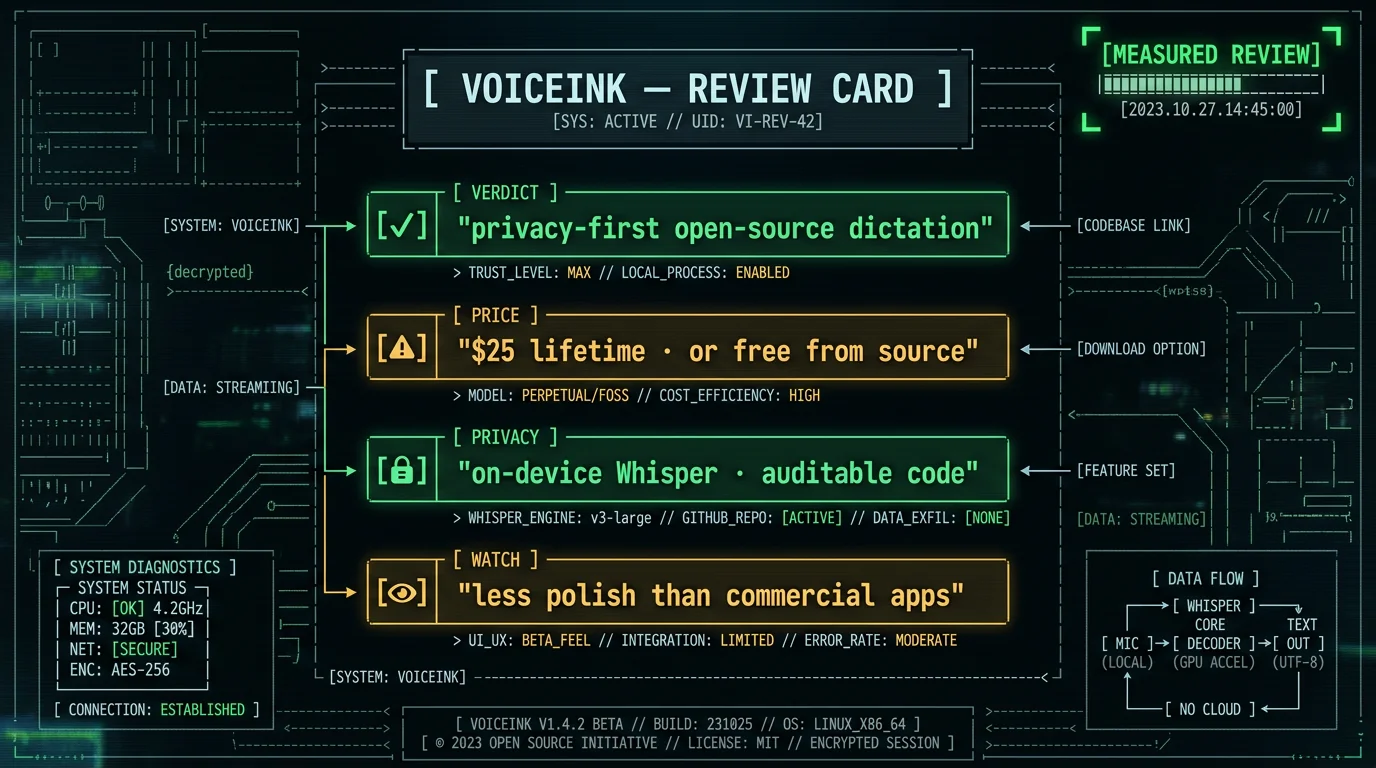
How this review was built: from VoiceInk's current published facts (features, pricing, source repo) verified June 2026, plus independent reviews, with links. I build a competing app — disclosed above — so the tone stays factual and every claim is sourced.
What Is VoiceInk?
VoiceInk is an open-source dictation app for macOS built by indie developer Prakash Joshi Pax. You press a shortcut, speak, and text appears at your cursor in any app — and the transcription runs locally using OpenAI's Whisper models via whisper.cpp, so audio is processed entirely on your Mac. It's written in Swift, updated regularly, and its source is public on GitHub under the GPL v3 license, where it has accumulated thousands of stars.VoiceInk Pricing (2026)
VoiceInk uses one-time pricing, with a free path for the technical. As of 2026, per tryvoiceink.com, checked 10 Aug 2026:- Solo — $29 (1 Mac), one-time, lifetime updates
- Personal — $49 (2 Macs)
- Extended — $69 (3 Macs)
- Free from source — it's GPL v3 open-source, so with Xcode you can build and run it at no cost
Is VoiceInk Private?
Yes — and unusually, you can prove it. On-device by design. VoiceInk runs Whisper locally via whisper.cpp, so your audio is transcribed on your Mac and isn't sent to external servers. It works offline, which you can confirm by dictating with Wi-Fi off. Open-source, so the privacy is auditable. This is VoiceInk's real privacy edge. Because the code is public under GPL v3, you (or anyone) can inspect exactly what it does with your audio — you're not trusting a privacy policy, you're reading the implementation. That's a stronger guarantee than a closed-source app offering the same on-device promise.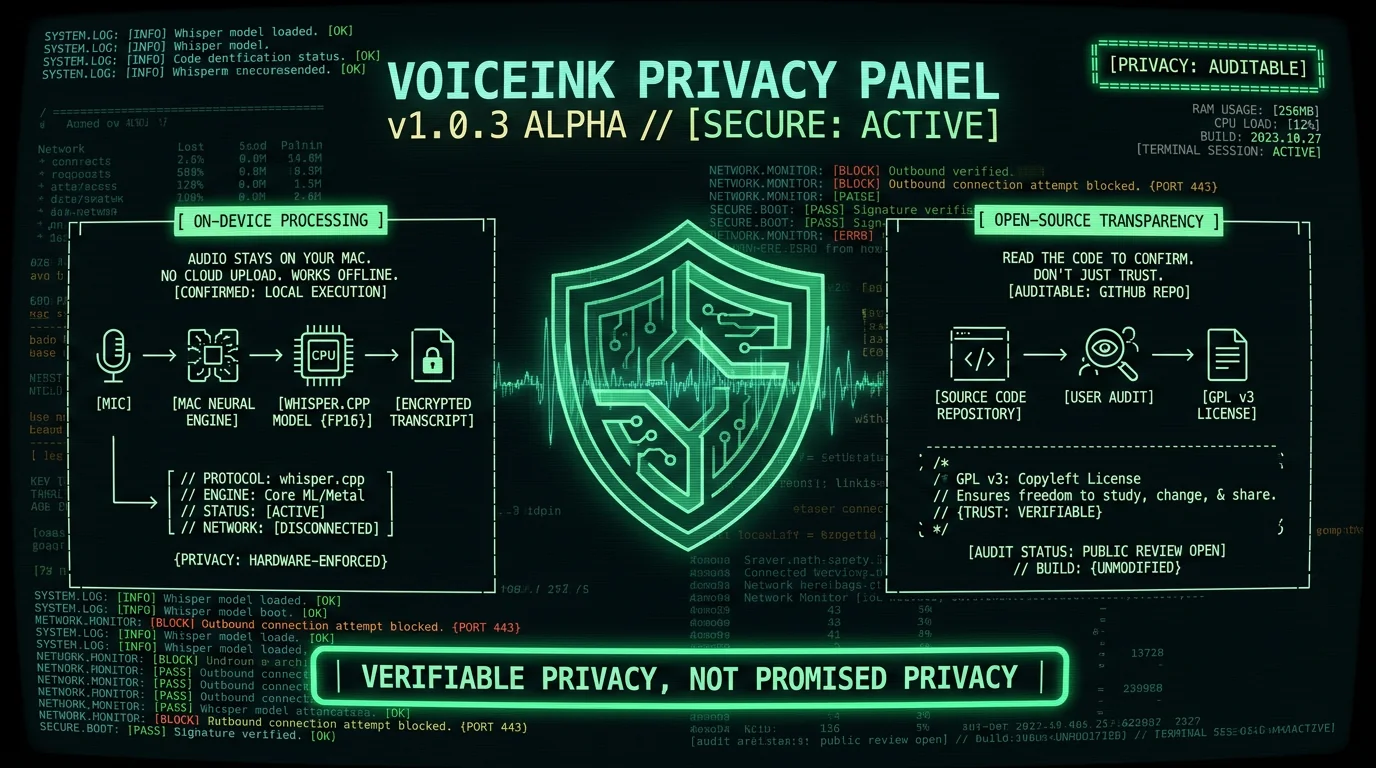
What's Genuinely Good About It
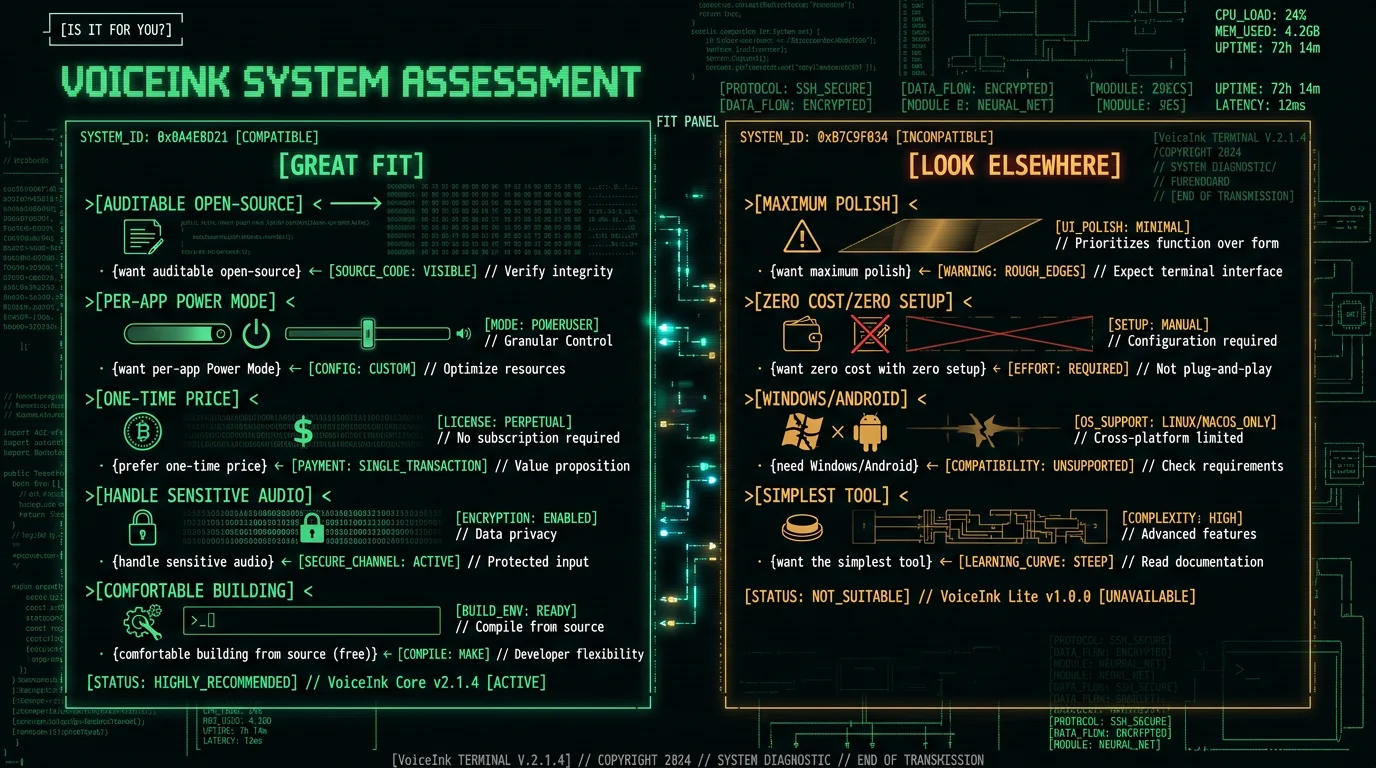
The praise VoiceInk earns is real, and it centers on privacy, price, and control. Power Mode. The standout feature: automatic per-app configuration. Your email client, code editor, and browser can each have their own optimized dictation settings, applied automatically based on which app is active. It's a genuine time-saver for people who dictate across different contexts. Model choice. You can switch between Whisper model sizes (tiny through large) and the Parakeet model to balance speed against accuracy for your hardware — useful tuning that simpler apps don't offer. Open-source and actively developed. Public on GitHub under GPL v3, written in Swift, with regular releases (version 1.72 shipped in March 2026) and a community of thousands of stars and hundreds of forks — signs of an alive, maintained project rather than abandonware. Fair one-time price. Strong accuracy comes from the underlying Whisper model — which I benchmarked at 2.76% word error rate (large-v3-turbo, LibriSpeech test-clean, May 2026) — and you get it for a single $29 payment, or free from source. No subscription.The Real Trade-Offs
A measured review names the downsides too, all factual. Less polish than commercial apps. As an indie open-source project, VoiceInk trails the most polished commercial tools on interface refinement and some power-user features. One 2026 review scores it 7/10 — "affordable, privacy-respecting" but behind commercial alternatives on developer features and polish. The free path is technical. "Free forever" is real but requires Xcode and building from source — not something a non-developer will do. For most people, the practical price is the $29 one-time license. macOS and Apple-focused. It's a Mac (and iOS) dictation app, so it isn't an option if you need Windows or Android.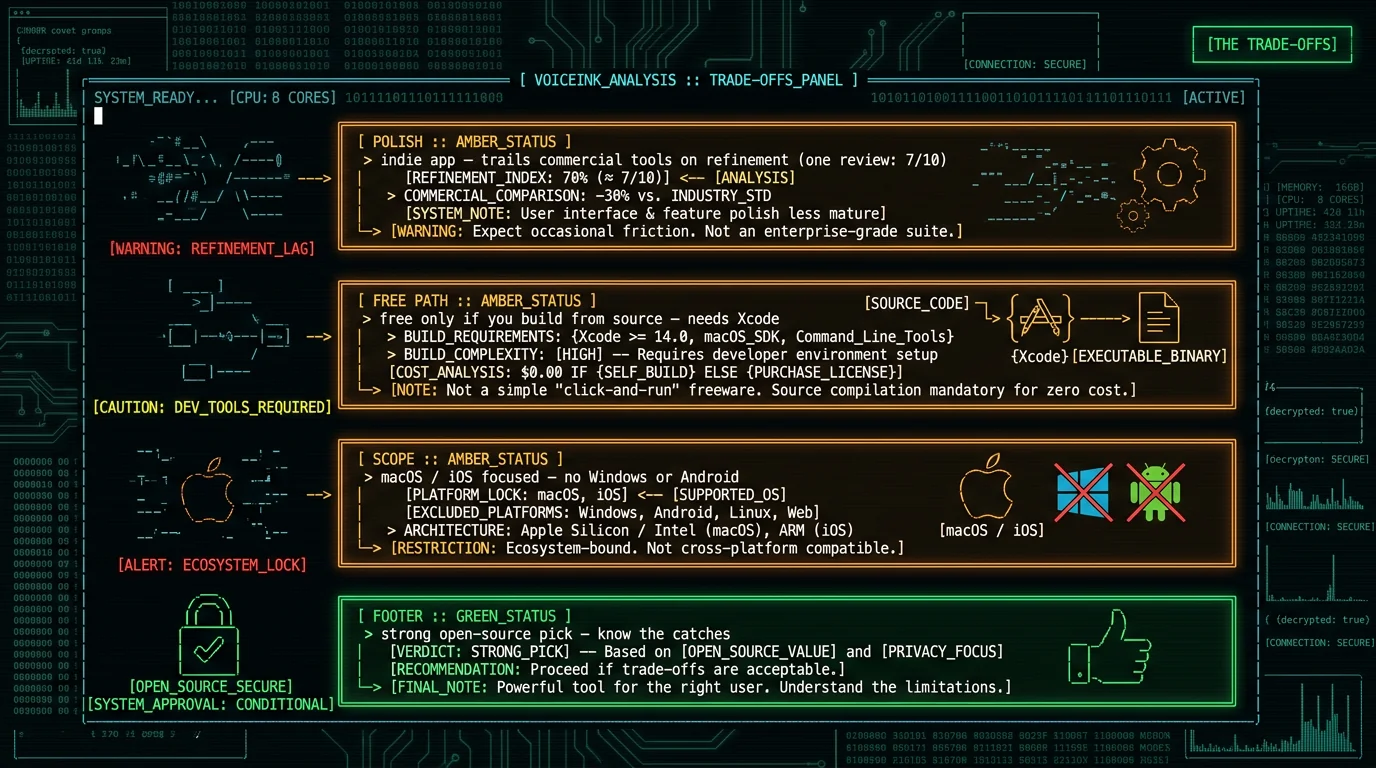
VoiceInk vs a Free Out-of-the-Box App
Here's my bias up front: I build MetaWhisp, a free, open-source, on-device dictation app, so weigh this accordingly. VoiceInk and MetaWhisp are philosophically close — both open-source, both on-device, both privacy-first — so the contrast is narrow and friendly. VoiceInk optimizes for per-app control with a one-time price: Power Mode, model switching, and a fair $29 lifetime license (or free from source). MetaWhisp optimizes for free and simple out of the box: it runs Whisper large-v3-turbo on the Apple Neural Engine via WhisperKit, costs nothing with no build step, and focuses on straightforward live dictation. If you want per-app configuration and don't mind a one-time payment (or a source build), VoiceInk is excellent. If you want a free, ready-to-run open-source app with no setup, that's the gap MetaWhisp fills. Both give you auditable, on-device privacy — the choice is configuration-and-one-time-price versus free-and-simple.Who Should Use VoiceInk?
Frequently Asked Questions
Is VoiceInk free?
Partly. VoiceInk is open-source under GPL v3, so if you have Xcode you can build and run it from source for free forever. The packaged, ready-to-run app is a one-time purchase — Solo $29 (1 Mac), Personal $49 (2 Macs), or Extended $69 (3 Macs), with lifetime updates and a 14-day refund. So the price buys convenience and support, not access; the code itself is free.
Is VoiceInk open-source?
Yes. VoiceInk is open-source under the GPL v3 license, with its code public on GitHub (github.com/Beingpax/VoiceInk), where it has thousands of stars. Being open-source is its main privacy advantage: you can audit the code to confirm audio stays on your Mac, rather than trusting a privacy policy. It's written in Swift and actively maintained, with regular releases.
Is VoiceInk private?
Yes, strongly. VoiceInk runs Whisper locally via whisper.cpp, so audio is transcribed on your Mac and works offline — confirm by dictating with Wi-Fi off. Because it's open-source, the privacy is verifiable: anyone can read the code to check there's no hidden upload or telemetry. That auditability makes it one of the safest options for sensitive dictation, stronger than a closed-source app making the same on-device claim.
What is VoiceInk's Power Mode?
Power Mode is VoiceInk's standout feature: automatic per-app configuration. It applies different dictation settings depending on which app you're in, so your email client, code editor, and browser can each have their own optimized setup without manual switching. For people who dictate across many contexts with different formatting needs, it's a genuine time-saver and a key reason to choose VoiceInk over simpler tools.
What are VoiceInk's downsides?
Mainly polish and reach. As an indie open-source app, it trails the most polished commercial tools on interface refinement and some power-user features — one 2026 review scores it 7/10. The "free forever" path requires Xcode and building from source, so for most people the practical price is the $29 license. And it's Apple-focused (macOS/iOS), with no Windows or Android version.
What's a free alternative to VoiceInk?
If you want the same open-source, on-device privacy but free out of the box with no build step, MetaWhisp is the closest match — free, open-source, running Whisper large-v3-turbo locally, focused on simple dictation. Apple Dictation is free and built in for casual use. The trade-off: a simpler free app won't include VoiceInk's Power Mode per-app configuration, so it depends on whether you need that control.
About the Author
Andrew Dyuzhov is the solo founder and CEO of MetaWhisp, a free, open-source, on-device voice-to-text app for macOS that runs Whisper large-v3-turbo locally via WhisperKit. He competes with VoiceInk — a fellow open-source on-device app — which is why this review credits its genuine strengths (auditable privacy, Power Mode, and fair one-time pricing), reports its trade-offs factually, and discloses the conflict. VoiceInk's facts verified June 2026. Connect on X or GitHub.
Related Reading
- 7 Best Free Dictation Apps for Mac — including open-source options
- Spokenly Review 2026 — a free closed-source comparison point
- 7 Best Local Transcription Apps for Mac — the on-device landscape
- MetaWhisp vs SuperWhisper — free open-source vs paid power
- Private Voice-to-Text on Mac — why on-device means private
