Two engines, one open-source model family. Which path gets you a finished Mac app fastest?

Short answer: WhisperKit is purpose-built for the Apple Neural Engine, so on Apple Silicon it generally outperforms whisper.cpp's generic Core ML/Metal path — but more importantly, it ships as a Swift package you can drop into a Mac app in a day. whisper.cpp works on Macs, but wrapping it in a stable, signed, sandboxed macOS app takes real engineering. MetaWhisp chose WhisperKit + Whisper large-v3-turbo so we could ship a finished, free, on-device dictation app instead of a build script.
WhisperKit vs whisper.cpp on Apple Silicon: what's actually different?
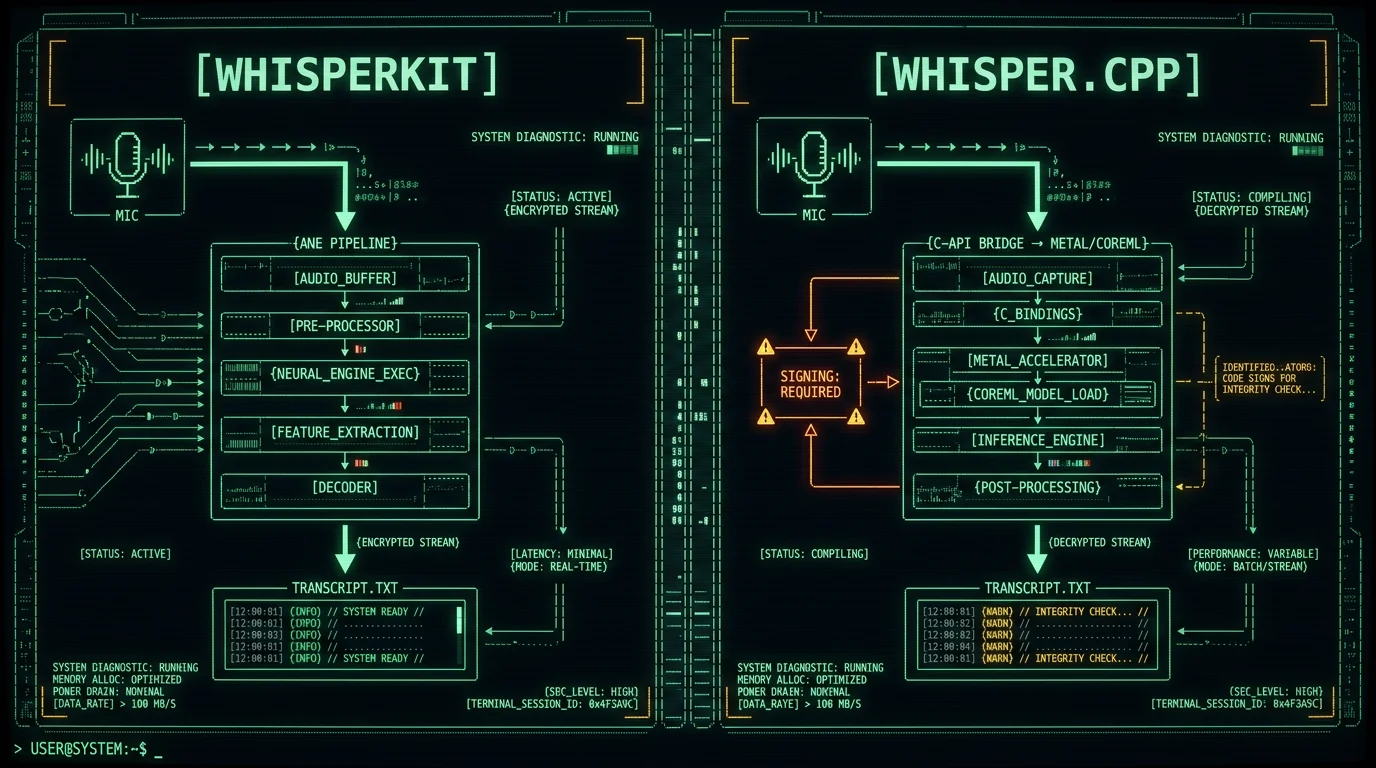
Both engines run the same open-source Whisper models from OpenAI. The difference is the silicon path. WhisperKit was designed from day one for Apple's Neural Engine (ANE), which is the dedicated matrix-math accelerator on every M-series chip. whisper.cpp was designed for CPU portability first, then grew Metal and Core ML backends later.
That origin story matters on a Mac. ANE access requires a specific model graph format, and WhisperKit generates those graphs as part of its packaging step. whisper.cpp instead leans on Metal compute shaders or Core ML's general-purpose path, neither of which uses the ANE directly the way WhisperKit does. In practice you give up some throughput and some power efficiency.
What is WhisperKit, and why is it the default Swift path for Whisper on Mac?
WhisperKit is a Swift package from Argmax that wraps Whisper with an Apple Neural Engine-first inference path. It includes a model compiler that converts OpenAI's Whisper checkpoints into Core ML models optimised for ANE, plus a clean Swift API for streaming audio in and transcripts out.
Argmax maintains a curated set of pre-converted models (tiny, base, small, large-v3, large-v3-turbo) so you don't have to compile anything yourself. The package is increasingly the Swift-native path Mac developers reach for when they want Whisper on-device without writing a custom tensor backend.
What is whisper.cpp, and what does it actually do on a Mac?
whisper.cpp is Georgi Gerganov's C/C++ port of Whisper, originally built for CPU inference across basically every platform. On macOS it offers two GPU-adjacent paths: a Metal backend that runs shaders on the GPU, and a Core ML backend that can delegate to ANE for some layers.
The catch is that whisper.cpp exposes a C API. To use it from a Swift Mac app you need an Objective-C++ bridging header, careful memory management across the boundary, and usually a small "sidecar" binary or static library to keep the toolchain happy. None of that is impossible — plenty of indie devs do it — but it's the difference between an afternoon integration and a multi-day build problem.
Does MLX-Whisper change the picture?
MLX is Apple's own machine learning framework built around unified memory on Apple Silicon. MLX examples include a Whisper port, and on M2/M3/M4 chips the unified-memory GPU path is genuinely fast — sometimes faster than ANE for certain layer shapes.
The trade-off is that MLX-Whisper is still very much a developer experience. You typically run it from a Python script or a Jupyter notebook. Wrapping it into a double-clickable, signed, sandboxed Mac app is a project, not an afternoon. If your goal is "I want to dictate into a text field on my Mac right now," MLX isn't the shortest path.
Model size (tiny → large-v3-turbo) versus engine: pick the right axis
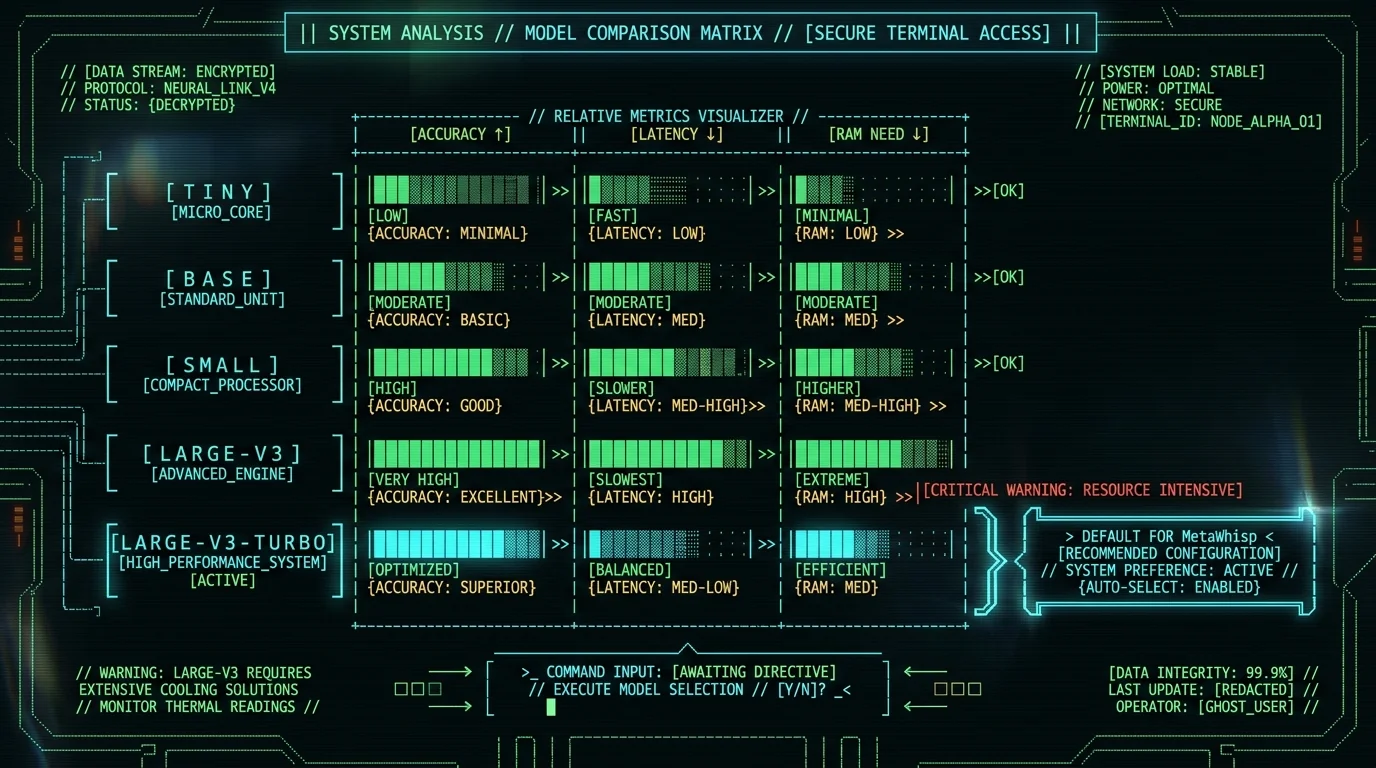
The single most common mistake I see is people arguing about model size when they really meant engine choice, or vice versa. They're separate axes.The model is the brain: tiny, base, small, medium, large-v3, or large-v3-turbo. Bigger brains are more accurate on hard audio (accents, noisy rooms, technical vocabulary) but slower and hungrier for RAM.
The engine is the muscle: how that brain gets exercised on your specific hardware. WhisperKit-on-ANE can run large-v3-turbo comfortably on an 8 GB M1. whisper.cpp-on-Metal struggles more on the same chip at the same model size.
If you swap models but keep the engine, accuracy changes but the build story doesn't. If you swap engines but keep the model, the build story changes but accuracy is roughly the same — it's the same Whisper weights either way.
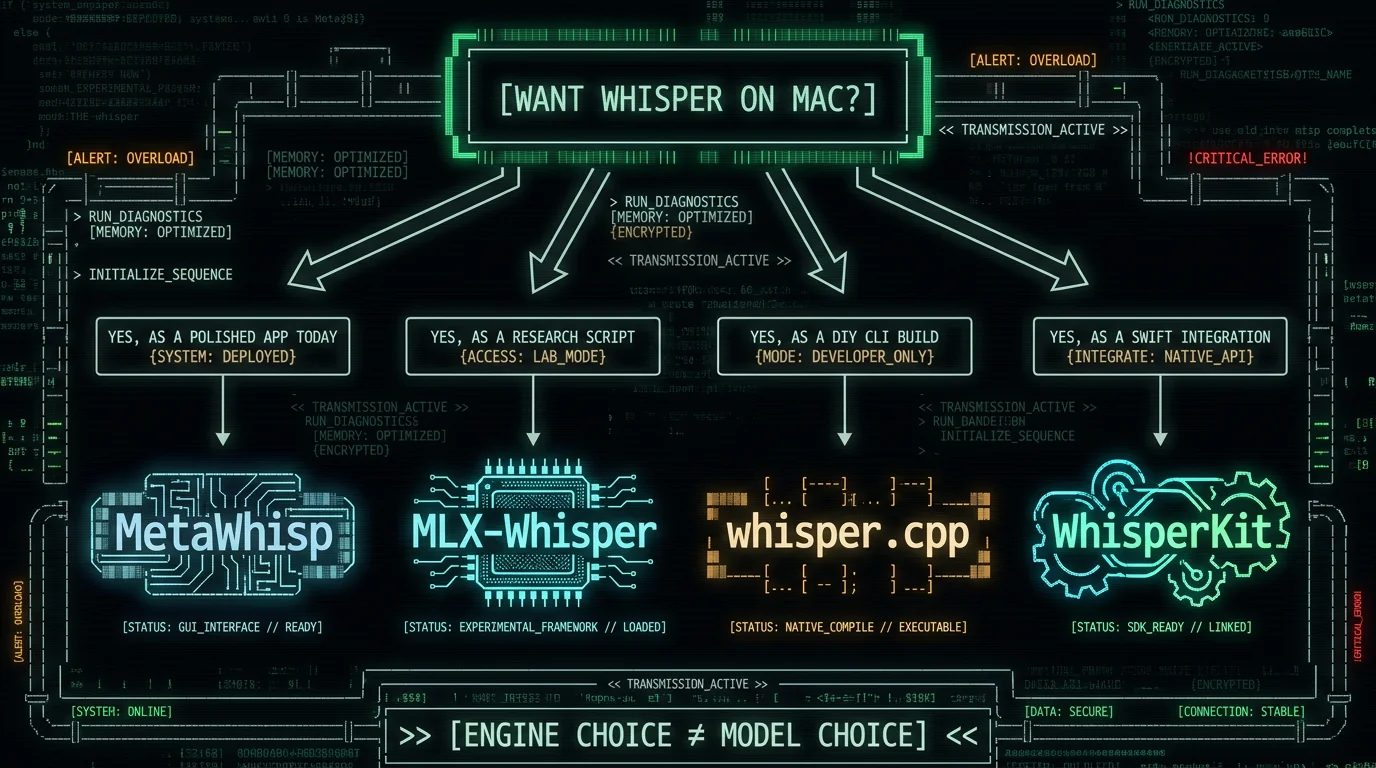
| Engine | ANE-native path? | Build effort for a Mac app | Typical UX |
|---|---|---|---|
| WhisperKit | Yes — compiled to ANE | Low (Swift package, SwiftUI-friendly) | Finished, signed app |
| whisper.cpp | Partial (Metal + Core ML backend) | High (C-API wrappers, sidecar binary, signing) | CLI tool or DIY build |
| MLX-Whisper | No (unified-memory GPU) | Medium (Python-first, app wrapping is DIY) | Notebook or research script |
Which engine feels faster on an M1, M2, or M3?
ANE is the most power-efficient path on Apple Silicon, and it shows up directly as latency and battery life. WhisperKit, by routing through ANE, gets to take advantage of that. whisper.cpp on Metal is competitive on raw GPU throughput but tends to draw more power for the same workload.
I don't want to publish specific "X% faster" numbers I haven't measured end-to-end across both engines on the same machine with the same model. Real-world speed depends on the model you pick, your chip generation, your RAM, and the audio length. Treat any clean-looking speed comparison with that grain of salt.
Pro tip: If you're evaluating engines for a personal project, time the same audio file through both, on the same Mac, with the same model. Anything else is theatre. Even then, watch thermals — the M-series chips will throttle if you run long batches back-to-back, which can hide the ANE advantage.
Which engine is actually easier to ship as a Mac app?
This is the question that decided it for me. WhisperKit gives you a Swift import, a sensible API, and a documented model download flow. You can be inside a SwiftUI app running real audio in an afternoon.
whisper.cpp gives you a C library, a CLI, and a community of people who've each shipped their own integration. You can absolutely make it work — MacWhisper has done it well — but the maintainer is also writing the Swift wrapper, the audio pipeline, and the model management.
MLX gives you Python notebooks. Lovely for research, but shipping it means building the Swift layer yourself from scratch. That's a real project.
How MetaWhisp wraps WhisperKit so you don't have to compile anything
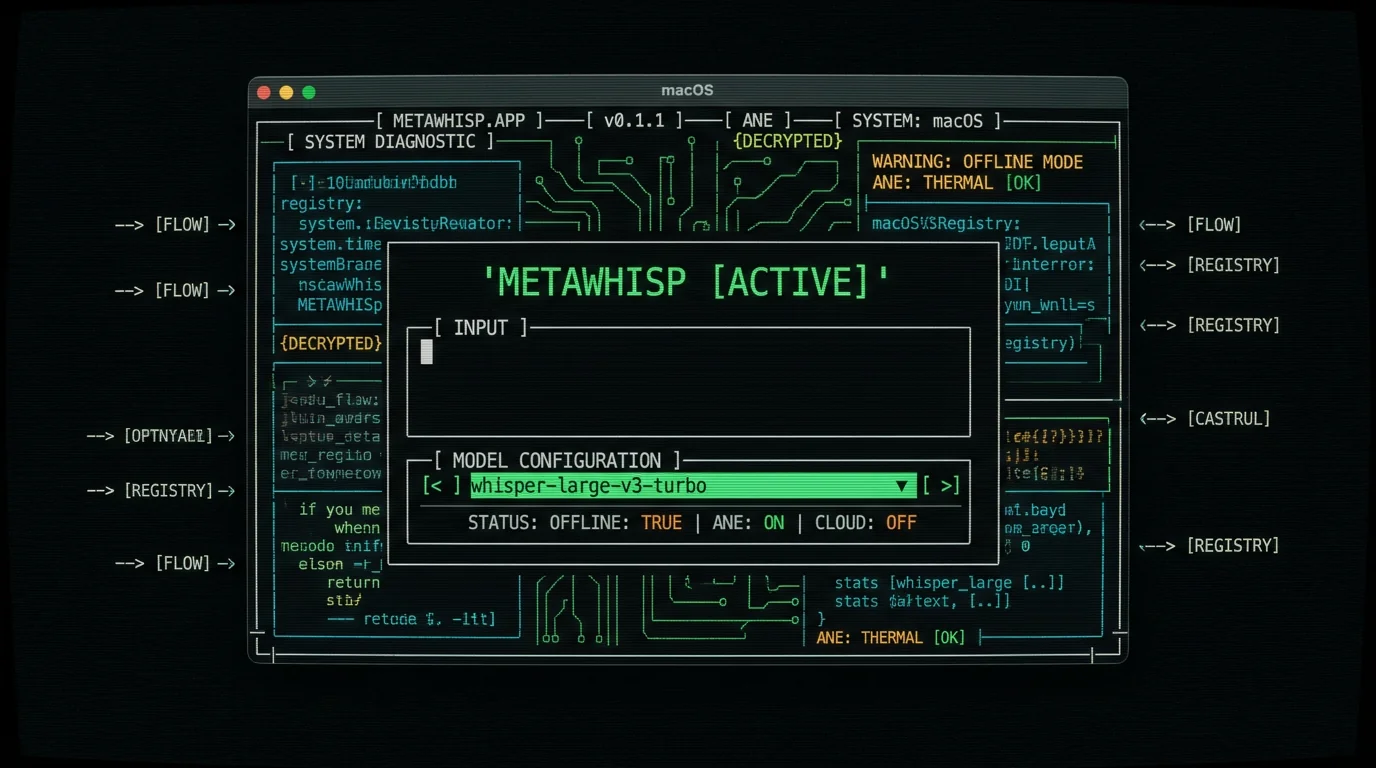
MetaWhisp is a small, signed, notarised macOS app that bundles WhisperKit and a pre-converted Whisper large-v3-turbo model. You download it, grant microphone permission, hold a hotkey (Right Option by default), and talk. The transcript lands in whatever app has focus. Audio never leaves your Mac. No account, no telemetry, no time caps in local mode.
The local mode is free and unlimited. AI post-processing (Structured/Correct/Rewrite) and translation work on the free tier with your own OpenAI or Cerebras API key — your text goes to your API, not MetaWhisp's servers. Pro removes the BYOK requirement and adds cloud transcription if you'd rather not use your Mac's compute. Pricing is on the site if you want the current numbers.
Founder's note: I'm a marketer with ADHD who assembled MetaWhisp with AI coding tools, not an ML researcher. If you're a researcher and MetaWhisp's 2.76% WER run looks off compared to your own, I'd love to hear what we did differently — it's the only number I quote because it's the only one I ran myself. My 7-app head-to-head on the same audio (Apple Dictation, Google Docs voice typing, Wispr Flow, SuperWhisper, MacWhisper, MetaWhisp) lives in a public post if you want the methodology.
FAQ
Is WhisperKit faster than whisper.cpp on Apple Silicon?
In our environment, yes — WhisperKit's ANE path holds up well against whisper.cpp's Metal backend, and it's noticeably more power-efficient. We don't publish a specific multiplier because that depends on model size, chip generation, and audio length, and we haven't run a controlled head-to-head across both engines on the same machine. Treat any clean-looking speed comparison online with caution.
Do I need whisper.cpp if WhisperKit already runs Whisper?
No. Both engines run the same OpenAI Whisper weights. WhisperKit is the better path if you're building a Swift macOS app on Apple Silicon. whisper.cpp still earns its keep for cross-platform CLIs, Raspberry Pi setups, and Linux servers where ANE doesn't exist.
Which engine does MetaWhisp use?
MetaWhisp uses WhisperKit on the Apple Neural Engine, running the Whisper large-v3-turbo model. That's the only stack inside the local-mode code path. The cloud fallback inside Pro uses a hosted Whisper large-v3-turbo endpoint.
Can I run large-v3-turbo on an M1?
Yes. large-v3-turbo is roughly 950 MB on disk and runs comfortably on the original 8 GB M1 Air with WhisperKit. Larger Macs handle it with more headroom for other apps. The model download happens once inside the app and is cached for offline use after that.
Does Apple Silicon matter more than model size for accuracy?
No — model size is where the accuracy comes from. Apple Silicon is where the speed and power efficiency come from. They solve different problems. Picking a bigger model on Apple Silicon gives you better transcripts; picking ANE over Metal gives you faster transcripts at the same model.
Is there a Metal build of whisper.cpp for Mac?
Yes — the upstream whisper.cpp repo ships a Metal backend you can enable at build time. It's real GPU compute, just not ANE compute. You'll see solid throughput but higher power draw than the WhisperKit path on the same audio.
Should I pick MLX-Whisper instead?
Pick MLX-Whisper if you're prototyping in Python, running on M2 or newer silicon, and don't need a finished app UI. Pick WhisperKit if you're shipping a Swift macOS app or want a faster on-ramp to a polished UX. Pick whisper.cpp if you need cross-platform or a CLI tool today.
Why does MetaWhisp ship WhisperKit and not its own fork?
Because WhisperKit is already good. Maintaining a parallel inference engine is a full-time job, and the accuracy comes from the model weights, not the runtime. We use the upstream WhisperKit package, the upstream Whisper model from OpenAI, and put our effort into the parts that actually matter for a daily-use dictation app — the audio pipeline, the hotkey, the paste-back behaviour, and the post-processing modes.
About the author: Andrew Dyuzhov is the solo founder of MetaWhisp, a free on-device voice-to-text app for macOS. He's a marketer and builder with ADHD who assembled MetaWhisp using AI coding tools on top of open-source Whisper, and he dictates into it daily in Russian and English. @hypersonq on X · MetaWhisp on GitHub.
Related reading
