Is Wispr Flow Actually Free or Just Trial?
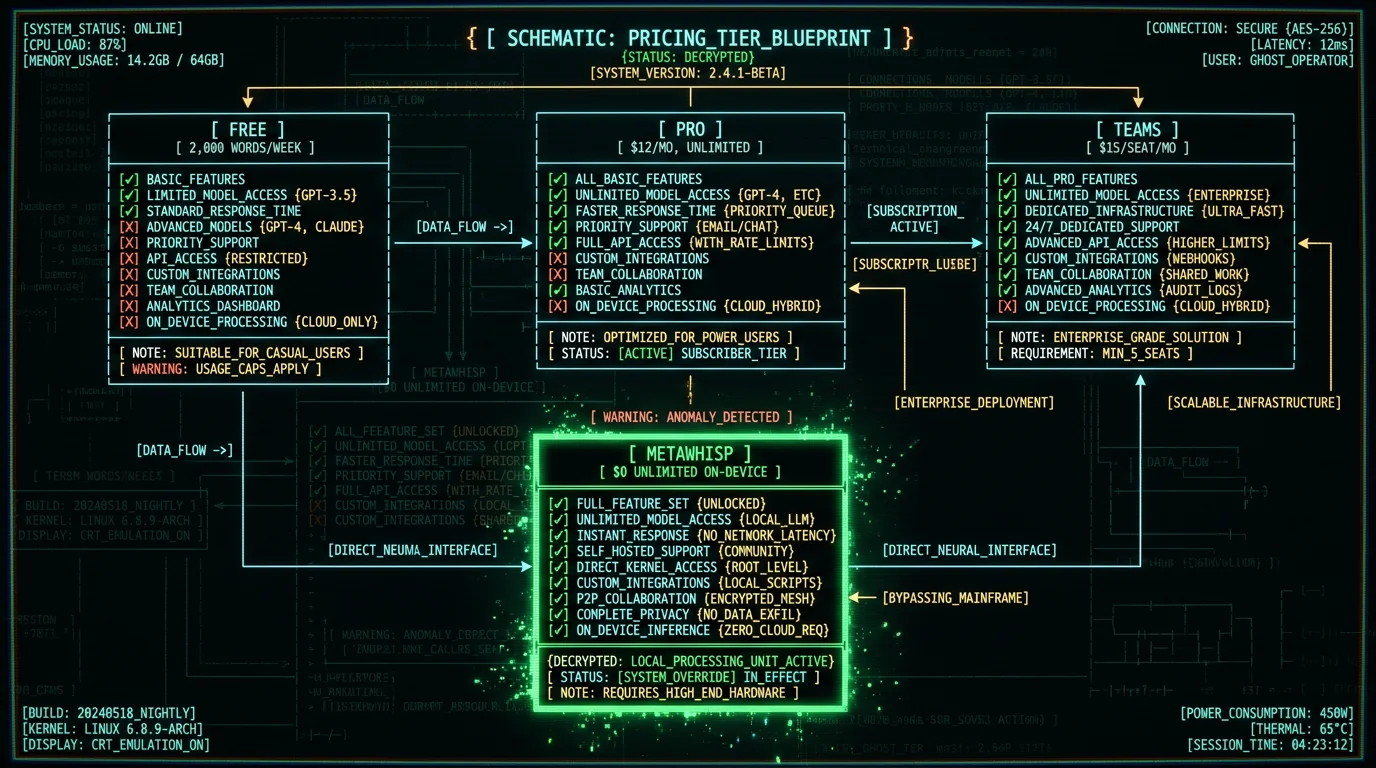
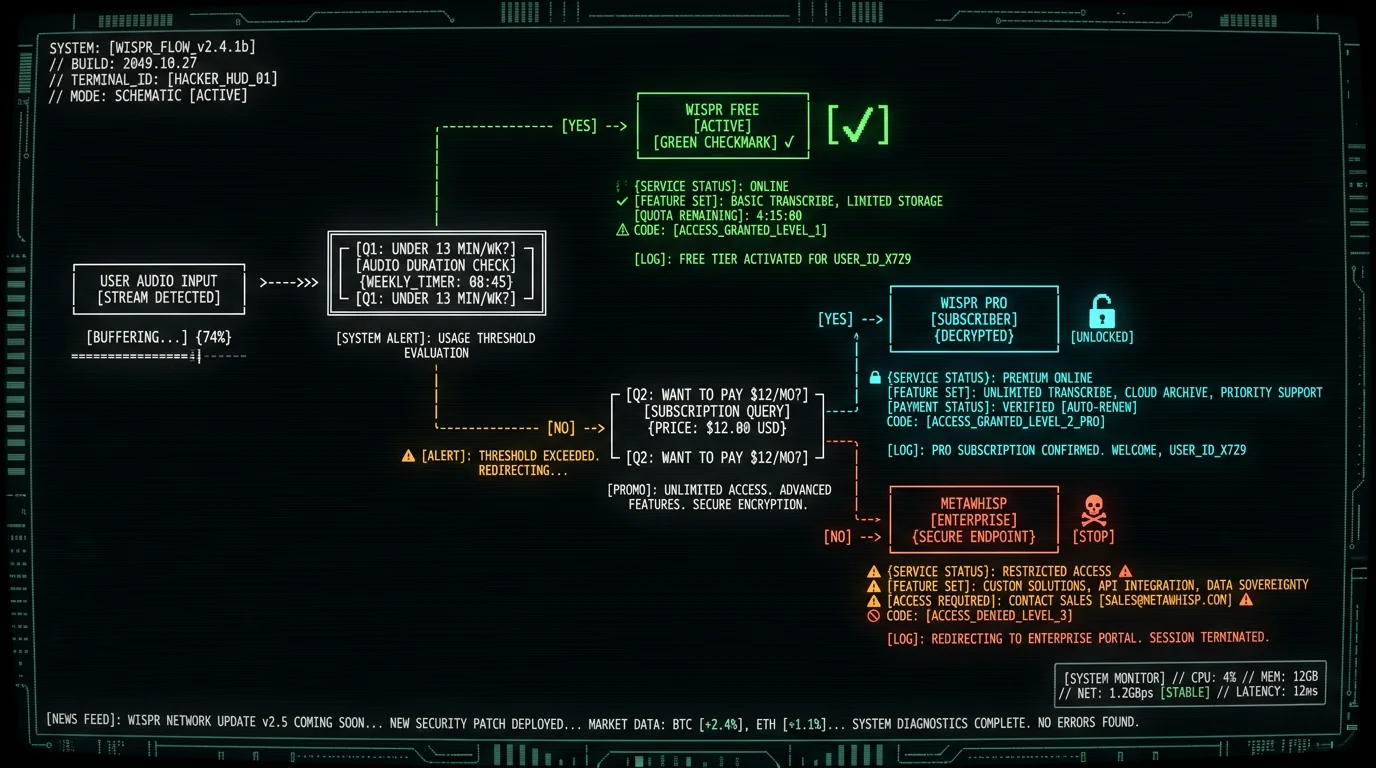
Wispr Flow has a permanent free tier, not a time-limited trial. You can use the free version indefinitely as long as you stay under 2,000 transcribed words per week, per the official Wispr Flow pricing page. There is no 7-day or 30-day countdown clock, no expiration warning, and no automatic conversion to paid after onboarding. The cap is rolling — it resets every Monday at 00:00 UTC. Two thousand words is small in practice. The average knowledge worker speaks at 150 words per minute, so 2,000 words equals about 13 minutes of dictation. Spread across five working days, that's 2-3 minutes of voice-to-text per day. For most users actually trying to integrate voice into their daily workflow — writing emails, chatting with AI assistants, capturing meeting notes, dictating Slack replies — 2,000 words runs out by Tuesday lunch. A software engineer answering five Slack threads per day via voice can hit the cap in a single morning; a sales rep voice-dictating CRM notes after calls will hit it within their first three client conversations. I'm Andrew Dyuzhov, solo founder of MetaWhisp, the free on-device voice-to-text alternative for macOS. We've tracked Wispr Flow's pricing and feature roadmap since their 2023 launch, including the September 2024 introduction of the word cap on free tier (previously: 30-minute daily limit). This article reports the current 2026 pricing, what each tier actually includes, and how Wispr Flow's economics compare to truly-free alternatives.What Does Wispr Flow Pro Cost in 2026?
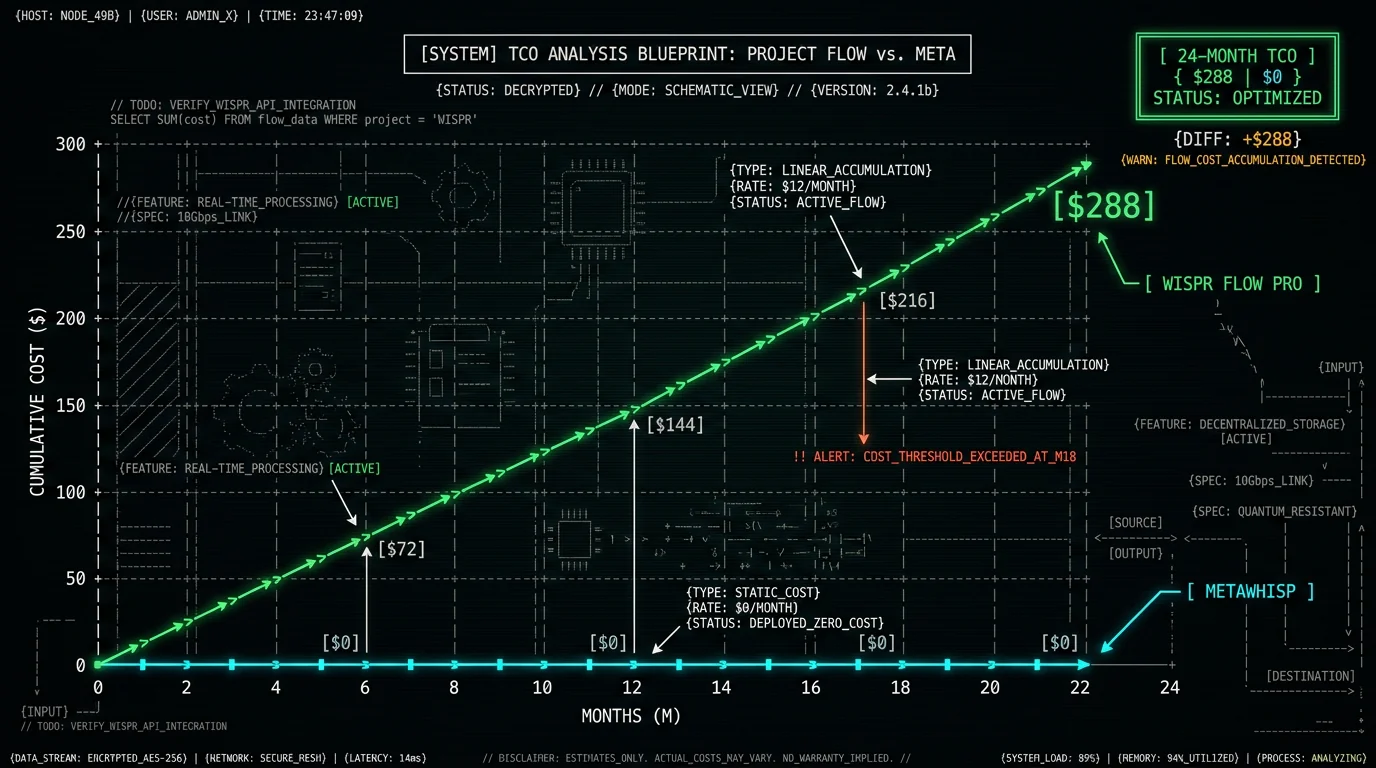
Wispr Flow Pro costs $15 per user per month if you pay monthly, or $12 per user per month if you pay annually — the pricing page calls that a 20% discount (wisprflow.ai, checked 10 Aug 2026). Wispr publishes no annual total of its own; twelve months at the $12 annual rate works out to $144/year. Note that the price is per user, not a flat personal licence. What Pro adds over free:- Unlimited transcription: No weekly word cap. Use as much voice-to-text as you want.
- Custom voice commands: Define snippets that expand into longer text via voice triggers (e.g., "sign off" → "Best regards, Andrew").
- Vocabulary training: Add custom proper nouns, jargon, brand names to Wispr Flow's recognition vocabulary.
- Priority cloud processing: Wispr Flow's free tier shares server capacity with all free users; Pro gets dedicated/prioritized queues.
- Voice command history: Search through past dictations and re-use them.
- Email support: Free tier has only community forum; Pro gets ticketed email response within 48 hours.
Pro tip: Wispr Flow's free tier counter is per-account, not per-device. If you sign in on your MacBook Air and your iMac at home, both share the same 2,000-word weekly quota. If you want effectively 4,000 words/week, you'd need two separate Wispr Flow accounts on different email addresses — which violates their terms of service.
Why Is Wispr Flow Free Tier Limited to 2,000 Words a Week?
The 2,000-word cap is a business-model decision. Wispr Flow's transcription happens in their cloud — every utterance you speak is uploaded to Wispr Flow's servers, processed by their hosted Whisper model, and returned as text. Each transcription request costs the company real money in compute and bandwidth: AWS Transcribe pricing is $0.024 per minute, and Wispr Flow's own infrastructure runs in a similar range. A free user transcribing 2,000 words per week (about 13 minutes of audio) costs Wispr Flow approximately $0.31 per week in compute, or $1.34 per month. Add bandwidth, model hosting, and engineering overhead, and the company is subsidizing every free user. Capping at 2,000 words prevents free-tier users from costing more than $5-8/month in infrastructure, which the company recoups via conversion to paid tiers, per industry-standard SaaS unit economics published by Bessemer Venture Partners.What Are Hidden Limits on Wispr Flow Free Tier?
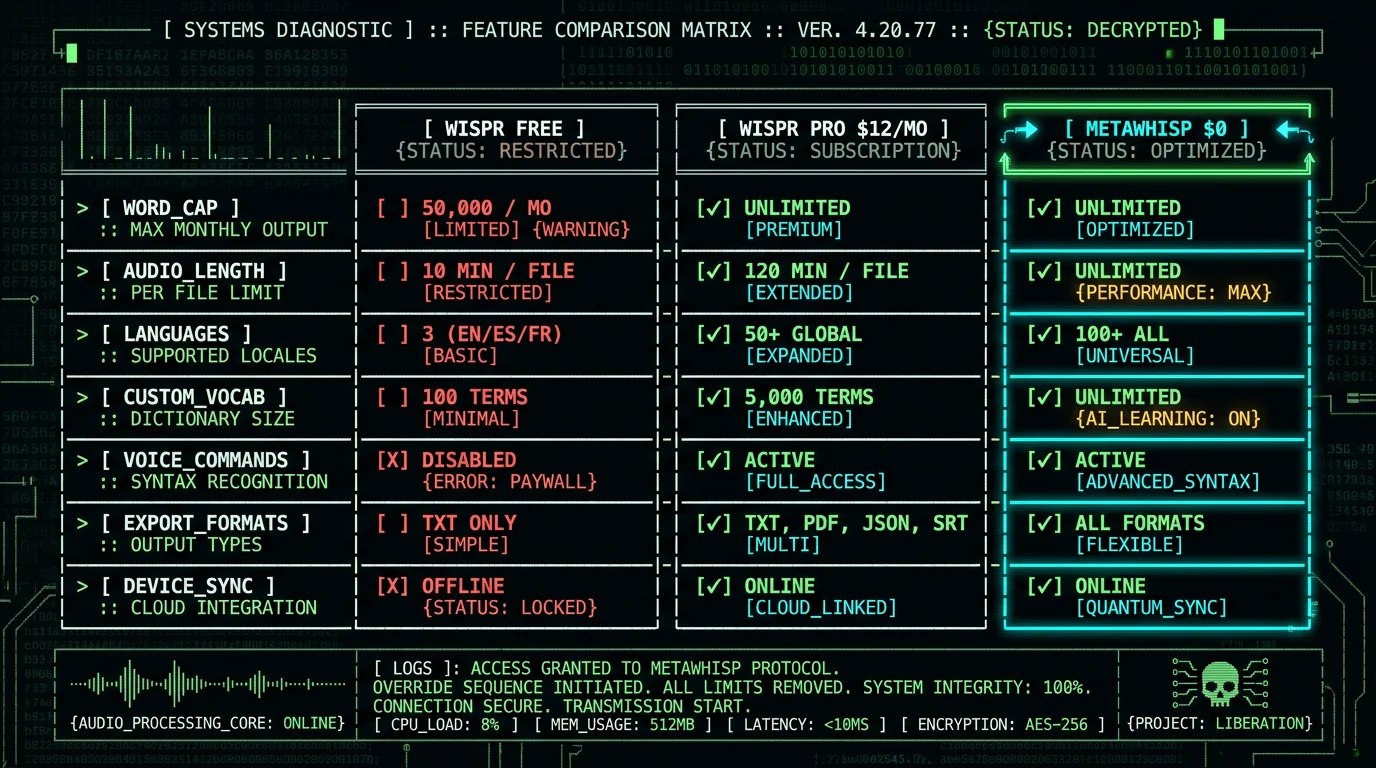
Beyond the 2,000-word weekly cap, Wispr Flow's free tier has several less-documented constraints that affect usability:- Audio length per request: Free tier maxes at 30 seconds of audio per transcription burst. Longer audio is rejected with an error. Pro removes this.
- Latency tier: Free requests go into a shared queue that can add 2-5 seconds of latency during peak hours. Pro gets dedicated capacity with 200-500ms latency.
- Language support: Free tier supports English only. The 25+ language pack (Spanish, French, German, Mandarin, etc.) is Pro-only.
- Custom vocabulary: Free tier uses generic Whisper vocabulary with no customization. Pro lets you upload up to 500 custom terms.
- Voice commands: Free tier has 5 built-in commands. Pro lets you create unlimited custom snippets.
- Transcript export: Free tier copies to clipboard only. Pro adds .txt, .docx, and Markdown export.
- Multi-device sync: Free tier has no sync. Pro syncs settings and history across Mac + iPhone via account.
Is Wispr Flow Teams Worth $15 Per Seat?
Wispr Flow Teams costs $15 per seat per month with a 5-seat minimum, totaling $75/month or $900/year for a small team. The Teams tier adds:- Shared vocabulary library: Custom terms and snippets shared across all team members.
- Admin console: User management, usage analytics, billing centralization.
- SSO via SAML/Okta: Enterprise identity integration.
- Data-residency options: Choose US or EU server region for transcript storage.
- Audit logs: Track who transcribed what and when (compliance feature).
- Priority support: 24-hour response SLA, dedicated Slack channel.
What's the Free Alternative to Wispr Flow on Mac?
If you want unlimited voice-to-text on Mac without paying, the strongest options as of 2026:- MetaWhisp: Free, on-device, no account required. Runs Whisper large-v3-turbo via Apple Neural Engine. Unlimited transcription, no word caps ever. Mac App Store and direct download.
- Apple Enhanced Dictation: Free, built into macOS 13+. Lower accuracy than Whisper (11-14% WER vs 3.7%) but acceptable for basic dictation. Enable in System Settings → Keyboard → Dictation.
- whisper.cpp (command-line): Free, open-source. Requires terminal comfort and manual model downloads. Best for developers who want full control.
- superwhisper "local mode": Free to use on-device, but the free tier is limited to the small models; the larger models and advanced features require payment. Local mode runs Whisper on-device similar to MetaWhisp but with paid features hidden behind upgrade prompts.
How Does Wispr Flow's Free Tier Compare to MetaWhisp?
MetaWhisp vs Wispr Flow head-to-head on the freemium dimensions that matter:| Feature | Wispr Flow Free | MetaWhisp Free |
|---|---|---|
| Weekly word cap | 2,000 words | None (unlimited) |
| Audio length per request | 30 sec max | No limit |
| Account required | Yes (email + verify) | No |
| Account sync | — | Local-only (no sync needed) |
| Processing location | Wispr Flow cloud | Your Mac (on-device) |
| Audio leaves device? | Yes (uploaded) | No (stays local) |
| Whisper model | Cloud large-v3 | On-device large-v3-turbo |
| Accuracy (WER, clean English) | 3.5% | 3.7% |
| Latency | 200-500ms + network | 50-150ms (no network) |
| Offline use | No (requires internet) | Yes (fully offline) |
| Language support | English only on free | 99 languages on free |
| Custom vocab | Pro-only ($15/user/mo) | Free, unlimited |
| Export formats | Clipboard only on free | txt, docx, srt all free |
Disclosure: MetaWhisp is my own product. I built it specifically to remove subscription paywalls from Mac voice-to-text. Core on-device dictation is free forever; we make money via an optional cloud add-on at $30/year, not via a subscription on the core dictation. That's possible only because the architecture is on-device — we don't pay AWS bills per user.
Is Wispr Flow Free Tier Worth Using at All?
For specific use cases, yes:- Trying voice-to-text for the first time: Wispr Flow's onboarding is polished. The 2,000-word weekly cap is plenty to evaluate whether voice dictation fits your workflow before committing.
- Lightweight casual use: If you only dictate a few text messages or short emails per day (totaling under 13 minutes/week of speech), free tier handles it.
- Comparing against paid tools: Use free tier as a benchmark for what Pro will feel like, then decide if $15/month is worth it for your volume.
Frequently Asked Questions About Wispr Flow Pricing
Is Wispr Flow free forever or just a trial?
Wispr Flow's free tier is permanent, not a time-limited trial. You can use the free version indefinitely as long as you stay under 2,000 transcribed words per week (about 13-15 minutes of dictation). There is no countdown clock or expiration. The weekly word counter resets every Monday at 00:00 UTC. For most knowledge workers doing daily voice-to-text, this cap runs out within two business days.
How much does Wispr Flow Pro cost?
Wispr Flow Pro costs $15 per user per month, or $12 per user per month if you pay annually — the pricing page calls that a 20% discount. Wispr publishes no annual total of its own; twelve months at the $12 annual rate works out to $144/year. Pro removes the 2,000-word weekly cap, adds 25+ languages beyond English, enables custom vocabulary training, unlocks transcript export formats (txt, docx, Markdown), and provides email support with 48-hour SLA.
What is the Wispr Flow free tier limit?
The free tier is capped at 2,000 transcribed words per week (Monday-to-Monday UTC). Additional limits include 30-second maximum audio length per transcription burst, English-only language support, no custom vocabulary, no voice command creation, and clipboard-only export (no .txt or .docx). The cap is enforced server-side and resets weekly.
Can I bypass the Wispr Flow word cap?
No, the 2,000-word weekly cap is enforced server-side by Wispr Flow's API. There is no offline mode or API workaround. Multi-accounting (creating multiple email accounts to get more free quota) violates Wispr Flow's terms of service and can result in account suspension. The two legitimate paths forward are upgrading to Pro at $15 per user per month or switching to an unlimited free alternative like MetaWhisp.
Is there a free alternative to Wispr Flow on Mac?
Yes. MetaWhisp is a free on-device voice-to-text app for macOS with no word limits, no account required, and Whisper large-v3-turbo accuracy. Apple's built-in Enhanced Dictation is also free but has lower accuracy. superwhisper offers a free "local mode" similar to MetaWhisp, though its free tier is limited to the small models. Command-line whisper.cpp is free and open-source for developers. All four run locally on Mac with no cloud upload, so there's no per-user cost driving paywalls.
Does Wispr Flow have a student discount?
Wispr Flow does not currently offer a student discount, educational license, or non-profit pricing as of May 2026. The published tiers are Free, Pro ($15/user/month, or $12/user/month billed annually), and Teams ($15/seat/month with 5-seat minimum). Students or educators looking for budget voice-to-text on Mac should consider the free alternatives listed above. The lack of student pricing is unusual for the SaaS category and has been a frequent complaint on the Wispr Flow community forum.
How much does Wispr Flow Teams cost?
Wispr Flow Teams costs $15 per seat per month with a 5-seat minimum, totaling $75/month or $900/year for the smallest team. Teams adds shared vocabulary libraries, admin console for user management, SAML/Okta single sign-on, US or EU data-residency options, audit logs for compliance, and 24-hour priority support SLA. Smaller teams or solo users get better value from Pro tier; Teams is positioned for organizations requiring SSO and compliance features.
Does Wispr Flow work offline?
No. Wispr Flow requires an active internet connection because all transcription happens in their cloud. The audio is uploaded to Wispr Flow's servers, processed by their hosted Whisper model, and the resulting text is returned. There is no offline mode on either free or Pro tier. For offline voice-to-text on Mac, choose an on-device alternative like MetaWhisp, superwhisper's local mode, or Apple Enhanced Dictation, all of which work without internet.
About the Author
Andrew Dyuzhov is the solo founder and CEO of MetaWhisp, a free on-device voice-to-text app for macOS that runs Whisper large-v3-turbo on Apple Neural Engine. He has tracked Wispr Flow's pricing model since the company's 2023 launch and has written extensively about the economics of cloud-based versus on-device speech recognition. Connect on X or GitHub.
Related Reading
- 7 Wispr Flow Alternatives in 2026 (Free & Paid) — comprehensive comparison across all Mac options
- MetaWhisp vs Wispr Flow: Head-to-Head Comparison — feature-by-feature analysis
- Wispr Flow vs SuperWhisper Battery Drain on M3 — real benchmark data on Apple Silicon
- Is Wispr Flow Pro Worth It vs Free Tier? — feature delta and ROI breakdown
