
TL;DR: Wispr Flow is, by architecture, a cloud voice-to-text app. Your audio leaves your Mac, is processed on Wispr Flow's servers (and is routed through their third-party AI providers) to generate a transcript. Wispr Flow is not deceptive about this — it's in their privacy policy. Whether that matters depends on what's in your audio and which tier you use. Below I read Wispr Flow's public docs so you don't have to, link the real sources, and lay out the honest case for when on-device voice-to-text on Mac is the right move instead.
What people actually mean by "Wispr Flow security concerns"
If you Google the phrase, you'll mostly find two flavors of complaint, and they're worth separating.
The first is technical: people worried that an always-listening dictation app is sending their mic audio somewhere they didn't expect. That's a fair default worry in 2026, after a decade of smart-speaker paranoia and the steady drip of consumer-AI privacy stories. Wispr Flow's product model is built around sending audio to a server — there is no local-only mode in the consumer product today. So if that's a deal-breaker for you, no amount of policy reading will change the architecture.
The second flavor is contractual: people reading the privacy policy and not loving what they see. Things like "we may retain audio for X days to improve our models," or "we use third-party subprocessors," or "your data may be processed in regions with different laws than yours." These are not unique to Wispr Flow — they're standard for cloud STT — but they're real and worth understanding before you dictate your therapy notes, your client email, or your unreleased product idea.
I'm not going to invent Reddit threads or quote posts. I'll point you at Wispr Flow's own public documents and walk through what they actually say. Verify on the live page — privacy policies change.
What Wispr Flow's privacy policy actually says
Per Wispr Flow's published privacy policy (linked — go read it yourself, it updates), the relevant pieces are:
- Audio is processed on their servers. The policy describes audio being uploaded from the desktop or mobile client to Wispr Flow's backend to produce a transcript. That upload is necessary for the product to work. It is not an undisclosed behavior.
- Third-party AI providers are used. The policy names subprocessors — including large model providers — used to generate the final transcript or to apply AI text editing. That means at least two companies see your audio, not just Wispr.
- Data is retained for some period. Cloud STT products don't delete audio the instant the transcript returns; the policy describes retention windows and the circumstances under which audio is kept for product improvement, debugging, or legal reasons. The exact window is in the policy text — I won't paraphrase a number I might misremember.
- An opt-out for model training exists. Most cloud STT vendors (OpenAI's API included) give you a way to opt out of having your data used for model training. Wispr Flow's policy describes settings or account controls that turn this off. Turn it on if you care.
- Encryption in transit and at rest. Standard TLS for transport and encryption at rest on their infrastructure. This is table stakes, not a differentiator.
None of this is scandalous. Wispr Flow is honest about being cloud, and the security posture is roughly what you'd expect from a Y-Combinator-era SaaS that handles audio. But "honest about it" is not the same as "fine for your use case." That's the question you have to answer yourself.
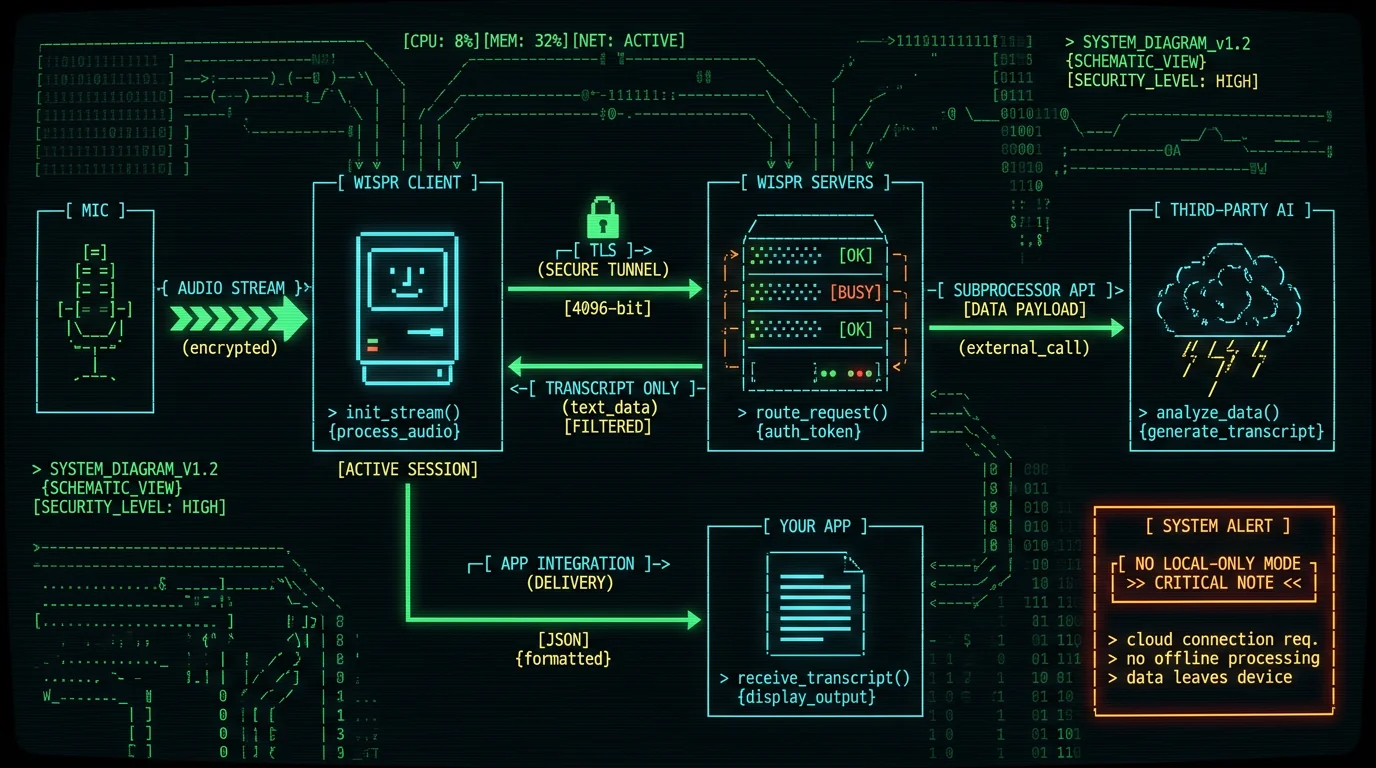
What Wispr Flow's policy actually tells you, in one pass. The policy is a few thousand words of legal language; here is the sentence-level summary a reader needs. First, audio is uploaded to Wispr Flow's backend — this is the product's architecture, not a footnote. Second, at least one named subprocessor receives the audio to generate the transcript, so two companies see the audio, not one. Third, audio and transcripts are retained for a defined window after generation, not deleted as soon as the transcript is delivered. Fourth, the policy describes an opt-out for using your audio to train or fine-tune models; it is not on by default. Fifth, transport-layer encryption (TLS) and disk-level encryption are in place, which is standard for cloud infrastructure. None of these five facts is hidden; together they describe a cloud STT product that meets industry expectations. The question is whether industry expectations match the expectations of your clients, your regulator, or your own conscience.
Where your audio actually goes
The honest data flow. You speak into your Mac's mic. The Wispr Flow client records locally, then uploads the audio over TLS to Wispr Flow's backend. Wispr Flow's backend may use its own speech models or forward the audio to a named third-party AI provider (per their published subprocessor list) to produce the transcript. The transcript is returned to your client and pasted into your active app. During this round-trip, your raw audio exists in memory — and likely on disk for some retention window — on servers you do not control. The transcript itself also passes through those servers, which means the same vendors see a written version of what you said even if the audio is later deleted on schedule. None of this is hidden; it is described, in plain language, in Wispr Flow's published privacy policy, and the absence of a local-only mode in the consumer product is consistent with what the policy describes. The architectural choice is the product.
That last sentence is the one that matters. The transcript returns to your Mac. The raw audio lived on someone else's hardware. If your audio is "I need to buy oat milk" it doesn't matter. If your audio is "Patient reports chest pain, prescribing…" it matters a lot. The product doesn't know the difference.
Data retention, model training, and the "delete" question
Three questions people ask in roughly this order:
How long do they keep my audio? The policy specifies a retention window for audio used to generate transcripts — usually days to weeks, with longer retention only for accounts or content explicitly flagged (e.g. abuse review). Treat this as approximate; check the current policy for the number.
Do they train models on my audio? Cloud STT vendors typically train models on de-identified usage data unless you opt out. Wispr Flow's policy describes an opt-out mechanism, usually in account settings or via a request to their support/DPO email. Use it.
If I delete the transcript, is the audio gone? Usually no — at least not instantly. Deleting from the app deletes from your view; the backend retention window still applies. For real deletion, you typically need to request it via the vendor's data-subject request process, which is mandated by GDPR and CCPA but not instant.
Pro tip: Before you dictate anything you wouldn't email unencrypted, open the vendor's privacy policy, search for "retention" and "training," and screenshot the relevant paragraphs. If the policy is vague, the product is vague, and your data's safety is vague.
What this means in practice. Treat the privacy policy as a contract, not a brochure; the wording controls what happens to your audio more than any blog post or testimonial. The practical moves are similar regardless of which cloud STT vendor you use. Find the retention window in the policy, because "soon" is not a number. Locate the opt-out for model training before you start dictating; toggling it later may not retroactively exclude already-collected audio. Request data deletion in writing — to a DPO or privacy email, not via chat — and keep the response, because verbal promises do not constitute compliance evidence. Ask about region-pinning and subprocessors before you commit, especially if your clients are in jurisdictions stricter than yours. Do not assume enterprise plans solve every concern by default; they often add a DPA and a SOC 2 report, but the architecture does not change. These few moves are how a marketing claim becomes a defensible position.
Enterprise tier, SOC 2, and the "we have a DPA" answer
Wispr Flow sells an enterprise / teams tier, and the marketing around it leans on security certifications. If you're at a company evaluating it, the meaningful questions aren't "is the consumer policy fine" — they are:
- Do they sign a DPA? Required for GDPR compliance. Most credible cloud vendors will, with the right tier.
- SOC 2 Type II report? A real third-party audit of their controls. Ask for the report under NDA — don't accept a "we're SOC 2" badge on a webpage as proof.
- Where does data live? Region-pinning matters for some compliance regimes. Confirm they can pin processing to your jurisdiction.
- Subprocessor list? You want to know every third party that touches audio, in writing.
- Data deletion SLA? "We'll delete within 30 days of request" beats "we'll delete eventually."
These are not Wispr-Flow-specific questions. They're the questions you ask any cloud vendor handling voice. If a vendor can't answer them clearly, that's the answer.
What to do right now, depending on who you are
If you're a casual user dictating grocery lists and Slack messages: Wispr Flow is fine. Cloud STT is the dominant model for good reason — the accuracy is excellent, the polish is real, and the privacy posture is reasonable for non-sensitive material.
If you handle client-confidential information as a freelancer or small-firm operator: read the policy, turn off model-training if you can, prefer the enterprise tier, and consider whether your client contract lets you send audio to a third party's servers at all. Many will. Some won't.
If you handle legally privileged, medically protected, or otherwise regulated information: cloud STT is a hard sell. A cloud vendor cannot be HIPAA-compliant on your behalf — compliance belongs to the covered entity — but using a cloud STT means audio is on infrastructure you don't control, and the policy controls the situation, not your malpractice carrier. The HHS guidance on HIPAA and cloud services is worth reading if this is you: hhs.gov cloud computing guidance.
If you just want voice-to-text that doesn't leave your machine: that's a different category of tool. Wispr Flow alternatives built on Whisper running on the Apple Neural Engine — like MetaWhisp — exist specifically because "send my audio to a third-party server" is a non-starter for some work.
When on-device voice-to-text on Mac is the right answer
I built MetaWhisp, so I'll be biased here, but I'll be specific about the bias: MetaWhisp's free local mode runs Whisper large-v3-turbo on the Mac's Neural Engine. The audio never leaves the device. There's no account, no telemetry, and no server. The model download is around 950 MB and runs entirely on Apple Silicon.
You give up a few things going local. You don't get cloud-class polish on the text by default — though you can pipe the local transcript through your own OpenAI or Cerebras key using MetaWhisp's processing modes, which keeps audio local and only sends the transcript text to your own API. You don't get cross-device sync. And on the oldest Apple Silicon (an M1 with 8 GB of RAM) latency is fine but not magical.
What you get in return is the only thing some work actually requires: a transcript where the audio was never on a server. For therapy notes, legal memos, unreleased product specs, source code, healthcare dictation, or anything where "we sent your voice to a third-party processor" would be a bad sentence in a deposition — that's the property you want.
The full head-to-head is in MetaWhisp vs Wispr Flow, including the WER numbers from my own 7-app test. Grab MetaWhisp free if you want to feel the difference; it runs on macOS 14+ on M1 or later.
| Property | Cloud STT (Wispr Flow, others) | On-device (MetaWhisp local mode) |
|---|---|---|
| Audio leaves device | Yes — to vendor and subprocessors | No |
| Account required | Yes | No |
| Data retention control | Per vendor policy + opt-out | N/A — nothing leaves the device |
| Model training opt-out | Yes, but you have to remember | No data to train on |
| Accuracy (my test, WER) | ~3.5% (Wispr Flow) | ~3.7% (MetaWhisp) |
| Works offline | No | Yes (after model download) |
| Cost | Free tier + Pro plan (see vendor pricing) | Free local mode unlimited |
The fair summary
Wispr Flow is a well-engineered cloud product that's transparent about being cloud. If you're worried about Wispr Flow security, the worry is usually "this whole category ships my voice to a server," not "this vendor is hiding what it does." For most consumer use cases, that's a fine tradeoff. For work where the wrong person hearing the audio is a problem — legal, medical, financial, source code, anything NDA'd — the right answer is a tool that doesn't send audio out at all. Read the policy, pick accordingly, and don't dictate anything onto a cloud server you wouldn't email unencrypted.
Whichever way you go, the goal is the same: useful transcripts, without surprises.
FAQ
Is Wispr Flow secure?
Per their public policy, Wispr Flow uses TLS in transit, encryption at rest, and standard cloud-vendor controls. "Secure" in the sense of "not obviously negligent" — yes. "Secure" in the sense of "your audio never leaves your device" — no, that's not the architecture. Check their current privacy policy for specifics.
Does Wispr Flow send audio to the cloud?
Yes. Cloud processing is how the product works. The audio is uploaded to Wispr Flow's backend and may be routed to named subprocessors (third-party AI providers) to generate the transcript. There is no local-only mode in the current consumer product.
Does Wispr Flow store my voice recordings?
Per their policy, yes — for a defined retention window. The exact window is specified in the policy and may differ between consumer and enterprise tiers. You can request deletion via their data-subject process, but it's not instantaneous.
Does Wispr Flow use my audio to train AI?
Most cloud STT vendors reserve the right to use de-identified data for model improvement unless you opt out. Wispr Flow's policy describes an opt-out. Find it in account settings or contact their support/DPO and ask.
Is Wispr Flow HIPAA compliant?
HIPAA compliance belongs to the covered entity (your practice), not the app. No vendor can make you HIPAA-compliant by signing up. That said, using a cloud STT means protected health information is on a third-party server, which raises significant questions regardless of what the vendor's marketing says. See the HHS cloud guidance. For PHI, on-device STT is usually the more defensible choice.
Is Wispr Flow SOC 2 certified?
Wispr Flow's enterprise marketing references SOC 2. Treat marketing claims as a starting point, not proof. Ask for the actual report under NDA and read the scope, period, and any exceptions.
How do I delete my Wispr Flow data?
Deleting transcripts in the app deletes them from your view. For backend deletion (audio, account data), use the vendor's data-subject request process — typically an email to their privacy or DPO address. Expect it to take days, not minutes.
What is the most secure voice-to-text app for Mac?
For sensitive work, the most secure category is on-device voice-to-text — apps that run Whisper locally on the Neural Engine and never send audio off the Mac. MetaWhisp is one such app (free local mode, no account, no telemetry). Accuracy in my own head-to-head test is in the same range as cloud leaders.
Should I use Wispr Flow for sensitive work?
Only after reading their current privacy policy, confirming the retention and training opt-outs are configured, and checking whether your client contract or regulatory regime permits cloud STT at all. For legally privileged, medical, financial, or NDA'd material, on-device is the more defensible default.
One last thing. The reason security concerns about Wispr Flow keep coming up is not that the vendor is doing something shady — it's that "send your voice to our cloud" is a big architectural fact that gets glossed over when a product is marketed as frictionless. That architectural fact isn't bad, but it should be a conscious choice, not a surprise. The principle applies beyond Wispr Flow: every cloud STT app that ships audio to a server carries that exposure. Vendors differ in retention windows, subprocessor lists, training opt-outs, and enterprise controls — but the architectural shape is shared. So when you evaluate any dictation tool, do not ask only which is most accurate. Ask how the audio leaves your device, who can see it on the way out, whether you can turn off model training, and whether your jurisdiction's privacy laws treat that handoff the way you do. Pick the tool that matches the work.
About the author. Andrew Dyuzhov is the solo founder of MetaWhisp, a free on-device voice-to-text app for macOS. He runs it on his own M1 Air, dictates daily in Russian and English, and writes about voice-first workflows because he has ADHD and hates typing. He's not a lawyer, a doctor, or a security researcher — just a marketer-turned-builder who reads privacy policies so you don't have to. @hypersonq on X.
