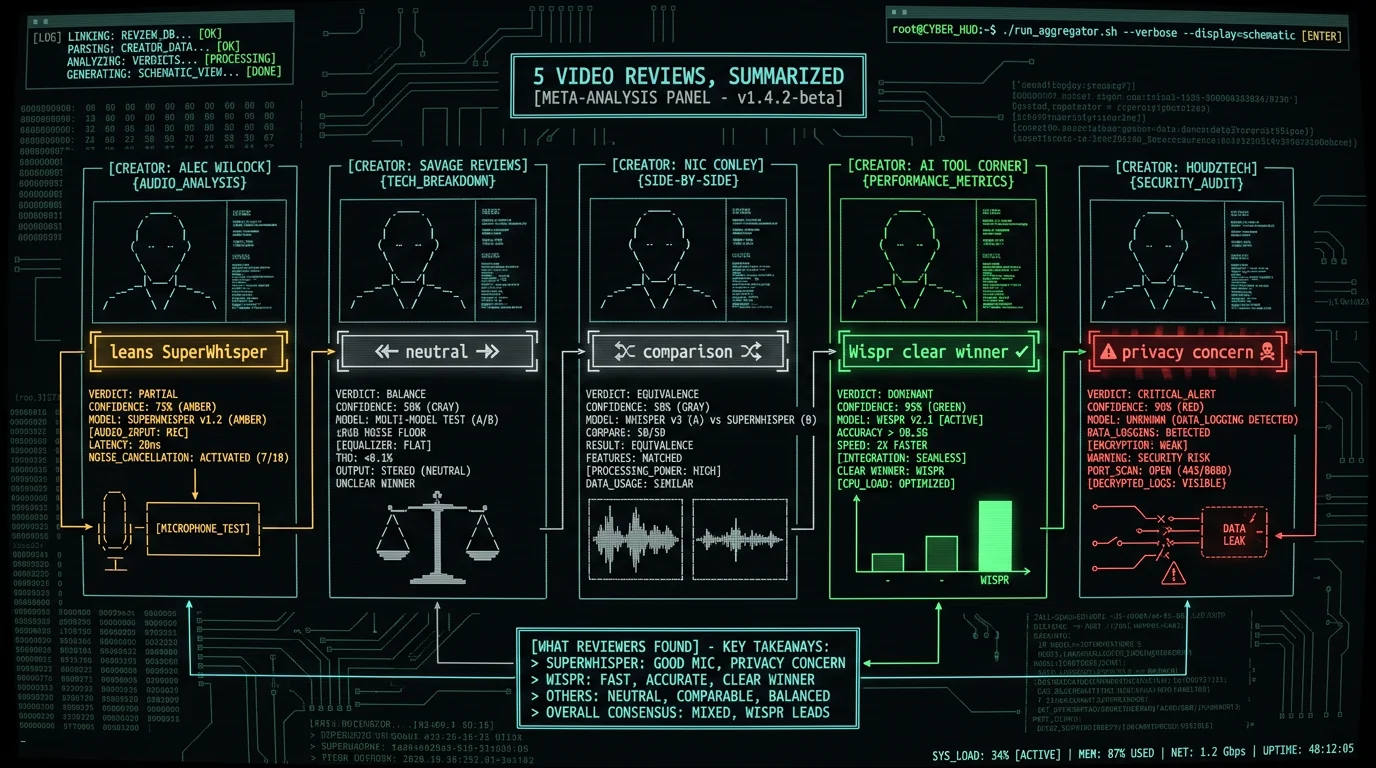
How We Analyzed These Reviews
Rather than rehash marketing claims, we pulled the transcripts of five YouTube Wispr Flow reviews and read what creators actually said on camera. Reading what reviewers conclude after weeks of real use cuts through the marketing on both sides. The five reviews analyzed:- Alec Wilcock — "Best AI Dictation App: Wispr Flow vs Superwhisper" (a self-described 9-month Wispr Flow power user)
- AI Tool Corner — "Why Wispr Flow Is the Best AI Voice Dictation App"
- Nic Conley — "Top 3 AI Dictation Tools Compared" (Wispr vs SuperWhisper vs MacWhisper vs Apple)
- Savage Reviews — "Wispr Flow vs Superwhisper Review"
- houdztech — "Wispr Flow vs Superwhisper Review"
| Reviewer | Length | Leaning | Standout point |
|---|---|---|---|
| AI Tool Corner | ~23 min | Pro Wispr Flow | "Clear winner" — best context detection |
| Alec Wilcock | ~15 min | Leans SuperWhisper | 9-month user; value favors SuperWhisper |
| Nic Conley | ~21 min | Comparison | Tests Wispr/SuperWhisper/MacWhisper vs Apple |
| Savage Reviews | ~2 min | Neutral | Free tier "tight for power users" |
| houdztech | ~2 min | Privacy concern | Wispr "sends your voice to cloud servers" |
What Reviewers Agree On
Across all five reviews, a few points came up repeatedly: The AI cleanup is the killer feature. Every reviewer praised how Wispr Flow removes filler words and formats text per context. AI Tool Corner noted it writes code function names in the right case automatically — "the AI is smart enough to understand what I'm talking about." The shift from old dictation (wrong punctuation, mangled words) to AI-cleaned output is what makes these tools feel new. Dictation is much faster than typing. Multiple reviewers cited the "4x faster than typing" framing, and AI Tool Corner put it plainly: you speak at least three times faster than you type. This is the core appeal that the reviews consistently validate. The free tier is tight. The 2,000-words-per-week free cap drew consistent criticism. Savage Reviews called it potentially tight for power users, and Alec Wilcock — a 9-month user — said you can burn through it in just a few days of real use.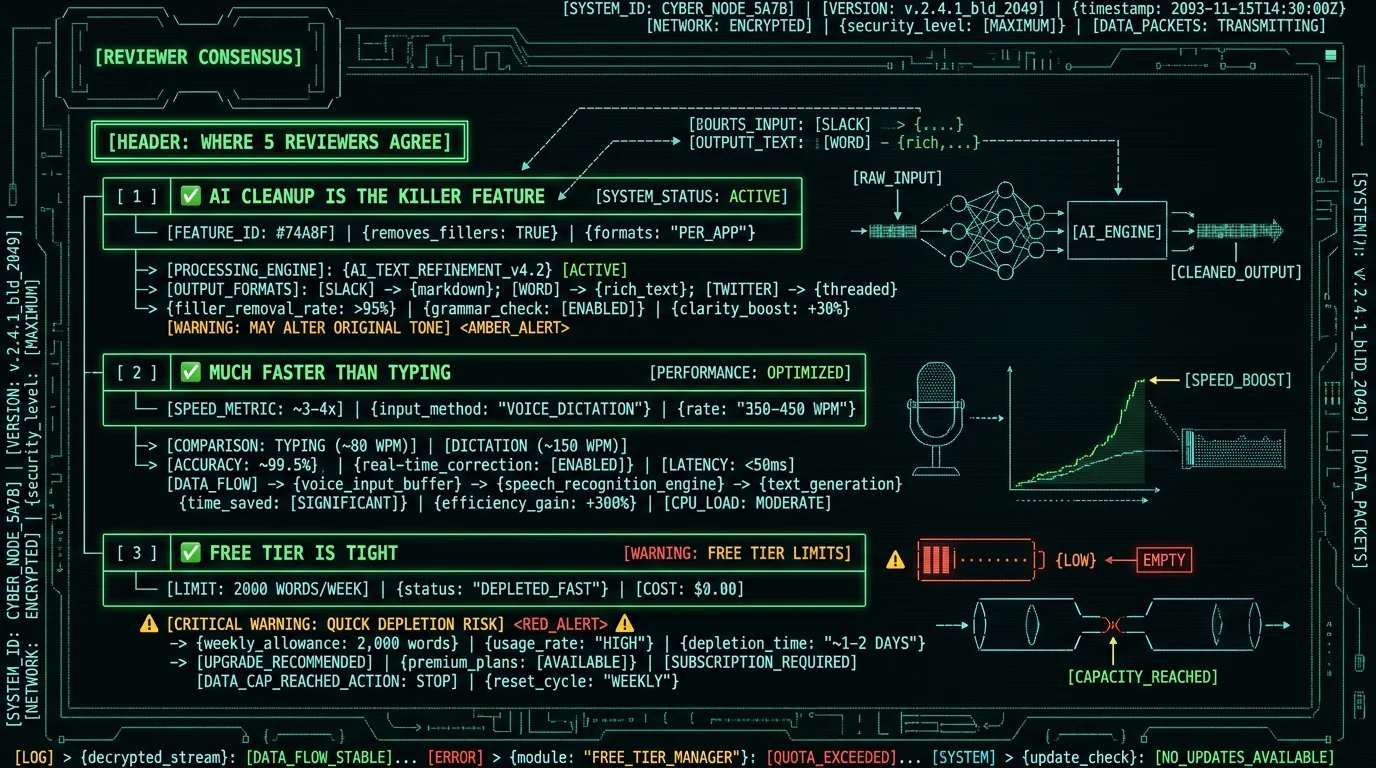
Where Reviewers Split: Wispr Flow vs SuperWhisper Value
The clearest disagreement was on whether Wispr Flow is worth its price versus SuperWhisper. Team Wispr Flow: AI Tool Corner was unequivocal, calling Wispr Flow "the clear winner" for its speed, accuracy, and best-in-class context detection, plus its broad platform support (Windows, Mac, iOS, Android). Team SuperWhisper: Alec Wilcock, despite being a long-time Wispr Flow user, leaned toward SuperWhisper on value — it was roughly 43% cheaper monthly in his comparison, and its lifetime plan (then $249.99) appealed to him because, as he put it, dictation is a tool he'd use indefinitely and paying $144 every year feels steep. The privacy angle: houdztech framed the split around architecture, noting "Whisper Flow sends your voice to cloud servers" while SuperWhisper keeps data local — calling privacy a "huge" differentiator. So the reviews don't deliver a single verdict, and that's the honest finding: Wispr Flow wins on polish and platform breadth, SuperWhisper wins on price and privacy. Which matters more is your call. (Note: SuperWhisper's lifetime price has since risen well above the $249.99 mentioned in the older review — verify current pricing.)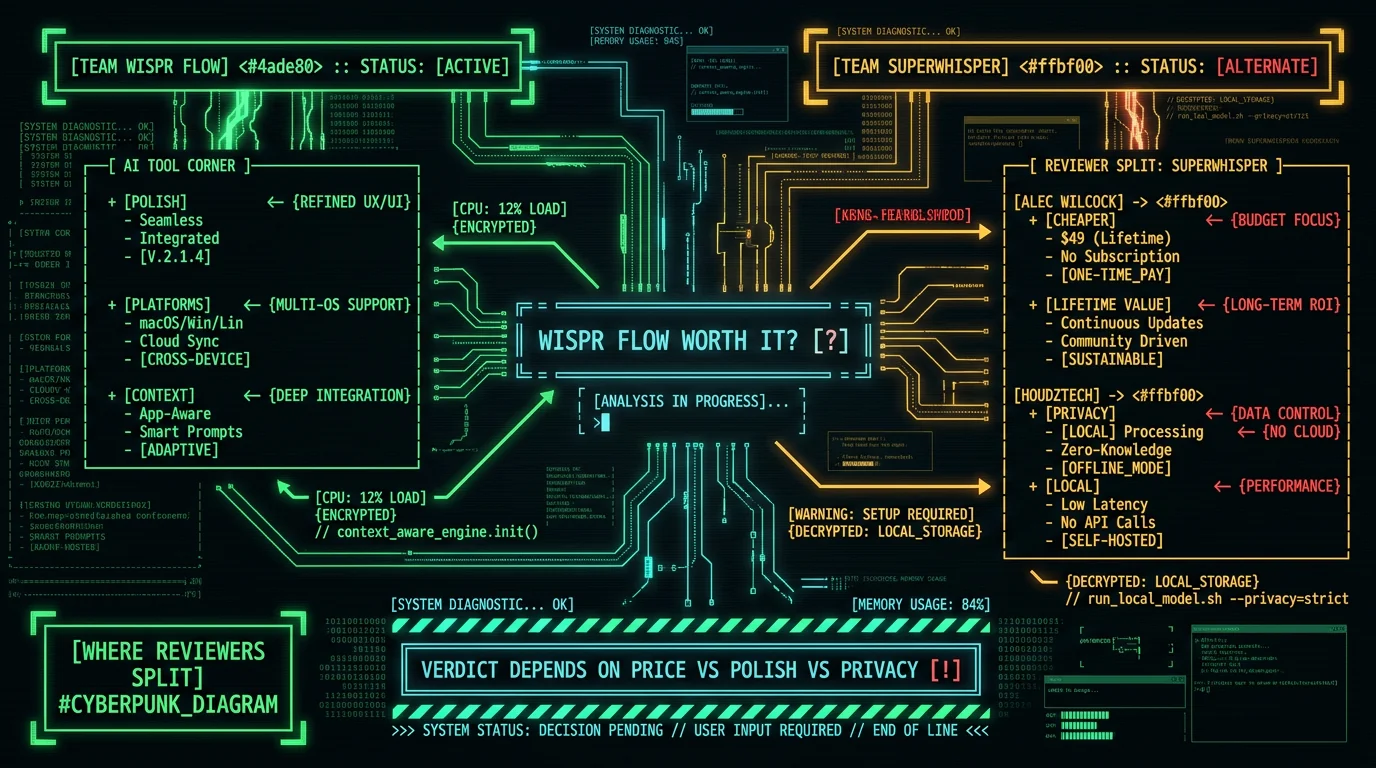
What Almost Every Video Review Misses
Here's the gap across these reviews: only houdztech meaningfully raised the privacy architecture, and even that was brief. None went deep on Wispr Flow's screenshot-capture behavior — the context-awareness feature that periodically captures your active window and uploads it, documented in a viral May 2026 incident. This is a common blind spot in video reviews generally. Reviewers test the feature that's marketed (fast, accurate dictation) and rarely audit what the app does in the background. The screenshot capture matters because it's not just "cloud upload of audio" — it's "upload of whatever is visible on your screen during dictation," which is a different and larger privacy surface. For most casual dictation, this doesn't matter. For anyone handling confidential content — health, legal, financial, journalistic — it's the most important fact about the tool, and it's the one the reviews skip. We covered it in depth in our screenshot capture explainer and is Wispr Flow safe analysis.What These Reviews Mean If You're Choosing a Dictation Tool
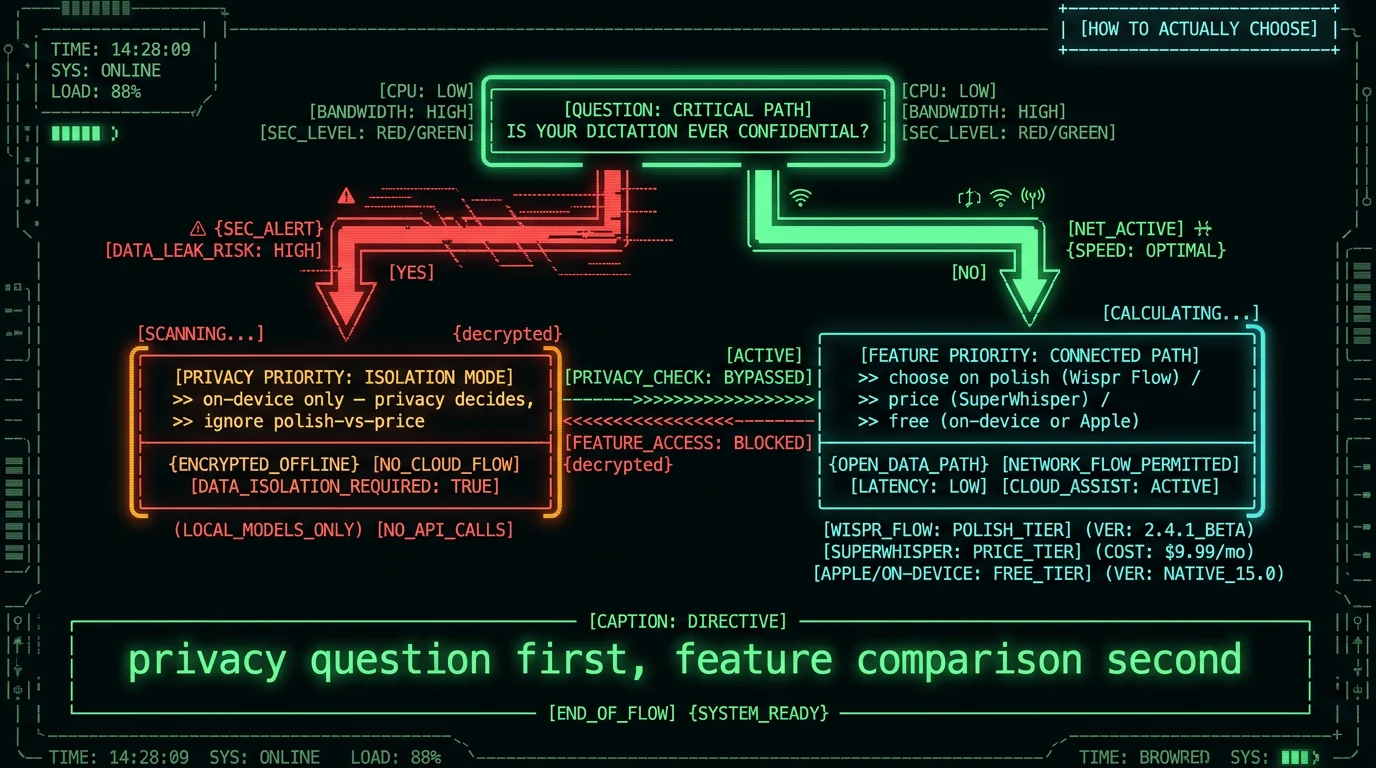
Synthesizing all five reviews into practical guidance:- If you type a lot and want polish — the reviews validate that Wispr Flow delivers fast, well-formatted dictation. AI Tool Corner's "clear winner" take reflects the polished experience.
- If price matters — multiple reviewers found SuperWhisper meaningfully cheaper, and Alec Wilcock's value analysis leaned that way.
- If you dictate heavily — every reviewer flagged the free tier as tight; budget for a paid plan or a genuinely free tool.
- If privacy matters — houdztech's point stands and goes further than the reviews explored: cloud tools upload your audio (and Wispr Flow, your screenshots). On-device tools don't.
- If you want free and private — the reviews don't cover this well, but a free on-device tool like MetaWhisp sidesteps both the free-tier cap and the cloud-privacy trade-off the reviewers raised.
Frequently Asked Questions
Is Wispr Flow worth it according to reviewers?
Reviewers split. AI Tool Corner called Wispr Flow the "clear winner" for polish and platform breadth. Alec Wilcock, a 9-month user, leaned to SuperWhisper on value (cheaper, lifetime plan). The consensus is that AI dictation genuinely works and is worth adopting; the specific tool depends on whether you prioritize polish (Wispr Flow), price (SuperWhisper), or privacy (on-device tools).
What do reviewers dislike about Wispr Flow?
The most consistent gripe is the free tier's 2,000-words-per-week cap, which reviewers called tight for power users — a 9-month user said you can exhaust it in a few days. Some noted occasional system-integration hiccups. The bigger issue most reviews miss is the screenshot capture and cloud-privacy trade-off, which matters most for confidential work.
Wispr Flow or SuperWhisper — which do reviewers prefer?
It's genuinely split. Reviewers favoring Wispr Flow cite its polish, context detection, and cross-platform support (Windows, Mac, iOS, Android). Reviewers favoring SuperWhisper cite its lower price (roughly 43% cheaper monthly in one comparison), lifetime plan option, and on-device privacy. SuperWhisper is Mac/iPhone-only. The right pick depends on whether polish, price, or privacy matters most to you.
Do YouTube reviews mention Wispr Flow's privacy?
Mostly only in passing. Of five reviews analyzed, only houdztech raised it meaningfully, noting Wispr Flow "sends your voice to cloud servers" while SuperWhisper stays local. None went deep on the screenshot-capture behavior. This is a common video-review blind spot — background data collection is invisible during normal feature testing, so it rarely gets covered.
Is the Wispr Flow free plan enough?
According to reviewers, not for heavy use. The free tier caps at 2,000 words per week, resetting weekly. A 9-month power user said this gets exhausted in two or three days of real use. It works as a trial to evaluate the tool, but heavy daily dictation quickly hits the limit — pushing you to the $15/month plan or a genuinely free alternative.
How were these review insights gathered?
We worked from the transcripts of five YouTube Wispr Flow reviews, then summarized what creators said with short attributed quotes and links to each video. This isn't a reproduction of the videos — it's an original summary surfacing opinions that text-based search can't otherwise see. Watch the linked originals for each reviewer's full take.
About the Author
Andrew Dyuzhov is the solo founder and CEO of MetaWhisp, a free, open-source, on-device voice-to-text app for macOS that runs Whisper large-v3-turbo locally via WhisperKit. He summarized five reviews in this article from their transcripts — a competitor summarizing competitors' reviews, which is why it leads with that disclosure, keeps quotes short and attributed, and links every source video. Connect on X or GitHub.
Related Reading
- Wispr Flow Review 2026 — our own standalone review
- Wispr Flow vs SuperWhisper — the comparison reviewers split on
- Is Wispr Flow Safe? — the privacy angle reviews skip
- Wispr Flow Screenshot Capture — the issue video reviews miss
- Best Local Transcription Apps for Mac — free and private options
