Hours of family tapes. Per-minute bills. A Mac sitting on the desk. Here's the math.
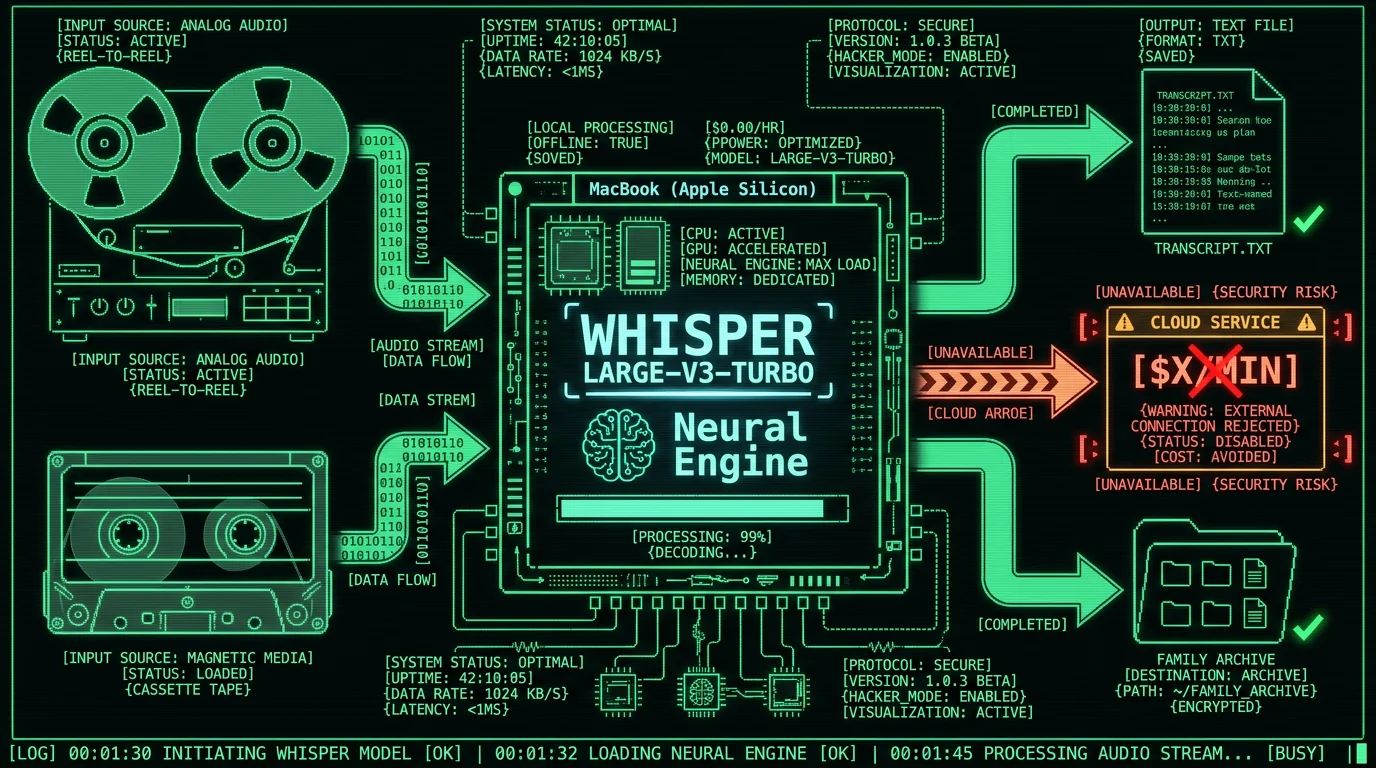
What counts as an oral history transcription service in 2026?
Why do per-minute services get expensive on hours of tapes?
Can you transcribe oral history yourself on a Mac?
Yes, and on Apple Silicon (M1, M2, M3, M4, M5) the experience is genuinely usable in 2026. Local transcription on Mac has matured a lot since the original Whisper release — OpenAI's Whisper model runs through WhisperKit directly on the Neural Engine, no GPU server required, no daemon eating your battery. The first-party model MetaWhisp ships is Whisper large-v3-turbo, which OpenAI published as a faster variant of large-v3. You download roughly 950 MB once, the model lives in your user folder forever, and after that every minute of audio you throw at it is free.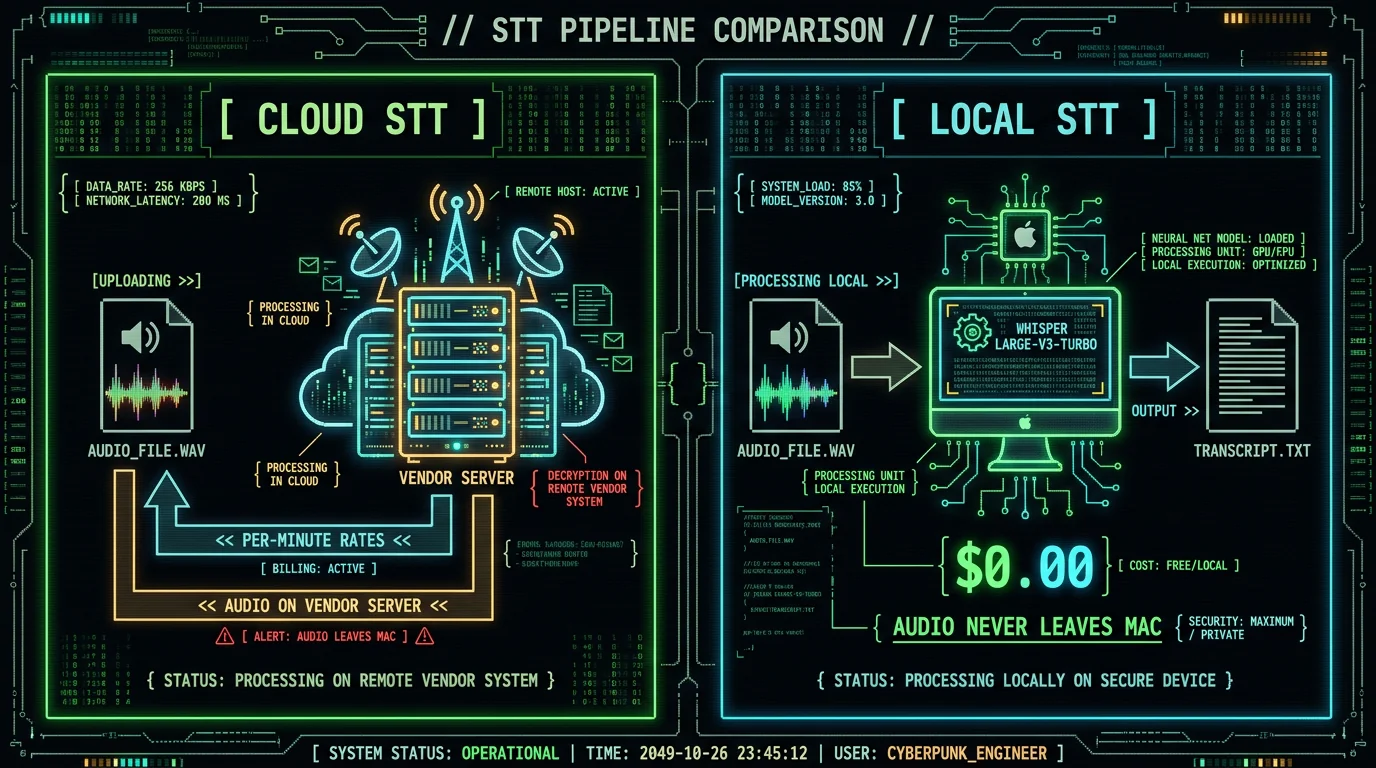
How accurate is local Whisper on real oral history audio?
The honest answer requires two numbers and a caveat. First, the only first-party accuracy number I've measured myself: a LibriSpeech test-clean run came in at 2.76% WER, which is roughly 97% word accuracy on clean read English audiobook audio — a useful sanity check, not representative of your tapes. Second, the public model-level figures: large-v3 sits in the 3-4% WER range on standard benchmarks per the model cards on Hugging Face, and large-v3-turbo (which is what MetaWhisp ships) measured 3.7% WER in my own head-to-head test across multiple apps on the same audio. Third, the caveat I owe you: those benchmarks are not oral history benchmarks. A 1998 cassette from a local historical society with a dying microphone, room echo, and a 78-year-old speaker telling a story in dialect is a different problem. I have not benchmarked archival tape accuracy and won't claim a number for it — anyone who quotes you a WER on "old family tapes" without naming the dataset is guessing. Plan on doing a quick cleanup pass on the transcript regardless of which tool you use.Pro tip: Before you transcribe, listen to the first two minutes of each tape with headphones and note any obvious problems — heavy hiss, dropouts, the interviewer talking over the subject. You'll thank yourself later when you're editing the transcript, because the model will get most words right but stumble on the same rough patches a human would.
How do you transcribe a family interview for free on a Mac?
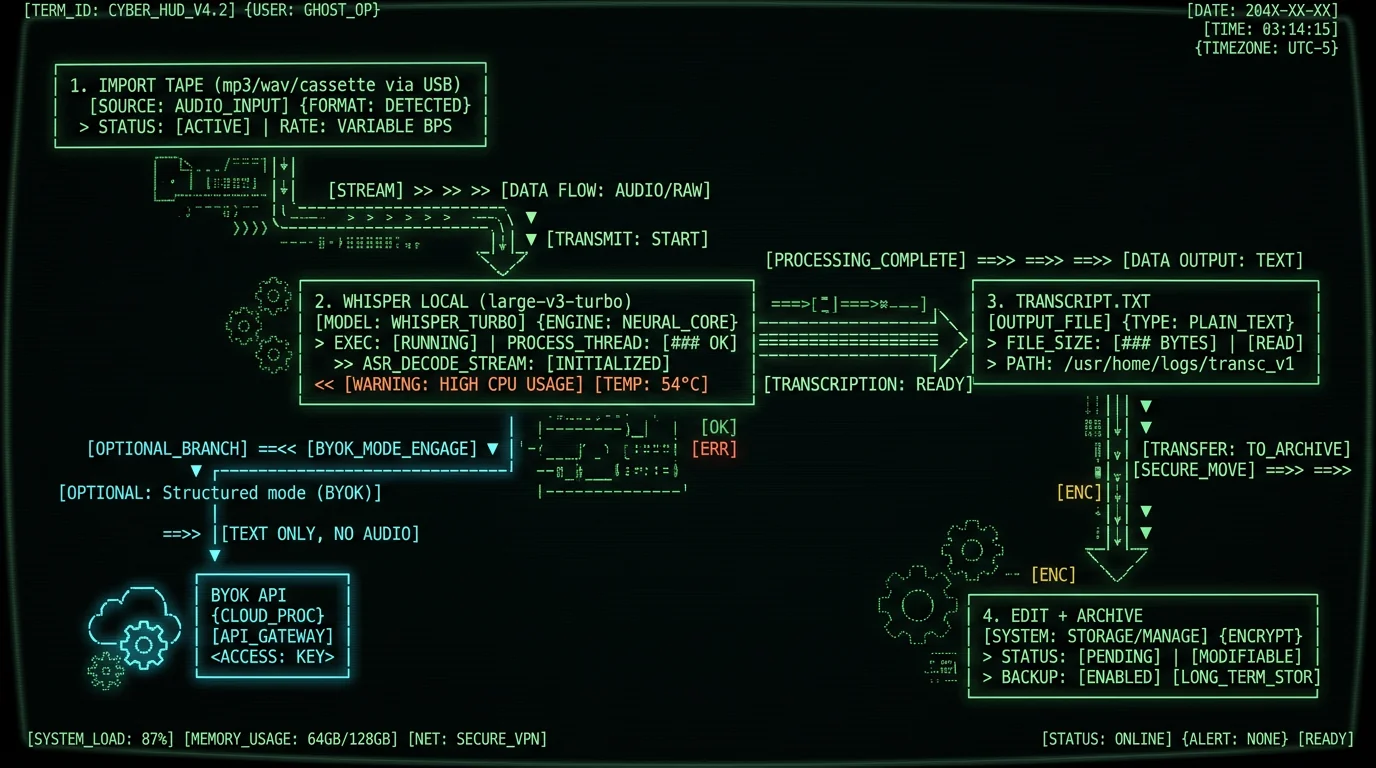
The actual workflow on Apple Silicon is short. Install MetaWhisp from the download page (free, no account), grant microphone and Accessibility permissions once, and the model downloads in the background. Two ways to work:- Live dictation: Hold Right Option, play the tape through a small speaker or cable the deck's line-out into your Mac, and MetaWhisp transcribes in real time. The text auto-pastes wherever your cursor is — TextEdit, Pages, a Word doc, a Google Doc. Great for working through a tape interactively.
- File transcription: Drop an audio file (mp3, m4a, wav, flac) onto the app. It runs Whisper on the Neural Engine and produces a full transcript, usually faster than real time. This is the right mode when you have twenty hours of batch work.
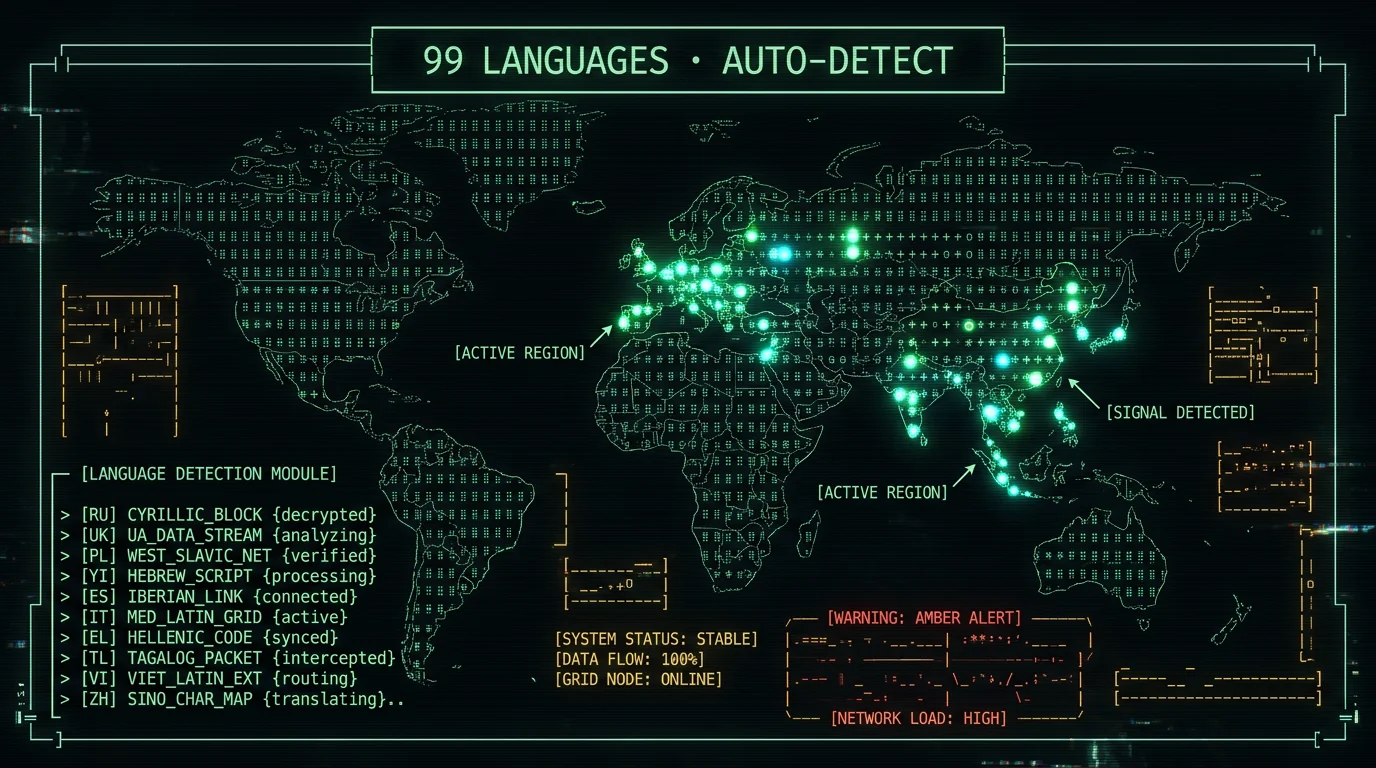
What about immigrant family histories in other languages?
What about multi-generation interviews with overlapping speakers?
Here's where I have to be straight with you. Speaker diarization — automatically labeling "Speaker 1, Speaker 2, Great-Uncle Bob" across an interview — is on our roadmap but is not shipped in MetaWhisp today. If your recording is a clean one-on-one interview (one interviewer, one subject, minimal crosstalk), the transcript is usable as-is and you'll add speaker labels manually in maybe five minutes. If you have a multi-generational round-table where three cousins, an aunt, and a grandparent all talk over each other for two hours, you'll get one merged transcript and you'll need to attribute quotes by ear afterward. That's a real limitation and I'd rather name it than hand-wave. For that specific case, a paid human transcription service that does include speaker labels may genuinely be worth the per-minute cost — see the comparison table below.What about poor-quality archive tapes?
Same answer, different shape. Local Whisper is a speech recognition model, not an audio restoration tool. It will not de-hiss a 1971 cassette, de-click a vinyl transfer, or magically fill in the words underneath a dropout. What it will do is transcribe what is audible, and on a tape where the speech is intelligible to a human ear it usually does well. Where the tape is genuinely degraded — the kind where you strain to catch every third word — no transcription tool, paid or local, is going to give you a clean read. The realistic workflow for a historical society is: digitize the tape (a one-time cost per cassette using a USB audio interface), do a rough noise reduction pass in a free tool like Audacity, then run it through Whisper. You still save the per-minute transcription bill, and you get a better transcript than you'd get feeding the raw noisy file into any tool.Founder's note: I built MetaWhisp because I dictate daily in mixed Russian and English and wanted something that worked the way I think. The same reason it works for me — local, free, 99 languages — is why it works for a genealogist with a box of tapes. The thing it doesn't do is speaker labels and audio cleanup. I'm upfront about that because pretending otherwise wastes your time.
When does a paid service still make sense?
| Option | Cost | Languages | Speaker labels | Audio privacy |
|---|---|---|---|---|
| MetaWhisp Local (free) | $0, unlimited | 99, auto-detect | Not yet | Stays on your Mac |
| MetaWhisp Pro | $30/yr or $7.77/mo | 99 | Not yet | Cloud audio uploaded |
| Paid human transcription | per minute, check vendor | Varies | Yes | Uploaded to vendor |
| Generic AI API | per minute, check vendor | Varies | Some plans | Uploaded to vendor |
How much does MetaWhisp cost vs a paid service?
The local mode is free forever — no subscription, no per-minute meter, no account required. Pro is $30 per year or $7.77 per month and exists primarily to remove the bring-your-own-key requirement for the AI post-processing (Structured / Correct / Rewrite modes) and translation, and to add a daily allotment of cloud transcription if you want it. Cloud features do upload audio, so I won't pretend they don't. For a genealogist working through a personal archive, the local free tier is the right default: it covers the actual transcription, the audio stays on your machine, and you only upgrade if you want the polish.The MetaWhisp download is on the site — free, no account, runs on macOS 14+ on Apple Silicon. If your tapes are in a language you're not sure the model handles, the languages page lists all 99.
Frequently asked questions
How much do oral history transcription services charge per minute?
Rates vary widely by vendor and turnaround. Human transcription agencies typically charge in the range of roughly a dollar per audio minute (sometimes more for rush); AI APIs like Whisper or OpenAI charge fractions of a cent per minute. Check the specific vendor's current pricing page — Rev, Sonix, Otter, AssemblyAI, and TranscribeMe all publish updated rates and they change.
Can Whisper transcribe a 3-hour family interview on a Mac?
Yes. MetaWhisp runs Whisper large-v3-turbo on the Neural Engine and processes long audio files without an artificial cap. On an M-series Mac, transcription usually finishes faster than real time, so a 3-hour file lands in roughly 1–2 hours depending on the model and your chip. There is no per-file fee.
Do you need the internet to transcribe oral history locally?
No. Once the model is downloaded (around 950 MB, one time), local mode runs entirely on your Mac. No upload, no API call, no cloud round-trip. You can transcribe on a plane, in a basement archive with no Wi-Fi, or at a historical society with strict network policies. Only Pro cloud features and the BYOK AI post-processing require internet.
Does MetaWhisp support languages other than English for immigrant histories?
Yes — 99 languages with auto-detect. The model picks up the language from the audio without you setting anything. Russian, Ukrainian, Polish, Yiddish, Spanish, Italian, Greek, Tagalog, Vietnamese, Mandarin, Cantonese, Arabic, and many more are supported. Mixed-language recordings (a few sentences in one language, a switch into another) work in the same pass.
Will MetaWhisp label speakers in a multi-generational interview?
Yes, with your own Gemini or Deepgram key, added in 1.3.27. For clean one-on-one interviews the transcript is usable without one; for round-table or overlapping-speaker recordings, you'll get one merged transcript and need to attribute quotes by ear. That's a real limitation — I won't pretend otherwise.
Can MetaWhisp restore audio on a damaged cassette tape?
No. MetaWhisp is a speech recognition app, not an audio restoration tool. It transcribes what's audible. If your tape is noisy or degraded, do a cleanup pass in Audacity (free) or a similar tool first, then transcribe. The model will still struggle on truly unintelligible audio — no transcription tool will give you a clean read on a recording a human ear can't follow.
Is it legal to use Whisper to transcribe a deceased relative's recordings?
For personal family archiving in the US, transcribing your own relative's recordings is generally fine — the underlying right is the recording itself, which your family typically owns. Laws vary by jurisdiction, by whether the subject is a public figure, and by the source of the recording. If you're a historical society publishing recordings of third parties, consult your own legal counsel.
Can I export the transcript to Word or PDF?
The transcript is plain text — copy it from MetaWhisp into Word, Pages, Google Docs, Scrivener, or wherever you archive family histories. Anything that accepts pasted text works. With the optional Structured mode you can also produce a clean, paragraphed version for printing or PDF export.
What format should I use to archive oral history transcripts long-term?
Plain text (.txt) is the most future-proof — it will open in any tool fifty years from now. For richer records, pair the transcript with the original audio file (uncompressed .wav or .flac if you have storage), a brief metadata file (date, interviewer, subject, language), and a copy of any photos or documents referenced. Store at least one copy off-site.
About the author — Andrew Dyuzhov is the solo founder of MetaWhisp. He's a marketer and builder with ADHD who assembled the app with AI coding tools on top of open-source Whisper. He dictates daily in Russian and English and runs voice-first workflows to get past the writing paralysis. He is not an ML researcher, archivist, or lawyer — and won't pretend to be one. Find him on X.
