The EU/Canada buyer's compliance question looks nothing like HIPAA.
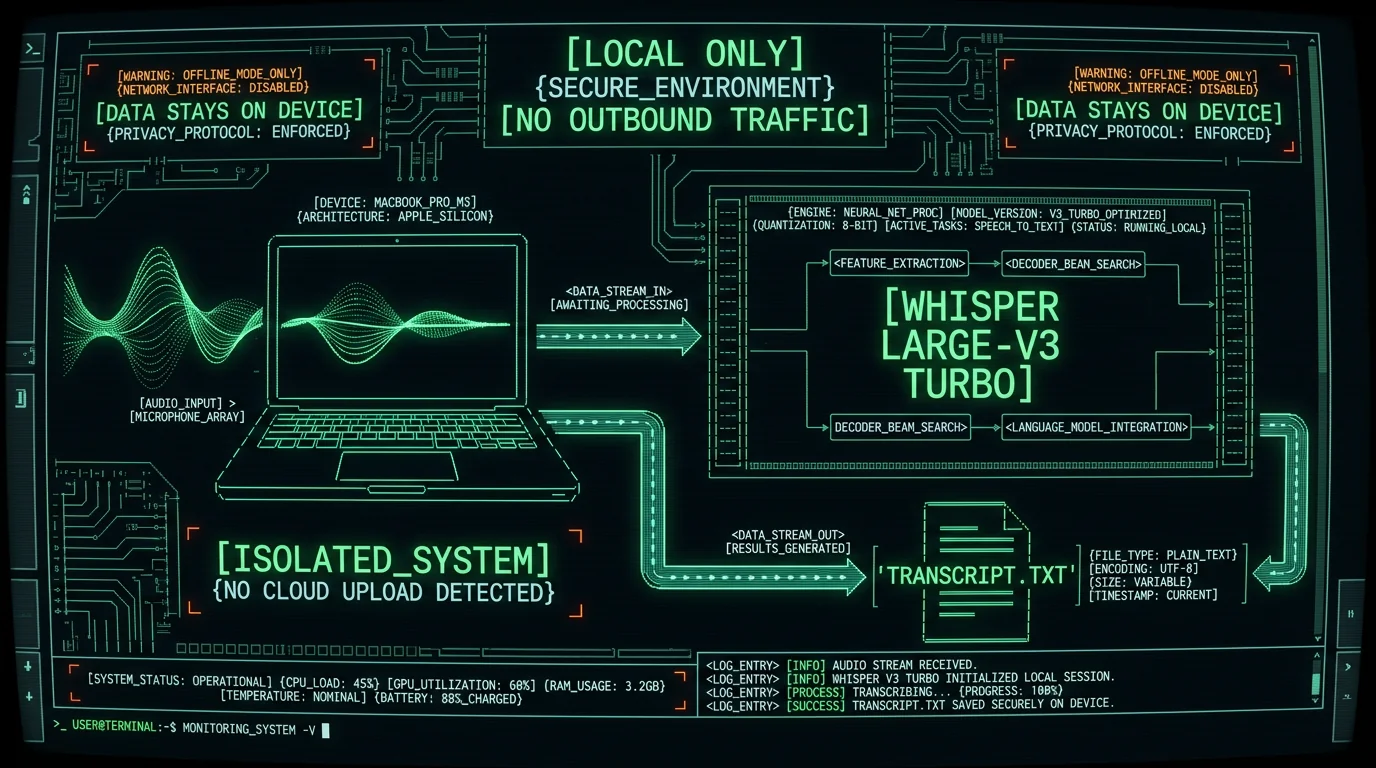
Why EU/Canada Buyers Ask a Different Question Than US Buyers
If you're buying voice-to-text software in the United States, the conversation almost always circles back to HIPAA—a US healthcare privacy law that mandates what happens to Protected Health Information (PHI) when it touches a third-party vendor. The buyer's question becomes: "Is this vendor HIPAA compliant?"
Switch the geography to Germany, France, the Netherlands, or Canada, and the entire frame shifts. The question isn't "What certification does this vendor have?" It's "Where does the data go, and can we account for every byte?"
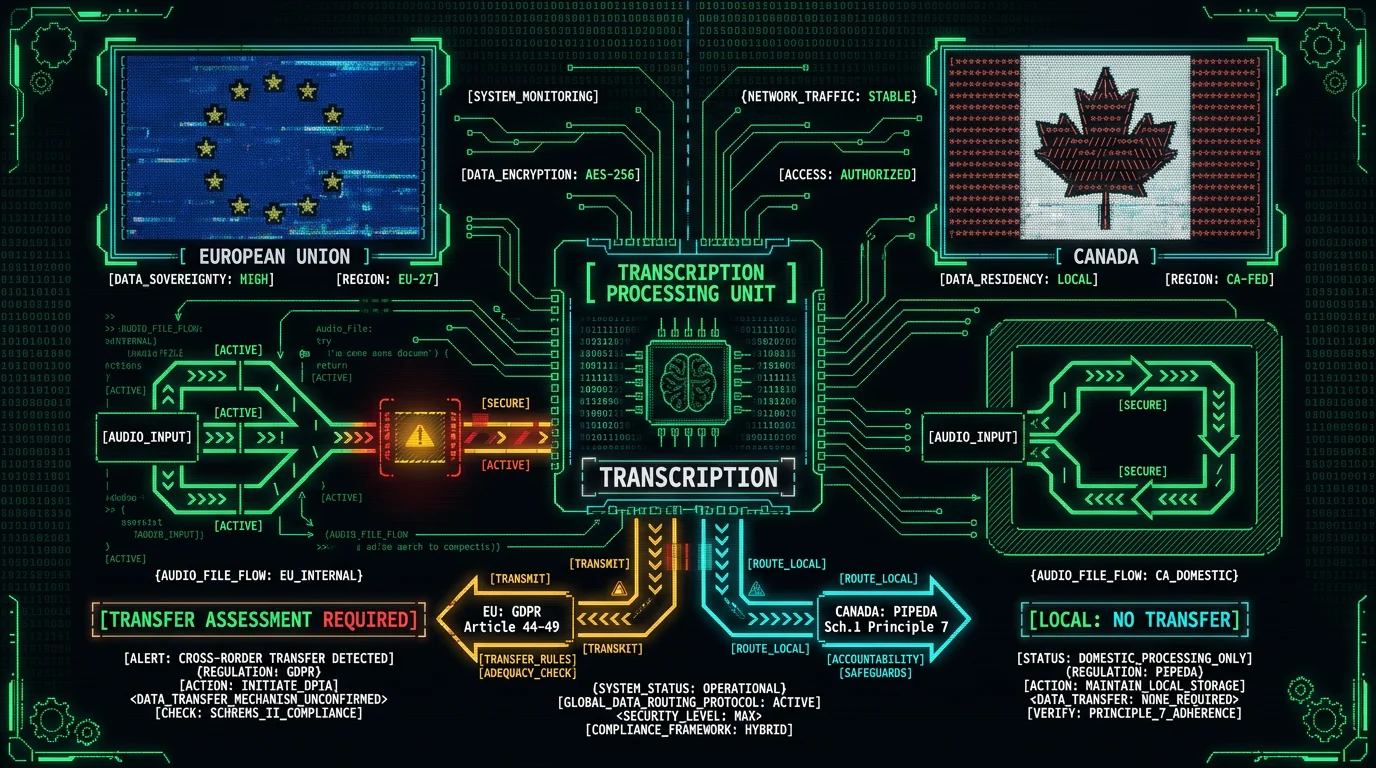
Under the EU's GDPR and Canada's PIPEDA, moving personal data across a national border triggers specific obligations: the transfer mechanism must be documented, the destination country or organization must offer adequate protections, and the data subject must be informed. If your audio—recorded voice, potentially revealing accent, language, health status, opinions, or location—crosses from Frankfurt to a US cloud server, you've initiated a cross-border data transfer that requires legal justification.
This is a fundamentally different compliance posture than "Does this vendor have a BAA?" HIPAA operates on a certification and agreement model—if you sign the paperwork and follow the procedures, you're covered. GDPR and PIPEDA operate on a data localization and transfer accountability model—if the data crosses a border, you must justify it, regardless of what paperwork exists.
What GDPR and PIPEDA Actually Say About Cross-Border Data Transfers
Neither GDPR nor PIPEDA bans cross-border transfers outright. But both impose accountability that most US-centric SaaS vendors never discuss.
Under GDPR (Articles 44-49), transferring personal data to a country outside the European Economic Area requires either an adequacy decision from the European Commission (the destination has "essentially equivalent" protections) or a valid legal mechanism like Standard Contractual Clauses (SCCs). The US lacks a general adequacy decision, though the EU-US Data Privacy Framework exists as a post-Schrems II mechanism. Sending an EU resident's voice recording to a US cloud provider is a "transfer" that must be covered by one of these mechanisms—and the sender (your organization) bears the accountability if the mechanism fails or doesn't exist.
Under PIPEDA (Schedule 1, Principle 7), organizations must "be accountable for the personal information in their possession or custody, including information that has been transferred to a third party for processing." The transfer must be documented, and the third party must provide "comparable protection" to PIPEDA standards. Unlike GDPR, PIPEDA is enforced by the federal Privacy Commissioner with order-making powers, and provincial legislation (notably Quebec's Act Respecting the Protection of Privacy in the Private Sector and Law 25) may layer additional requirements depending on your jurisdiction.
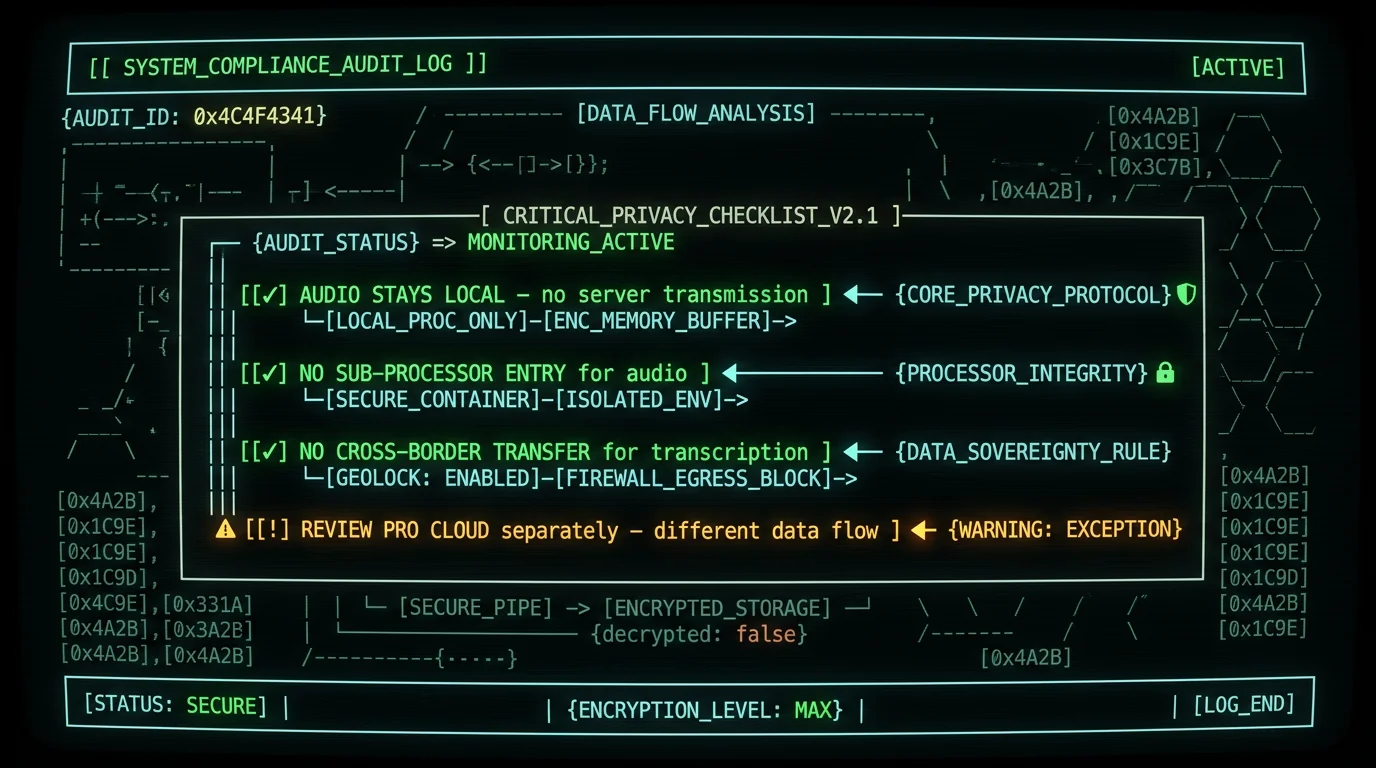
In both cases: if the audio never leaves your device, there is no transfer to assess. No mechanism required. No sub-processor entry. No DPA for that step.
How On-Device Processing Changes the Architecture Entirely
When a transcription tool runs entirely on your Mac, the compliance analysis for the transcription step looks like this:
- No outbound audio. The recorded audio never leaves your device. There is no "transfer" in the technical sense—no packet leaves your machine for a remote server.
- No sub-processor relationship. Sub-processors are companies your data touches downstream. If no data leaves your Mac, there's no downstream party for the audio.
- No Data Processing Agreement required for transcription. A DPA is a contract between you (data controller) and the vendor (data processor). If the vendor never processes your data, the DPA's purpose—governing what the processor does with your data—doesn't apply to the transcription step.
- Your own hardware, your own audit trail. You're processing on infrastructure you own and control. The GDPR/PIPEDA obligation is on the controller (you) to document the processing, but the processing is local.
This is the architectural insight that reframes the buying decision for EU/Canadian teams. You don't need MetaWhisp to be "GDPR compliant" for the local mode—because MetaWhisp isn't processing your data. Your Mac is.
What MetaWhisp's Free Tier Actually Does (Technical Architecture)
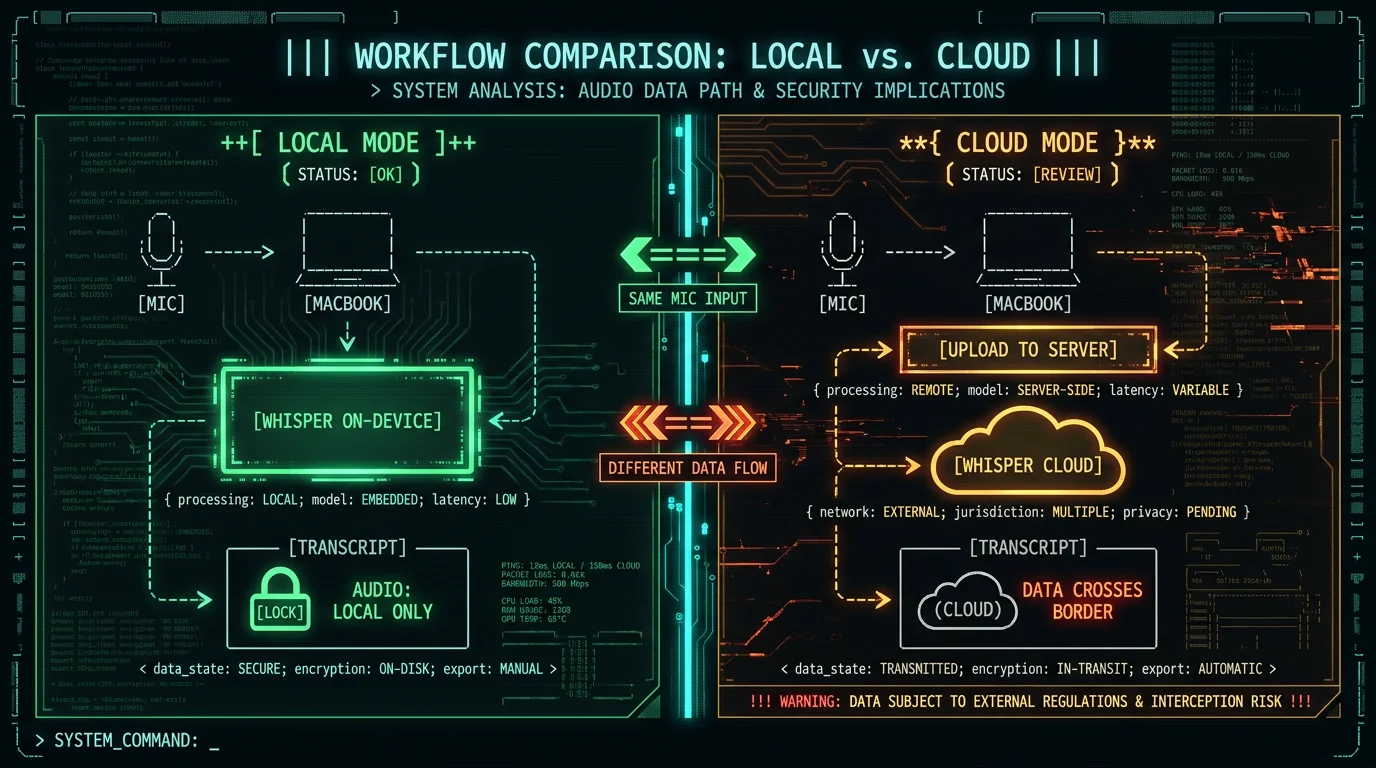
The free tier runs WhisperKit, which executes OpenAI's Whisper large-v3-turbo model on your Mac's Apple Silicon Neural Engine. Here's what that means in practice:
Model runs locally. The ~950 MB Whisper model is downloaded to your Mac once and stored locally. When you dictate, the audio is processed entirely on-device. The audio waveform never traverses a network interface.
No telemetry. MetaWhisp does not send usage data, audio snippets, transcripts, or any identifier back to any server in free local mode. This is not a policy choice that could change—it's architecturally impossible when the model runs on your hardware.
API keys stay in Keychain. If you're using the free tier's AI post-processing modes (Structured, Correct, or Rewrite—available when you add your own OpenAI or Cerebras key), that key is stored in your Mac's Keychain, never transmitted to MetaWhisp servers. The transcript text goes to the API provider you specified; the audio never goes anywhere.
Auto-paste to any app. After transcription, the text is inserted into whatever application you're working in via the system pasteboard. No logging, no history stored on any server.
This is what we mean when we say the compliance question changes: in free local mode, MetaWhisp is a tool running on your infrastructure. The GDPR/PIPEDA question shifts from "Does MetaWhisp have adequate transfer mechanisms?" to "Have you documented that processing occurs on-device?"
Can Canadian Law Firms and EU Businesses Use This for Client Work?
Profession-specific use cases deserve a direct answer because the stakes vary.
For Canadian law firms: PIPEDA applies to personal information in commercial activities. Client communications, interview recordings, and case notes likely contain personal information. Using a cloud transcription service that sends audio to US servers means you're transferring that personal information to a third party—your law firm is the data controller, and you need to document the transfer mechanism (SCCs, adequacy, or consent). Using on-device transcription where the audio stays local sidesteps this for the transcription step. Your transcription workflow is between you and your hardware.
For EU businesses in sectors like healthcare, finance, or legal: GDPR applies to personal data of EU residents, full stop. If a German therapist records a session with a patient on their Mac, and that audio is processed locally, no GDPR Chapter V transfer obligations are triggered. The therapist's own Mac is the processing environment. If the same audio goes to a cloud service in Ireland (still an EU adequacy country), a transfer assessment is still technically required but the legal landscape is simpler. If it goes to a US cloud, SCCs or the EU-US DPF become necessary.
The free tier's local processing mode is relevant here: the audio never reaches a server in any country. The "data residency" question is answered by the hardware's physical location—and your Mac is wherever you are.
Important: This article describes technical and architectural realities of on-device processing and how they relate to data residency concepts under GDPR and PIPEDA. It does not constitute legal advice. Privacy law compliance depends on your specific jurisdiction, industry, the nature of the data you process, and other factors outside any software tool's control. Consult a qualified privacy lawyer for advice applicable to your situation.
When Does the Analysis Change? (The Pro Cloud Tier)
I need to be direct: everything above applies to MetaWhisp's free local mode. The Pro tier ($7.77/month or $30/year, per the pricing page) changes the analysis materially.
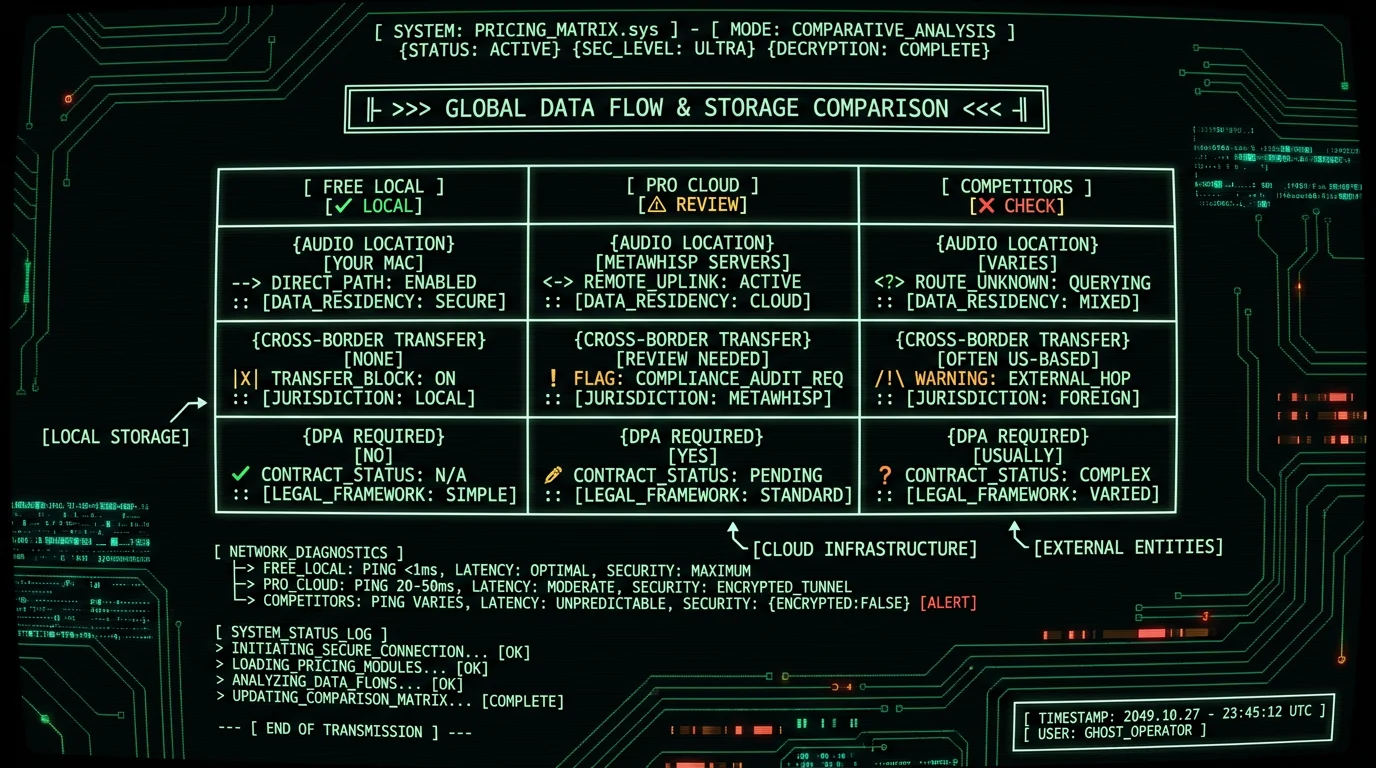
Pro cloud mode uses MetaWhisp's hosted Whisper large-v3-turbo for transcription. This means your audio does go to servers. The servers are MetaWhisp's infrastructure, and you should evaluate that transfer under GDPR and PIPEDA like any other cloud vendor—DPA, transfer mechanisms, sub-processor lists, data retention policies.
Pro also adds cloud AI post-processing (Structured mode, translation) with built-in AI rather than requiring your own API key. That's a different risk profile than the free tier, and a different compliance conversation.
If your organization's procurement or legal team is evaluating MetaWhisp, both tiers need to be on the table separately. Free: local processing, no server touch. Pro: cloud processing, server-side data handling.
The One Question That Actually Matters: Where Does the Audio Go?
Strip away the regulations, the certifications, and the legal frameworks, and the compliance question for transcription tools in the EU and Canada reduces to one check:
Does the recorded audio leave the device?
If yes: assess the destination, the transfer mechanism, the sub-processor list, and the DPA.
If no: the transfer question doesn't arise. The compliance question shifts from "Is this vendor compliant?" to "Is our use of on-device processing documented?"—a much simpler and more directly controlled question.
On-device Whisper transcription answers "no" to the first question by construction. It's not a policy, it's not a promise—it's a fact of the architecture. The audio cannot be on your Mac and on a server simultaneously.
Remote Teams and Cross-Border Collaboration
A common scenario: a Toronto-based marketing agency with a remote team spanning Berlin, Amsterdam, and Montreal. Everyone uses voice-to-text. Who has what compliance obligations?
If every team member runs MetaWhisp on their own Mac in local mode:
- The Berlin employee processes on a Mac in Germany—no EU-to-third-country transfer.
- The Amsterdam employee processes on a Mac in the Netherlands—same.
- The Montreal employee processes on a Mac in Quebec—PIPEDA applies to the employee's organization, but no personal information of clients or third parties crosses a border for transcription purposes.
- The Toronto employer still needs to document that local processing is the policy, but the cross-border transfer concern is eliminated at the transcription layer.
If instead the team uses a cloud transcription service with US-based servers, every employee—regardless of location—is sending audio to US infrastructure. The Berlin employee's data is transferring from Germany to the US. The Amsterdam employee too. Each transfer requires assessment under GDPR's Chapter V. The employer needs SCCs or a valid adequacy mechanism for each EU-based employee.
For distributed teams, local processing doesn't just reduce compliance complexity—it reduces the number of jurisdictions where transfer obligations apply.
HIPAA vs. GDPR/PIPEDA: Why One Word Matters
If you've read our HIPAA article, you know the US healthcare framing: "HIPAA-compliant" tools require a Business Associate Agreement (BAA), specific security controls, and breach notification procedures. "HIPAA-compatible" (a softer term meaning the tool can fit into a HIPAA workflow) applies to local processing tools.
GDPR and PIPEDA don't use a compliance certification model. There's no "GDPR-compliant" badge you can buy. The GDPR has no official certification body for software vendors. PIPEDA's federal Privacy Commissioner can issue findings and orders, but there's no certification equivalent to a BAA.
This matters when evaluating vendor marketing. A tool marketed as "GDPR compliant" may simply mean "we have SCCs available." That's not meaningless, but it's also not a regulatory seal of approval—because none exists. The actual question is: where does your data go, and do you have the documentation to show it?
For HIPAA-eligible healthcare organizations in the US, local dictation on Mac remains the recommended starting point precisely because it sidesteps the BAA requirement for the transcription step. For EU/Canadian organizations, the equivalent starting point is local processing that eliminates the transfer assessment entirely.
What to Tell Your Procurement or Legal Team
If you're evaluating MetaWhisp for organizational use and need to explain the free tier to a compliance officer, here's the architecture summary in legal-team language:
- Data category: Voice recordings (potentially containing special category / sensitive personal information depending on use case).
- Processing location: The user's Apple Silicon Mac (M1 or later, macOS 14+).
- Processing entity: The user's device, executing the Whisper model via WhisperKit. No data transmitted to MetaWhisp infrastructure in free local mode.
- Transfer assessment: Not applicable in free local mode—no cross-border transfer occurs for the transcription step.
- Sub-processors: No sub-processor relationship exists for audio data in free local mode.
- Data retention: Audio is processed in memory and not stored on any server. Transcript is delivered to the user's application via pasteboard.
For the Pro cloud tier: request MetaWhisp's DPA, sub-processor list, and data processing addendum. Evaluate under your standard third-party vendor assessment process, including transfer mechanism documentation for any applicable cross-border flows.
FAQ: Data Residency and Voice-to-Text for EU/Canada Mac Users
Does MetaWhisp send my voice recordings to servers in free local mode?
No. In free local mode, the Whisper model runs entirely on your Apple Silicon Mac's Neural Engine. The audio never leaves your device. There is no server component in the transcription pipeline for the free tier.
What does "data residency" mean for voice-to-text software?
Data residency refers to the physical location where your data is stored and processed. For voice-to-text, the critical question is where the audio goes. If it's processed on your Mac, the data resides in your office or home—wherever the Mac is. If it's sent to a cloud service, the data resides wherever that service's servers are located, potentially triggering cross-border transfer obligations under GDPR or PIPEDA.
Is MetaWhisp GDPR compliant?
MetaWhisp does not claim GDPR compliance and cannot do so—GDPR has no official certification for software vendors. For the free local tier, MetaWhisp processes no personal data because the processing happens on your device. For the Pro cloud tier, data is processed on MetaWhisp's infrastructure and a Data Processing Agreement is required. This article describes the architecture; consult a privacy lawyer for compliance advice specific to your situation.
How is PIPEDA different from HIPAA for transcription tools?
HIPAA operates on a certification and BAA model—you sign agreements and follow procedures to handle PHI. PIPEDA (and GDPR) operate on a data transfer accountability model—if personal information crosses a national border, you must document the legal mechanism justifying that transfer. For voice-to-text, the HIPAA question is "Do we have a BAA?" The PIPEDA/GDPR question is "Where does the audio go?"
Does on-device transcription eliminate all GDPR/PIPEDA obligations?
No—it eliminates the obligations specifically tied to cross-border data transfers for the transcription step. Other GDPR/PIPEDA obligations remain: you still need a lawful basis for recording and processing personal information (consent, legitimate interest, etc.), and you still have data subject rights obligations. Local processing is one layer of a complete privacy posture, not a blanket exemption.
What's the difference between MetaWhisp's free and Pro tiers for EU/Canada users?
The free tier runs entirely on-device with no server contact for audio. The Pro tier ($7.77/month or $30/year) sends audio to MetaWhisp's cloud servers for transcription. For EU/Canadian users focused on data residency, the free tier eliminates cross-border transfer concerns. The Pro tier requires the same DPA and transfer assessment as any cloud transcription service—evaluate it separately.
Can I use MetaWhisp for client meetings in EU/Canada jurisdictions?
MetaWhisp's free local mode processes audio on your Mac with no data leaving your device. For client-facing work in regulated industries (legal, medical, financial), this means the transcription step doesn't require a DPA or cross-border transfer assessment. The broader question of whether recording client meetings is permissible under applicable professional rules and consent requirements is separate from the transcription tool itself—consult your professional body's guidance.
Does MetaWhisp have a sub-processor list?
For the free local tier, there are no sub-processors because no data is sent to any server. For the Pro cloud tier, MetaWhisp maintains a sub-processor list covering the cloud infrastructure used for transcription and AI processing. Request the current list as part of your vendor assessment if evaluating Pro.
What about Quebec's Law 25 or other provincial privacy laws?
Provincial privacy laws in Canada (Quebec's Law 25, Alberta's PIPA, BC's PIPA) may impose additional obligations beyond PIPEDA's federal floor. Local on-device processing reduces the cross-border transfer concern, but the specific requirements vary by province and by the nature of your organization. Quebec's Law 25 has specific rules around consent and breach notification that apply regardless of where the data is processed. Consult a Canadian privacy lawyer for provincial-specific guidance.
Next Steps
If you're evaluating voice-to-text tools for an EU or Canadian organization and data residency is a procurement requirement:
- Download and test the free tier of MetaWhisp on a Mac (M1 or later, macOS 14+). Run it in local mode. Verify that no data leaves your machine during dictation.
- Document the architecture for your compliance team: local mode uses on-device Whisper, no sub-processor relationship for audio, no cross-border transfer for the transcription step.
- Evaluate Pro separately if cloud features are needed. Request MetaWhisp's DPA and sub-processor list. Assess under your standard vendor review process.
- Consult a privacy lawyer for jurisdiction-specific advice—particularly if you're in a regulated profession (legal, medical, financial) or processing special categories of personal data under GDPR Article 9.
The free tier won't solve every use case. But if your primary compliance concern is data residency—keeping the audio within a specific jurisdiction or eliminating cross-border transfer obligations from the transcription step—local on-device processing addresses it by construction rather than by policy.
About the author: Andrew Dyuzhov is the CEO and solo founder of MetaWhisp, a free on-device voice-to-text app for macOS. He builds tools for his own ADHD-driven voice-first workflows and writes about privacy, productivity, and the gap between legal frameworks and technical reality.
Related reading:
