A meeting-notes method, checked against the research
The quick answer: write down decisions, owners, deadlines and your own questions, and let the rest go. Research on divided attention, and on how interpreters take notes, suggests that listening and writing compete for attention. Even investigators' "verbatim" notes of forensic interviews left out more than half of what the interviewers themselves said, and a quarter of the key details. So keep the exact words in a recording or transcript, and spend your attention on what someone has to act on.
Key takeaways
- In Microsoft's 2023 survey of 31,000 workers, 55% said next steps at the end of meetings are unclear. Capture those first.
- Use a four-box page: notes, your questions, decisions, and action items with an owner and a date.
- The famous "handwriting beats laptops" result didn't hold up in a direct replication. Pick whichever tool lets you capture decisions.
- Right after the meeting, write a short summary from memory, then check it against your notes or transcript.
Why Is It Hard to Listen and Take Notes at Once?
Because both draw on the same attention. In four lab experiments with spoken word lists in 1996, Fergus Craik and colleagues found that dividing attention while taking information in caused large drops in memory. Dividing it while recalling caused little or none. The study didn't test note-taking, but writing during a meeting splits attention at that same stage.
The research closest to meetings is sobering:
- Conversations fade fast. In a 1987 study by Laura Stafford and colleagues, people recalled only about 10% of their conversations right afterwards, and about 4% a month later.
- "Verbatim" notes aren't. When Michael Lamb's team compared forensic interviewers' "verbatim" notes with the recordings of 20 interviews, 57% of the interviewers' own utterances were missing. So were 25% of the details about the incident. The authors concluded that recording is better when content must be preserved.
- Notes still help, modestly. A 2005 meta-analysis of 57 studies comparing note-taking with no notes describes the benefit as positive but modest. Interpreters are trained to listen and write at the same time, and a 2016 pilot with nine interpreting students found each scored at least slightly higher with notes than without.
The lesson isn't "stop taking notes". It's that you can't capture everything, so decide in advance what's worth your attention.
What Do Experts on YouTube Actually Do?
We read the full transcripts of five popular note-taking videos: four on work meetings, one on lectures. Kara Ronin's was cited in Google's AI Overview for "how to take notes in a meeting" (US) in September 2026. The others are by Jeff Su, Leila Gharani, The Financial Controller and learning researcher Benjamin Keep. Three say they set up the page before the meeting starts, and all four meeting practitioners separate actions from discussion.
- Kara Ronin splits the page into four boxes: general notes, your questions and contributions, decisions made, and your action items. The questions box is there so you don't interrupt the speaker or forget your point.
- Leila Gharani uses the same four-quadrant idea, with separate boxes for your to-dos and other people's. She recommends summarising the takeaways and to-dos before the meeting ends, so everyone is on the same page.
- The Financial Controller starts the meeting from a questions box filled in beforehand. When someone takes ownership of a task, it goes in their box, and afterwards he emails the to-dos to the group.
- Jeff Su keeps action-oriented notes: a personal doc for his own meetings, and shared sheets with a rotating note-taker for team meetings. Afterwards he spends five to ten minutes on key takeaways, which he usually emails.
- Benjamin Keep argues the other way, for lectures. Take minimal notes during the talk, write down everything you remember on a blank page right afterwards, then check it against slides or a transcript.
Where they disagree: three of the five write by hand, Jeff Su works in docs and shared sheets, and Keep would rather you barely write during the talk and write it all down afterwards. None of them covers AI meeting notes or recording consent.
What Does a Good Meeting-Notes Page Look Like?
A page split into four boxes, set up before the meeting starts. Three of the five creators use a version of it. Put the date, purpose and attendees at the top. Then give notes, questions, decisions and action items their own space, so the important parts don't get buried in the discussion.
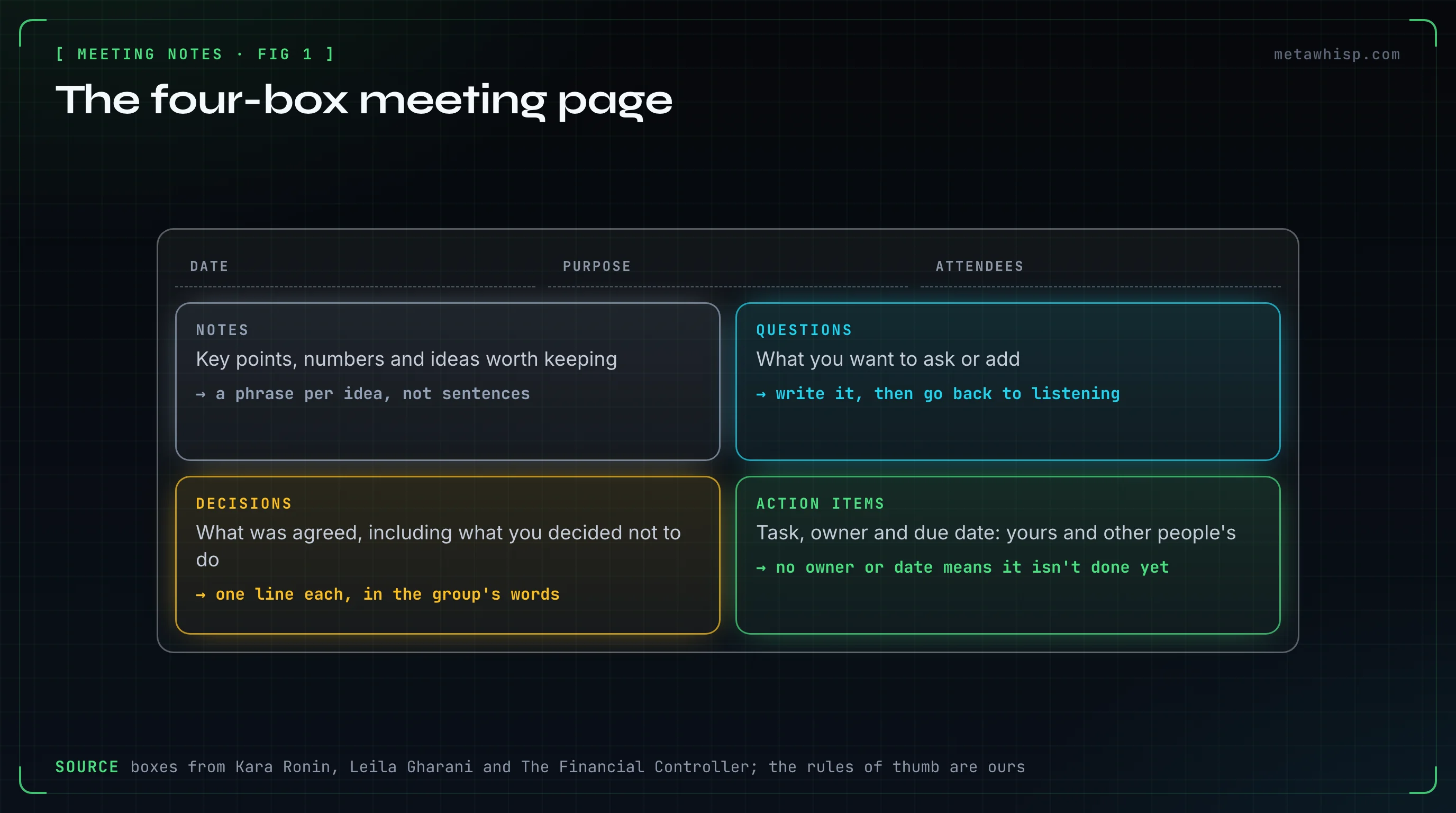
| Box | What goes in it | Rule of thumb |
|---|---|---|
| Notes | Key points, numbers and ideas worth keeping | A phrase per idea, not sentences |
| Questions | What you want to ask or add | Write it, then go back to listening |
| Decisions | What was agreed, including what you decided not to do | One line each, in the group's words |
| Action items | Task, owner and due date; yours and other people's | No owner or date means it isn't done yet |
There may be a reason the questions box helps. Psychologists call it the "next-in-line effect": people who are about to speak remember less of what was said just before their turn. We found no study testing whether writing the question down fixes that. But writing it down may get the question out of your head, and your attention back to the person talking.
For action items, borrow the government version. California's project-management template for meeting minutes tracks each action item with a description, owner, date assigned, target date and status.
Is Handwriting Better Than a Laptop?
Probably not by much. A widely cited 2014 study by Pam Mueller and Daniel Oppenheimer found laptop note-takers did worse on conceptual questions. But a preregistered direct replication by Heather Urry and colleagues in 2021, with 142 students, found no reliable difference. Its mini meta-analysis of eight similar studies put the overall effect near zero.
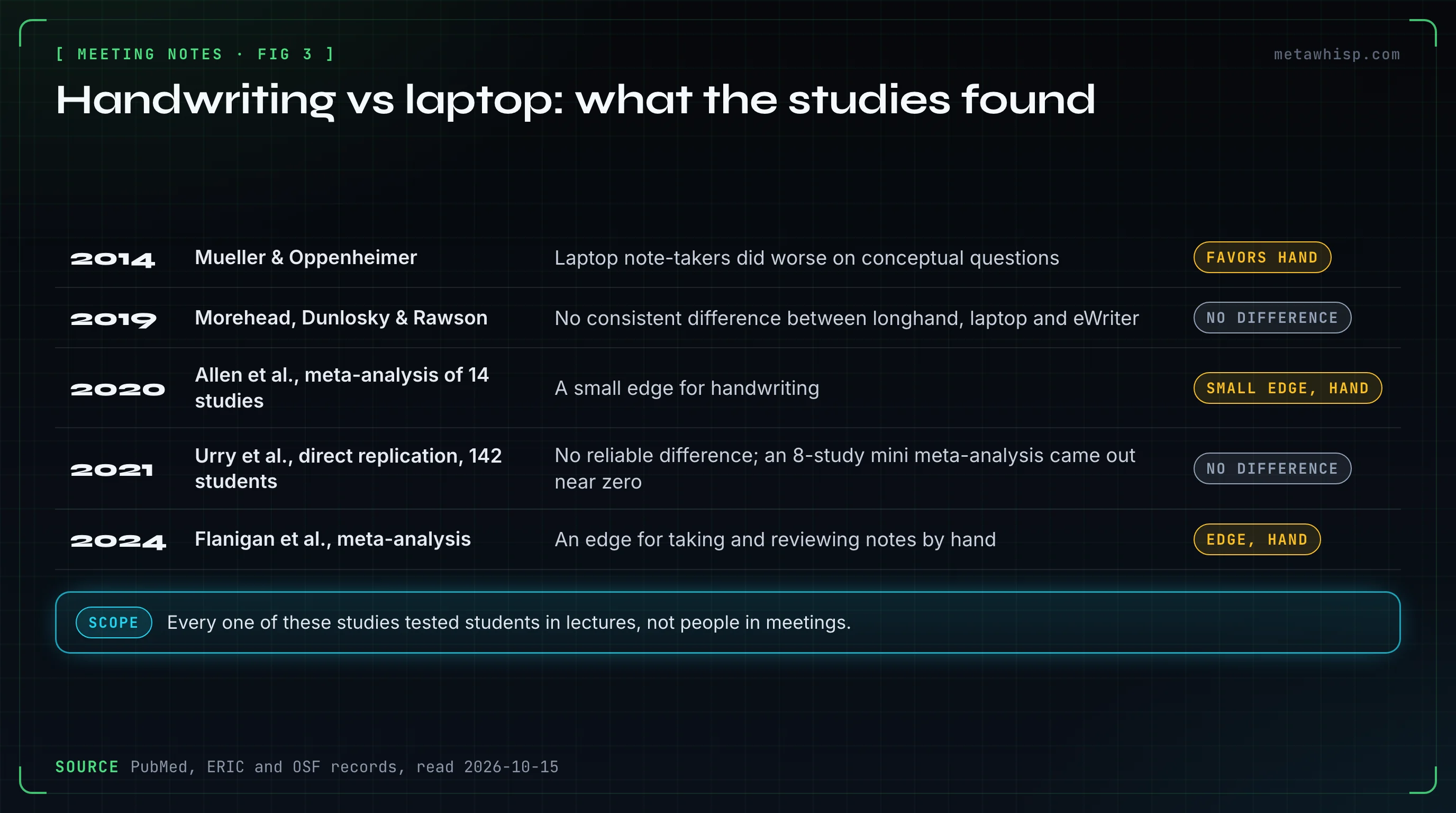
The full record is mixed, not settled:
- A 2019 replication by Kayla Morehead, John Dunlosky and Katherine Rawson found no consistent difference between longhand, laptop and eWriter groups. One of its experiments found none even against a group that took no notes at all.
- Two meta-analyses still find a small edge for handwriting. One, in 2020, pooled 14 studies and 3,075 participants. The other, in 2024, found it for taking and reviewing handwritten notes.
- Laptops consistently produce more words. In the 2021 replication, laptop notes averaged about 231 words against 136 by hand.
Every one of these studies tested students in lectures, not people in meetings. In a meeting, the bigger question is social. A study of 30 visits to three doctors in Israel found that the more time a physician spent looking at the computer screen, the less they asked about the patient's wider life. That's a correlation, not proof. A 2015 study of 100 visits found that actively sharing the screen with the patient went with more engagement, which suggests notes everyone can see.
Use whatever lets you capture decisions without hiding behind a screen.
What Should You Write Down, and What Can You Skip?
Write what someone will act on: decisions, owners, deadlines and open questions. Skip the play-by-play. Robert's Rules of Order says minutes record what was done at a meeting, not what was said. Your notes can be looser, but the same idea keeps them short.
- Do write: decisions (including "we're not doing X"), every task with a name and a date, numbers you'll need later, and questions nobody answered.
- Don't write: anything you could get back from slides, a document or a transcript, and the back-and-forth that led to a decision.
- Borrow from interpreters: a 2020 summary of Jean-François Rozan's classic interpreting method lists his seven principles. Note the idea, not the word. Abbreviate. Mark links between ideas, negations and emphasis. Stack related items vertically, and indent a line that continues the one above.
Less isn't automatically better, though. In both the 2014 study and its 2021 replication, people who wrote more words tended to score better. The goal is to choose, not to starve the page.
What Should You Do Right After the Meeting?
Spend five minutes writing what you remember before you look at your notes, then check and send. In a 2017 study by Ralf Rummer and colleagues, testing yourself beat rereading for remembering material after one and two weeks. A summary from memory is a version of that test, and the comparison shows you what you missed.
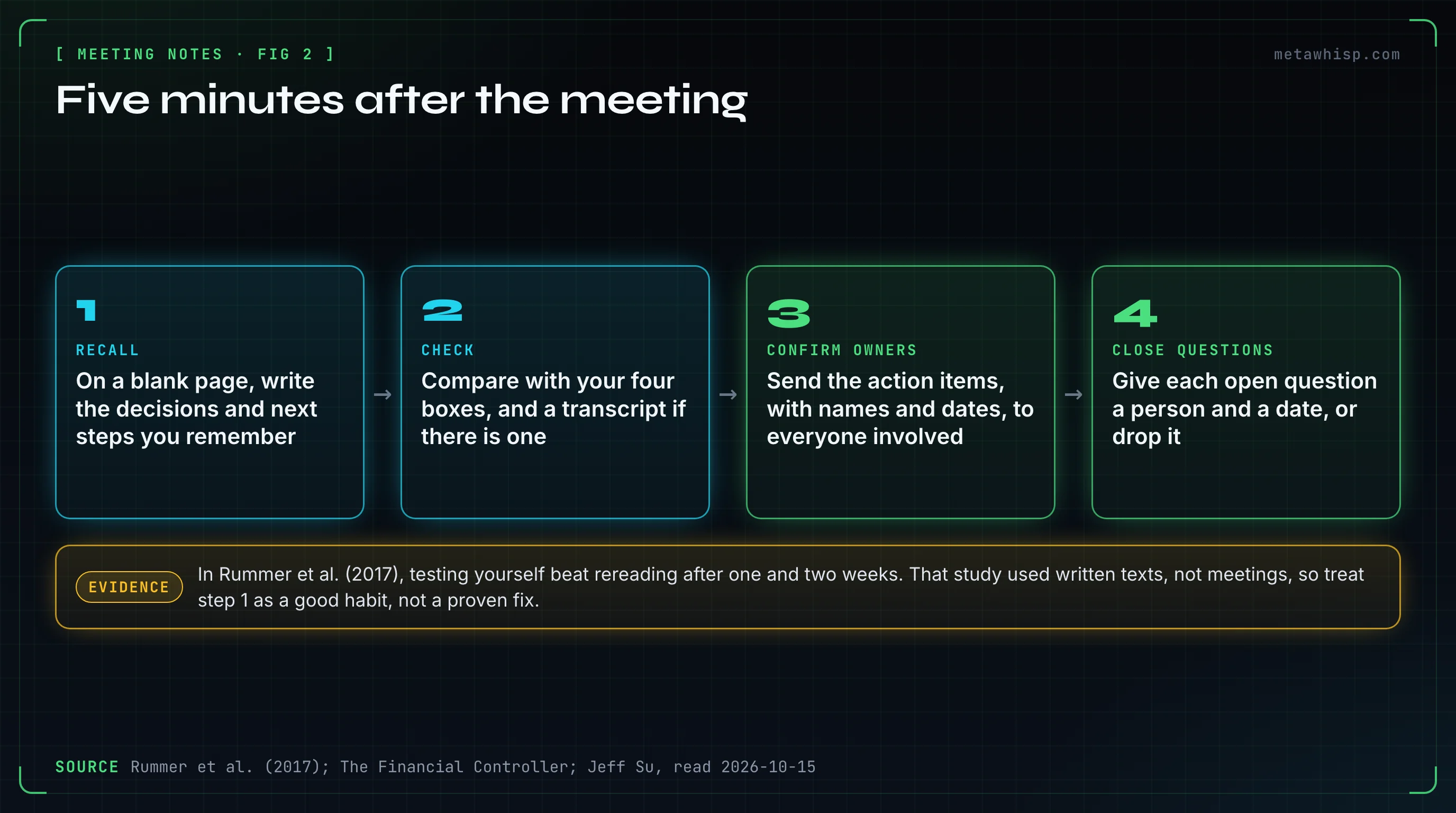
- Recall: on a blank page, write the decisions and next steps you remember.
- Check: compare with your four boxes, and with a recording or transcript if there is one.
- Confirm owners: send the action items, with names and dates, to everyone involved. The Financial Controller does this so ownership is in writing; Jeff Su usually emails his key takeaways.
- Close the questions: move each unanswered question to a person and a date, or drop it.
The study used written texts, not meetings, so treat the five-minute recall as a good habit, not a proven fix. If you join late or the meeting was a blur, you're not alone. In the same Microsoft survey, 56% said it's hard to summarise what happened in a meeting, and 57% said it's hard to catch up if they joined late.
Can AI Take Meeting Notes for You?
It can keep the words, but you still need to listen. Microsoft says AI content in Teams recaps may be inaccurate or incomplete. Google says Meet's "Take notes for me" summaries can be incomplete or inaccurate, and recommends meetings of at least 15 minutes. Peer-reviewed studies report the same kinds of errors.
- Invented text: a 2024 study found that about 1% of OpenAI Whisper's transcriptions contained entire phrases or sentences that were never said. Its 2023 tests used recorded speech that included people with aphasia.
- Summary errors: a 2025 paper describes AI meeting summaries as error-prone, with hallucinations, omissions and irrelevant content.
- A real test: In a 2024 pilot, Seattle University's IT team found that Zoom's AI Companion summaries weren't always accurate. They found it sometimes missed the meaning even when the words were right.
- Your own memory: in a 2025 study with 30 people watching lectures, fully automated AI notes led to the lowest test scores. A real-time summary led to the highest, even though people preferred full automation.
A practical split works: let a recorder keep the words, and keep the decisions and owners yourself. In an r/projectmanagement thread with more than 200 comments, one commenter, who says they run a project-management department, works this way: the AI writes the summary, and the people in the meeting still capture actions and decisions. If you record, tell people first; recording laws differ by place.
Which Note-Taking Method Fits Meetings?
The four-box page fits most meetings, because it puts actions and decisions first. The Cornell method suits meetings you need to learn from. Outlines suit tightly structured agendas. Walter Pauk created the Cornell system and published it in his 1962 book How to Study in College, but none of these methods was tested in meetings.
| Method | How it works | Best for |
|---|---|---|
| Four boxes | Notes, questions, decisions, action items | Most work meetings |
| Cornell | Notes on the right; cue questions on the left and a summary at the bottom, added afterwards | Training sessions, briefings you'll need to recall |
| Outline | Main points at the margin, details indented | Status meetings that follow a set agenda; Cal Poly warns it fails when the speaker goes fast |
| Charting | Columns set up in advance by category | Recurring meetings with known topics |
| Interpreter's notes | Ideas, symbols, links, vertical layout | Fast talk you must relay to others |
How Can MetaWhisp Help?
MetaWhisp keeps the words so you can keep the decisions. It's a free Mac app that records a meeting from your microphone and your Mac's audio, with no bot joining the call. On the free version it transcribes on your Mac by default and stores the transcript there. On calls, the transcript is split into "Me" and "Them".
It fits the recall-first habit. Write your summary from memory, then open the transcript to check names, numbers and who said they'd do what. "Them" covers everyone else on the call, so check names yourself. Turn on Meeting Recording in Settings, and you start a recording from the menu bar. Switch on call detection too, and MetaWhisp shows a card when a Zoom, Teams, Meet or similar call starts, including calls that never had a calendar invite.
The limits: it's Mac-only (macOS 14 or later on Apple Silicon). AI recaps need a local model, your own API key, or Pro at $7.77 a month or $30 a year. And it doesn't announce the recording, so tell people. See how meeting transcription works.
FAQ
What are the 5 R's of note-taking?
Record, Reduce, Recite, Reflect and Review: the steps of the Cornell method, from Walter Pauk's How to Study in College. Cornell's own Learning Strategies Center names the second step "Questions" instead of "Reduce", citing the same book. Both versions fill the left-hand cue column after the session: one with short summary cues, the other with questions.
What are the 7 rules of note-taking?
There's no standard list; the "7 rules" you'll find online vary from site to site. The best-documented set of seven is Jean-François Rozan's principles for interpreters: note ideas, abbreviate, mark links, mark negation, mark emphasis, write vertically, and indent continuations.
What are the 5 P's of meetings?
Answers vary. iSixSigma lists five different versions. A common one is Purpose, Participants, Process, Product (or Payoff) and Preparation. Treat it as a planning checklist, not a fixed standard.
What is the 40/20/40 rule for meetings?
Spend about 40% of your attention preparing, 20% in the meeting itself and 40% on follow-up. Productivity writer Graham Allcott credited it to Lois Graessle and George Gawlinski in 2012. It's a planning rule of thumb, not a research finding.
What's the difference between meeting notes and minutes?
Minutes are the formal record of what a meeting decided and did. Robert's Rules of Order says they record what was done, not what was said. Meeting notes are informal and personal, and can include your own questions and to-dos.
Should I take meeting notes by hand or on a laptop?
Either works. The 2014 study favouring handwriting didn't hold up in a 2021 direct replication with 142 students, though two meta-analyses find a small edge for handwriting. All of them tested lectures, not meetings. Choose the tool that lets you capture decisions without hiding behind a screen.
Related reading
- How to transcribe meeting minutes on a Mac
- MetaWhisp vs Otter.ai
- Meeting transcription
- AI note taker without a bot
Sources
Checked on October 15, 2026. Where we only read a paper's abstract, the link goes to the abstract. Every study on note-taking method cited here tested lectures, interviews or lab tasks; none tested meetings directly.
- Attention and memory: Craik et al. (1996), Stafford, Burggraf & Sharkey (1987), Lamb et al. (2000), Pérez Campos & Varela Salinas (2016), Innes (1982) on the next-in-line effect, Rummer et al. (2017), Kobayashi (2005) meta-analysis
- Handwriting vs laptop: Mueller & Oppenheimer (2014), Urry et al. (2021), Urry et al. preprint, Morehead, Dunlosky & Rawson (2019), Allen et al. (2020), Flanigan et al. (2024), Margalit et al. (2006), Asan et al. (2015)
- Methods: Cornell Learning Strategies Center, Cornellians on the Cornell method, University of Maine at Fort Kent, Cal Poly note-taking systems, Kriston (2020) on Rozan, Robert's Rules FAQ, CA-PMF meeting template, iSixSigma on the 5 P's, Graham Allcott on 40/20/40
- Meetings at work: Microsoft Work Trend Index 2023
- AI notes: Microsoft Teams recap, Google Meet "Take notes for me", Seattle University on Zoom AI Companion, Koenecke et al. (2024), Kirstein et al. (2025), Chen et al. (2025), r/projectmanagement thread (archived)
- Videos: Kara Ronin, Jeff Su, Leila Gharani, The Financial Controller, Benjamin Keep
- MetaWhisp: pricing, privacy
