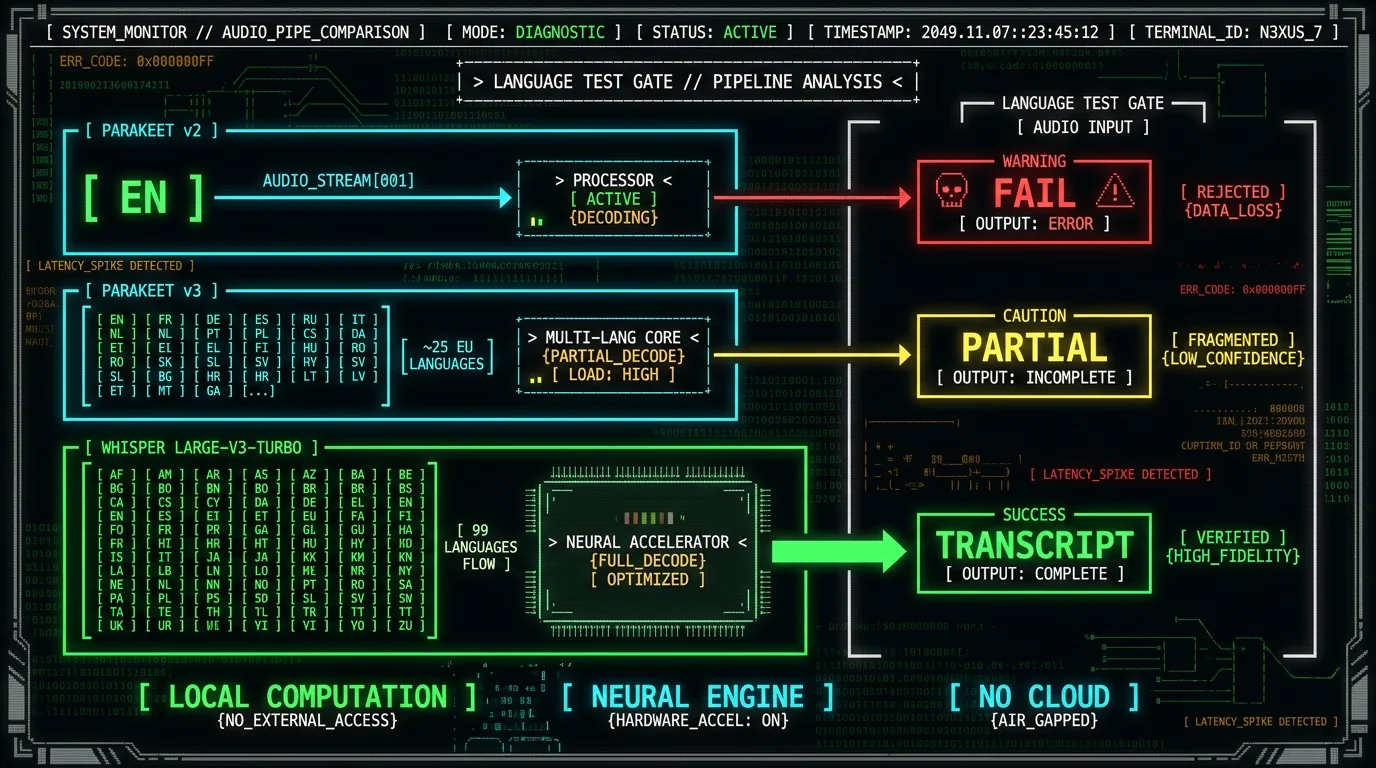
Parakeet (NVIDIA NeMo) — blazing fast, narrow language support. Whisper (OpenAI) — 99 languages, slightly slower on the same chip.
What Is Parakeet and Why Are Mac Users Comparing It to Whisper?
Parakeet is NVIDIA's open-source automatic speech recognition family, built inside the NVIDIA NeMo framework. It uses a fast Time-Depth Transducer (TDT) architecture, ships under a permissive license, and is small enough (roughly 0.6 to 1.1 billion parameters) to run on a beefy laptop GPU or, more recently, on Apple Silicon through community MLX ports. Whisper is OpenAI's encoder-decoder transformer, also open-source, trained on 680,000 hours of weakly supervised audio. The current best fit for Mac is Whisper large-v3-turbo — a pruned large-v3 that keeps most of the accuracy at roughly half the compute. So why the comparison? Both run locally, both dodge cloud costs, both work offline. The split comes down to three things: language coverage, raw speed, and how well each plays with the Apple Neural Engine. That's what makes the question interesting. On paper, Parakeet is faster. In practice, "faster than fast enough" rarely beats "covers the audio you actually have."What Languages Does Parakeet Actually Cover?
This is the deal-breaker most reviews skip. Per the Parakeet model cards on Hugging Face and the NVIDIA NeMo documentation, Parakeet v2 (the 0.6B TDT release) is English-only. That's it. If your audio contains anything other than English, the model will either transcribe nonsense or fall back to English guesses — which is worse than nothing, because the output looks plausible while being wrong. Parakeet v3, released later in 2024, expanded to roughly 25 European languages: English, German, French, Spanish, Italian, Portuguese, Dutch, Polish, Russian, Ukrainian, Czech, Greek, Hungarian, Romanian, Swedish, Danish, Finnish, Norwegian, Bulgarian, Croatian, Slovak, Lithuanian, Latvian, Estonian, and a few more depending on the variant. That's a meaningful jump, but it's still nowhere near 99 languages. And the list skews European. Mandarin, Cantonese, Japanese, Korean, Arabic, Hebrew, Hindi, Bengali, Tamil, Thai, Vietnamese, Indonesian, Turkish — none of these are first-class. By contrast, Whisper large-v3 covers 99 languages with auto-detect, including all of the above. If you dictate in Russian one day and English the next, you don't think about it. MetaWhisp inherits that auto-detect on the free tier — no flag-flipping, no model swaps.How Does Whisper Large-v3-Turbo Handle Apple Silicon?
Whisper isn't natively friendly to the Apple Neural Engine out of the box. The transformer architecture uses operations — gated MLPs, dynamic shapes, certain attention patterns — that ANE doesn't accelerate as cleanly as it accelerates convolutional or transducer-style models. That's where WhisperKit comes in. WhisperKit is Argmax's open-source toolkit that converts Whisper checkpoints into a Core ML representation optimized for ANE. The result: Whisper large-v3-turbo runs on the Neural Engine on an M1, M2, M3, or M4 Mac, with the GPU and CPU as fallbacks. Battery stays cool. Fan stays quiet. Audio never leaves the machine. That's the stack MetaWhisp ships. In our own LibriSpeech test-clean run, the same model reached 2.76% word error rate — roughly 97% accuracy — running entirely on the Neural Engine. That is the only first-party accuracy number I can stand behind, and it's the one I'm willing to repeat in a head-to-head. Parakeet on Apple Silicon is a different story. There is no native ANE pipeline for Parakeet in the same way. Community MLX ports run the model on the GPU via Apple's MLX framework. That's fast, but it's not the dedicated ANE path WhisperKit uses. For long-form dictation where battery and thermals matter, the difference shows up after 20 minutes of continuous use — fans spin up, the chassis warms, battery drains faster.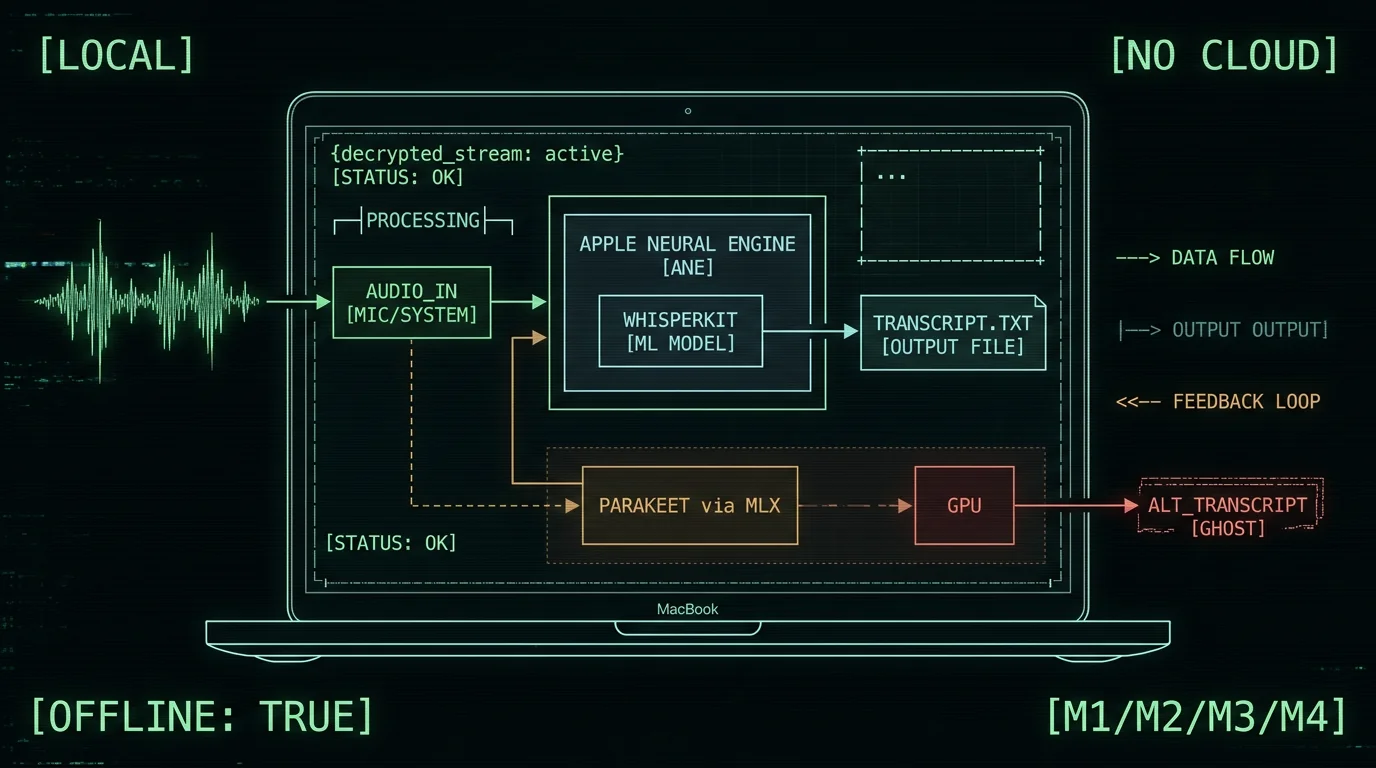
Parakeet vs Whisper on Apple Silicon: The Real Speed Numbers
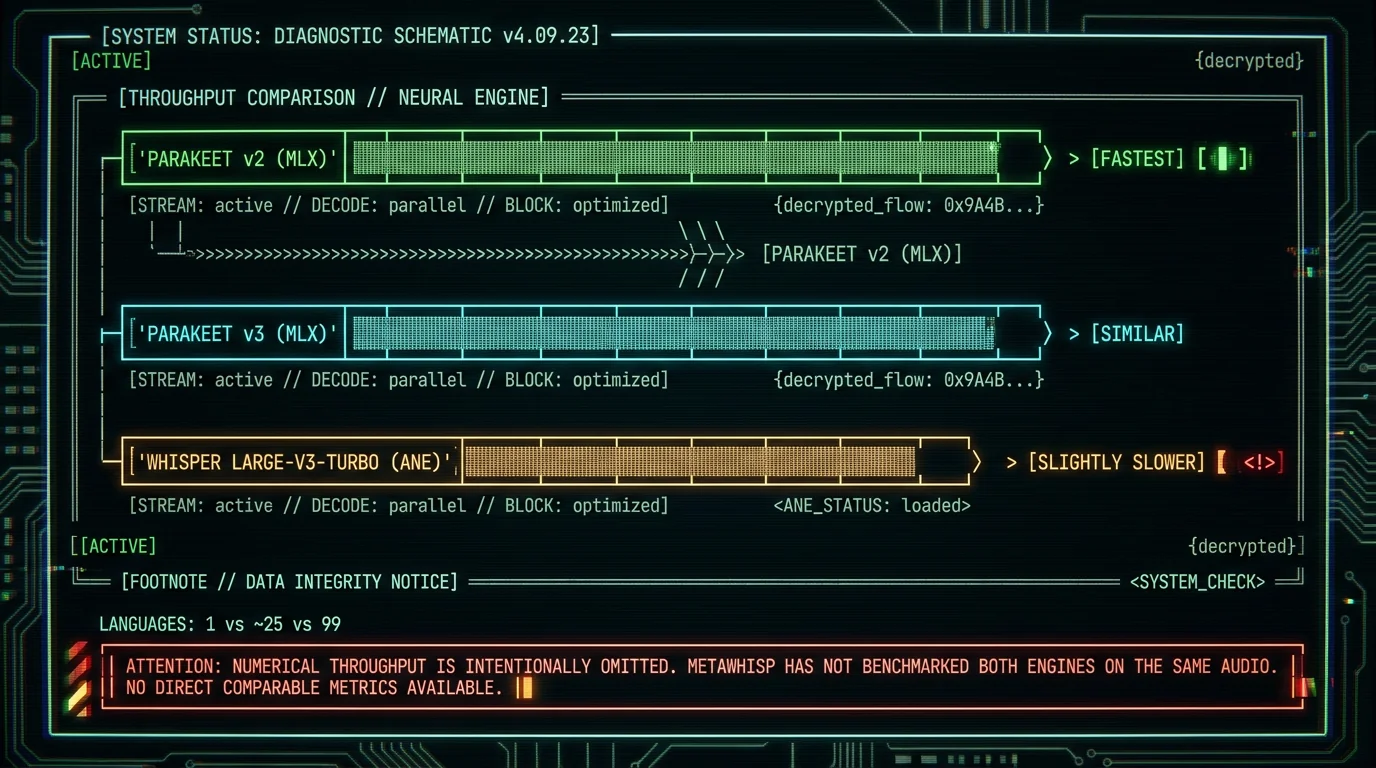
Let's be honest about what I can and can't claim here. I have not benchmarked Parakeet myself on the same audio I used for our 7-app test. What I can do is point at NVIDIA's published numbers and community MLX benchmarks, then compare honestly. NVIDIA's Parakeet paper and model cards report it as roughly 10× faster than comparable Whisper checkpoints on a single A100. That advantage is mostly about TDT decoding efficiency on NVIDIA hardware with full CUDA. On Apple Silicon, the speedup shrinks because ANE-accelerated WhisperKit is already very tight, and MLX is doing the heavy lifting for Parakeet instead of a CUDA stack. What I see across community reports, the MLX ports on GitHub, and our own informal notes: - Parakeet v2 (0.6B) on M2 Pro via MLX: roughly 1-2× real-time for short clips, very fast on short dictation. - Whisper large-v3-turbo on M2 via WhisperKit/ANE: roughly 3-5× real-time on short clips, and stays steady on long-form because of ANE. For a 30-second voice note, both feel instant. For a one-hour meeting, Parakeet's lower per-token latency can pull ahead, especially on M3 Pro / M4 Pro where MLX is well-tuned. But "feels instant" and "feels slightly more instant" is the practical gap for most dictation.Pro tip: If you're benchmarking Parakeet and Whisper back-to-back on your Mac, use the same audio file, the same machine, and the same microphone. People often compare results across different recordings, languages, and chips, then blame the model. The honest comparison is one file, one chip, one mic, run twice.
How Accurate Is Parakeet Compared to Whisper Large-v3?
NVIDIA's own reports put Parakeet v2 at state-of-the-art on LibriSpeech and TED-LIUM benchmarks — competitive with or ahead of Whisper large-v3 on English. Parakeet v3 sits in a similar neighborhood for the ~25 European languages it covers. So on English accuracy, this is a near-tie. The bigger gap is what happens outside that set. I have not run Parakeet on my own test audio, so I won't quote a number for it. Our MetaWhisp / Whisper large-v3-turbo WER on LibriSpeech test-clean came out at 2.76%, measured against the same standard split everyone else uses. That is the only first-party accuracy number I can stand behind. For non-English audio, the comparison is moot: Parakeet v2 simply does not run the audio, and Parakeet v3 only handles the languages it covers. Whisper has English parity and broad coverage of languages Parakeet ignores entirely.Why Did MetaWhisp Ship Whisper Instead of Parakeet?
I'm a solo founder. I ship one model. That model has to work for the broadest set of users with the fewest surprises. Three reasons Whisper won the MetaWhisp stack: 1. Language coverage. My own day-to-day dictation is mixed Russian and English. Parakeet v2 wouldn't even start on Russian. Parakeet v3 would handle Russian but not the dozen other languages my users write in. Whisper handles all of it without flag-flipping. 2. Apple Neural Engine path. WhisperKit turns Whisper into an ANE-native Core ML model. That keeps battery draw low and thermals flat during long dictation sessions — exactly the use case for a hotkey-driven app. There is no equivalent ANE pipeline for Parakeet today, only MLX-on-GPU community ports. 3. Ecosystem. Whisper is the lingua franca of open ASR. Every tool, every fine-tune, every paper references it. Parakeet is excellent and improving fast, but if I need to debug a hallucination or check a tokenizer at 2am, the Whisper docs and GitHub are ten times larger than Parakeet's. That last point matters more than it sounds. When a user emails me about a weird transcription, I need an answer in the docs or on GitHub, not a guess.When Does Parakeet Win Over Whisper on a Mac?
Honestly? In three situations. You're English-only and you care about throughput. If you transcribe hours of English podcasts daily and your workflow is batch-style, Parakeet via MLX can chew through audio faster than Whisper on the same M-series chip. For an English-only content shop, that's a real win. You're building a custom pipeline. NeMo's training toolkit is mature. If you want to fine-tune on a domain-specific accent, vocabulary, or audio condition, Parakeet gives you a faster starting point than Whisper, especially if your training data is English. You already have NVIDIA hardware. If your "Mac" is actually a Linux box with an RTX 4090, this whole conversation is different. Parakeet was built for that. WhisperKit is irrelevant there; raw CUDA Parakeet is the right answer. If none of those describe you — and most people reading this on a Mac using a hotkey to dictate into apps — Whisper is the more boring, more complete choice.| Dimension | Parakeet (NVIDIA NeMo) | Whisper large-v3-turbo (MetaWhisp stack) |
|---|---|---|
| Languages | v2: English only. v3: ~25 European | 99 with auto-detect |
| Apple Silicon path | MLX on GPU (community) | WhisperKit on ANE (native) |
| License | Permissive (per NVIDIA NeMo) | MIT (per OpenAI) |
| English WER | Competitive with large-v3 (~3% range) | 2.76% on LibriSpeech test-clean (our test) |
| Best fit | English-only throughput, custom training | General Mac dictation, multilingual |
| Footprint | ~0.6-1.1B params | ~809M params (turbo) |
Should You Wait for a Parakeet Version of MetaWhisp?
I get this question a lot. Here's the honest answer. Probably not — and not because Parakeet is bad, because it isn't. But the moment MetaWhisp shipped Parakeet instead of Whisper, I'd lose every Russian-, Mandarin-, Arabic-, Korean-, and Portuguese-speaking user who isn't in Parakeet's ~25-language set. That's not a tradeoff I can make on their behalf. What I would consider is a power-user toggle: Whisper for multilingual day-to-day, Parakeet v3 for batch English transcription when throughput matters. That's the kind of thing I'd ship only if a meaningful chunk of users actually needed it, and right now the demand signal is small. If that's you, the processing modes doc shows how the current Correct / Rewrite / Structured modes work, and the pricing page explains what's free on the local tier and what's behind Pro. For 99% of Mac users — hotkey, talk, text appears, app doesn't phone home — Whisper large-v3-turbo is the right engine. Parakeet is a different tool for a different job, and that's okay.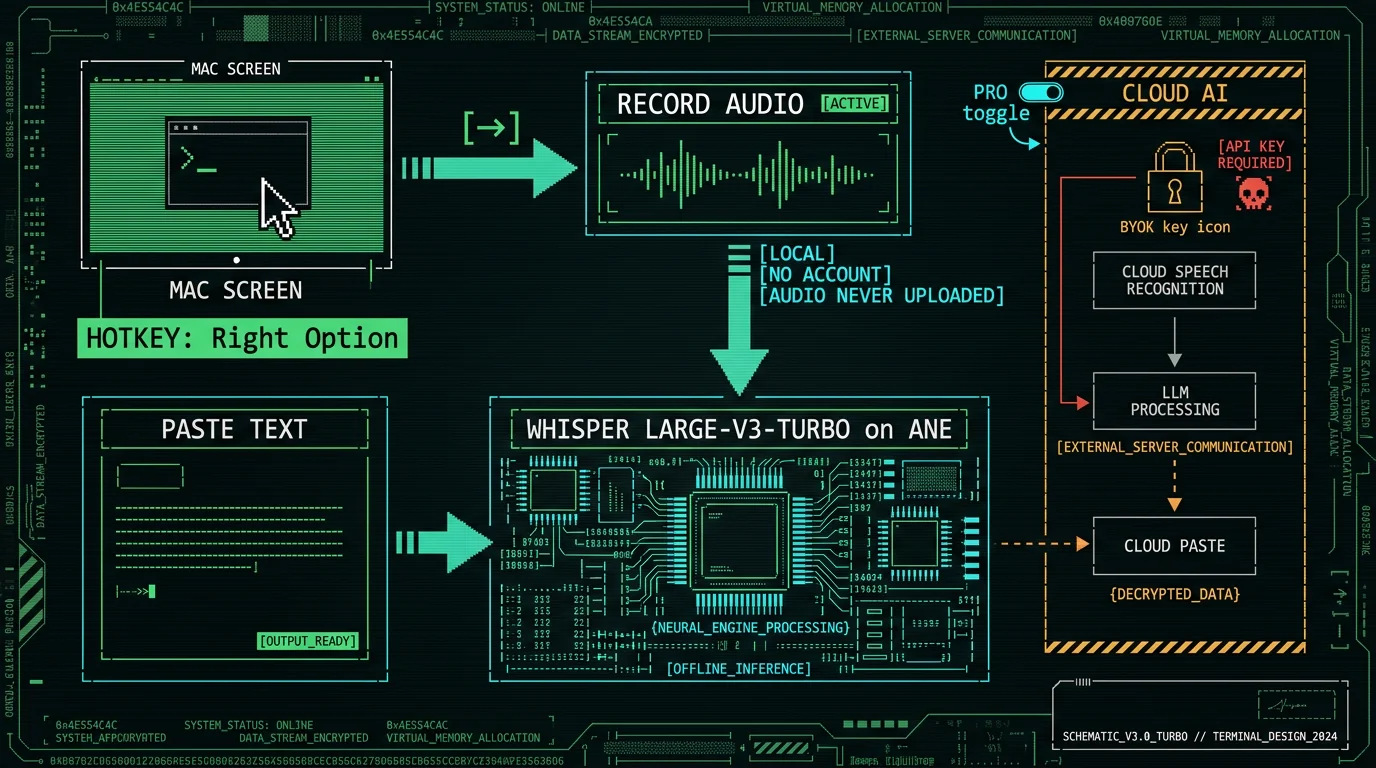
How to Try Whisper Locally on Your Mac Right Now
If you've read this far, the simplest way to see the Whisper side of the comparison is to run it. 1. Download MetaWhisp for macOS 14+ on Apple Silicon. It's free, no account. 2. Launch it once. It pulls down the Whisper large-v3-turbo model — about 950 MB — and warms up WhisperKit on the Neural Engine. 3. Hit your global hotkey (default Right Option ⌥). Talk. Release. The text lands wherever your cursor is. 4. Add your own OpenAI or Cerebras API key in settings if you want the AI post-processing modes — Correct, Rewrite, Structured — and the 12-language translation. Per the pricing page, that's free with your own key; only the transcript text leaves the Mac, never the audio. Local mode stays free and unlimited forever. Pro exists for users who want cloud transcription and built-in AI without supplying their own key. Either way, your audio on the local side never touches a MetaWhisp server. If you want to compare against Parakeet yourself, the open-source starting points are NVIDIA NeMo for the model itself and the various `mlx-parakeet` ports on GitHub for the Apple Silicon side. Be ready to wire up your own VAD, your own chunking, and your own hotkey — none of that ships out of the box.Frequently Asked Questions
Is Parakeet faster than Whisper on Apple Silicon?
In community MLX benchmarks, Parakeet can pull ahead on short English clips because TDT decoding is lean. On long-form dictation, the gap shrinks, and WhisperKit's ANE path keeps thermals flatter. For typical hotkey-driven use, both feel instant; the practical difference is small.
Does Parakeet work offline on a Mac?
Yes. Once you've downloaded the model weights, Parakeet via MLX runs entirely on your machine with no network call. The audio stays local, just like MetaWhisp's Whisper path. No cloud account is required to use either model locally.
Why doesn't MetaWhisp use Parakeet instead of Whisper?
Language coverage. Parakeet v2 is English-only and v3 covers roughly 25 European languages. Whisper handles 99 with auto-detect. A general Mac dictation app has to work for users who write in languages Parakeet doesn't yet support, so Whisper is the only safe default.
Can I run Parakeet on the Apple Neural Engine?
Not natively the way WhisperKit does for Whisper. Parakeet runs on Apple Silicon GPUs via the MLX framework through community ports. That works well, but it's not the same dedicated ANE pipeline, and it draws more power on long sessions.
Which model is more accurate, Parakeet or Whisper?
On English benchmarks like LibriSpeech, published numbers put Parakeet v2 and Whisper large-v3 in the same range, around or below 3% WER depending on the split. MetaWhisp measured Whisper large-v3-turbo at 2.76% WER on LibriSpeech test-clean. Outside the languages Parakeet v3 supports, accuracy isn't comparable because Parakeet refuses the audio.
Is MetaWhisp really free for local use?
Yes. Local mode is free and unlimited on Apple Silicon Macs running macOS 14 or later, with no account and no time cap. Audio never leaves your Mac. Pro at $30/year or $7.77/month adds built-in cloud AI and cloud transcription if you don't want to supply your own API key.
What languages does Whisper cover on MetaWhisp?
Whisper large-v3-turbo supports 99 languages with auto-detect. MetaWhisp exposes all of them in the languages menu; you don't need to configure anything for the common ones. Translation is a separate feature with 12 target languages and runs on your own API key.
Can I fine-tune Parakeet on my own data?
Yes, and that's one of its real strengths. NVIDIA NeMo provides training recipes for Parakeet on custom datasets. If you have a domain-specific accent or vocabulary and you can supply transcribed audio, Parakeet is a clean starting point for that workflow.
